

What is Life Insurance? Types & How It Works

Last fact-checked: · Editorial standards
Life insurance is simple: you pay a monthly premium, and if you die, your family gets a tax-free lump sum (called the death benefit). It’s a financial safety net that keeps your loved ones secure when you’re gone.
Here’s the reality: 74 million Americans need life insurance, but 40% still don’t have enough coverage. Why does it matter? Life insurance replaces your income, pays off your mortgage, covers funeral costs, and funds your kids’ education—even when you’re not around.
Think it’s expensive? Most people do. Young adults overestimate the cost by 6 to 12 times. The truth? A healthy 30-year-old can get a $500,000, 20-year policy for just $19–$37 per month—less than your streaming subscriptions.
What is Life Insurance?
Let’s cut through the confusion. I bought my first policy in 2019, and while it took some effort, it wasn’t the headache I feared. This guide will walk you through everything you need to know.
Here’s the core idea: life insurance is a promise. You pay premiums regularly (monthly, quarterly, or yearly), and the insurance company promises to pay your beneficiaries when you die. Stop paying? The policy ends, and your family loses that protection.
One crucial thing most people learn too late: premiums skyrocket as you age. Waiting until your 40s or 50s can cost you double or triple what you’d pay in your 20s or 30s. The younger and healthier you are when you buy, the cheaper your rates—and the sooner your family is protected.
The concept is simple. What gets complicated is choosing the right policy type, passing the medical exam, and figuring out how much coverage you actually need. That’s what we’ll tackle next.
How Does Life Insurance Work?
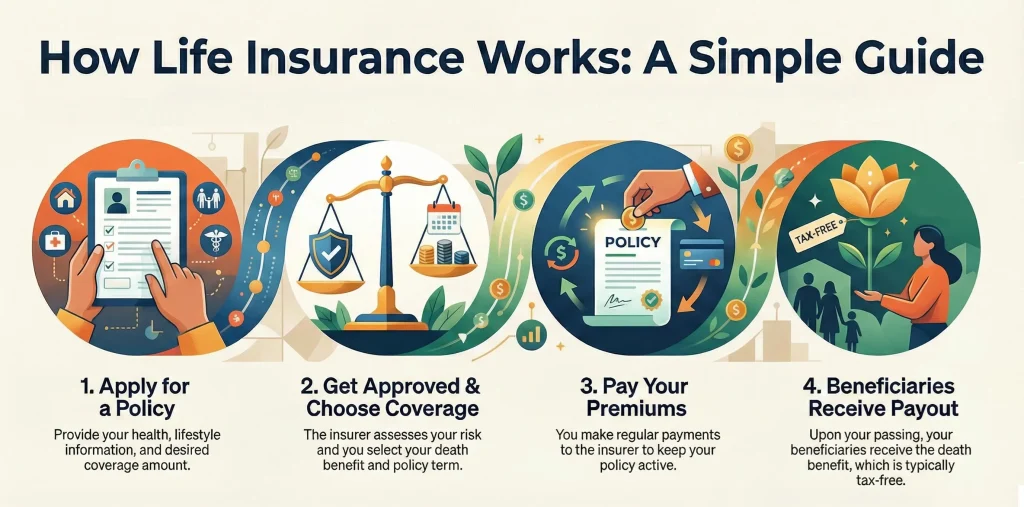
The mechanics of life insurance are simple:
Step 1: Apply for a policy. You provide your health history, age, lifestyle information (smoking status, occupation, hobbies), and desired coverage amount. Depending on the policy type, you may need a medical exam.
Step 2: Get approved and choose your coverage. The insurance company assesses your risk and offers premium rates. You select the death benefit amount (e.g., $250,000, $500,000, $1 million) and policy term (length of coverage).
Step 3: Pay your premiums. You make regular payments to keep the policy active. If you stop paying, coverage ends.
Step 4: Beneficiaries receive the payout. When you pass away, your named beneficiaries submit a claim and receive the death benefit, usually within 30–60 days. The payout is typically tax-free for the beneficiaries.
That’s it. Life insurance is fundamentally a transfer of financial risk from you to an insurance company.
What is a Beneficiary?
A beneficiary is the person or organization you name to receive your death benefit. You can name:
- Your spouse
- Your children
- Your parents
- A business partner
- A charity
- Multiple beneficiaries (and decide how to split the proceeds)
You can update your beneficiaries anytime, which is important after major life events like marriage, divorce, or the birth of children.
What is a Premium?
A premium is what you pay for life insurance coverage. Premiums vary based on:
- Age – Younger = cheaper premiums
- Health status – Pre-existing conditions increase costs
- Smoking – Smokers pay 2–3x more
- Coverage amount – Higher death benefit = higher premium
- Policy type – Term is cheaper than whole life
- Gender – Women typically pay less than men
For example, a 30-year-old healthy male paying for a $500,000, 20-year term policy pays approximately $19–$37 per month, while a 50-year-old male pays $30–$64 per month.
The 7 Main Types of Life Insurance
Life insurance comes in two broad categories: temporary (term) and permanent (whole life, universal life). Here’s what you need to know about each:
1. Term Life Insurance (The Most Affordable)
Term life insurance provides coverage for a specific period: 10, 20, or 30 years. If you die during the term, your beneficiaries receive the full death benefit. If the term expires and you’re still alive, coverage ends — and you get nothing back.
Key features:
- Lowest cost – Most affordable life insurance option
- No cash value – It’s pure protection, no investment component
- Fixed premiums – Your monthly payment stays the same throughout the term
- Simple underwriting – Easier to qualify for
Best for: Young families, breadwinners, anyone who wants affordable, straightforward protection.
Example: A 30-year-old woman buys a $500,000, 20-year term policy for $25/month. For 20 years, she’s protected. If she passes away during those 20 years, her family gets $500,000 tax-free. If she’s alive after 20 years, the policy ends.
2025 market note: Term life represented only 18% of total U.S. life insurance sales in the first nine months of 2025, despite being the most affordable. This suggests many Americans are choosing permanent policies for additional benefits.
2. Whole Life Insurance (Lifetime Protection + Cash Value)
Whole life insurance provides permanent coverage that lasts your entire life — as long as you pay premiums. A portion of each premium goes toward a guaranteed cash value that grows over time.
Key features:
- Lifetime coverage – Protection never expires
- Cash value – Guaranteed growth; you can borrow against it or surrender the policy for cash
- Fixed premiums – Payments stay the same throughout your life
- Dividends – Many whole life policies pay dividends (not guaranteed, but common)
- Higher cost – Significantly more expensive than term life
Best for: Those who want lifelong coverage, legacy planning, or a policy with investment features.
Example: A 40-year-old man buys a $500,000 whole life policy for $355/month. He’s covered for life, and a portion of his premium builds cash value. By age 60, he may have accumulated $50,000+ in cash value that he can access.
2025 surge: Whole life sales grew dramatically in 2025, with new premiums climbing 6% to $4.6 billion in the first nine months, and policy count growing 11% year-over-year. Much of this growth came from final expense policies (small whole life policies under $50,000), driven by middle and lower-income consumers.
3. Universal Life Insurance (UL) – Flexible Premiums & Benefits
Universal life insurance is permanent coverage with flexible premiums and death benefits. You can adjust how much you pay each month and how much your beneficiaries receive (within limits).
Key features:
- Flexible premiums – Pay more one month, less the next (as long as the policy stays funded)
- Flexible death benefits – Increase or decrease coverage as your needs change
- Cash value – Grows based on current interest rates (not guaranteed)
- Higher cost than term – But often cheaper than whole life
Best for: Those with changing financial situations or who want more control over their premiums.
4. Indexed Universal Life Insurance (IUL) – Market-Linked Growth
IUL is a permanent policy where the cash value is tied to the performance of a market index (like the S&P 500). Your cash value grows when the index performs well, but you’re protected from market losses with a “floor” (typically 0% minimum).
Key features:
- Market-linked growth – Potential for higher returns than traditional UL
- Downside protection – You don’t lose money if markets decline
- Permanent coverage – Lifetime protection
- Higher cost – More expensive than term or fixed UL
2025 explosion: IUL reached record-high sales of $3.2 billion in the first nine months of 2025, up 19% year-over-year. IUL now represents 25% of the total U.S. life insurance market. This surge reflects strong stock market performance and consumer interest in market-linked returns.
5. Variable Universal Life Insurance (VUL) – Investment Control
VUL gives you direct control over how your cash value is invested. You can allocate funds into different investment accounts (stocks, bonds, money market funds), offering the highest potential returns — but also the highest risk.
Key features:
- Full investment control – You decide how to invest your cash value
- Highest growth potential – For experienced investors
- Highest risk – You bear the investment risk
- Permanent coverage – Lifetime protection
2025 growth: VUL surged 30% year-over-year in the first three months of 2025, totaling $1.9 billion in new premium, representing 15% of the total market.
6. Final Expense Insurance (Burial/Funeral Coverage)
Final expense insurance is a small, whole life policy (typically $5,000–$50,000) designed to cover funeral, burial, and end-of-life costs. It’s easy to qualify for (often no medical exam required), and premiums are guaranteed for life.
Key features:
- Guaranteed issue – Easy approval, often no health questions
- Small coverage amounts – Focuses on final costs
- Lifetime coverage – Protected for life
- Affordable – Rates stay fixed
2025 boom: Final expense policies surged 16% between 2023 and 2024, with sales exceeding $1 billion. This growth reflects America’s aging population and middle/lower-income consumers seeking affordable coverage.
7. Convertible & Increasing Term (Term Variations)
Some term policies offer special features:
- Convertible term – Convert to permanent coverage without a medical exam (useful if your health declines)
- Increasing term – Death benefit increases annually to keep pace with inflation.
These variations cost more, but offer added flexibility.
Who Actually Needs Life Insurance?
You should seriously consider life insurance if:
✓ You have dependents – Children, spouse, or aging parents who rely on your income
✓ You have debt – A mortgage, student loans, or credit cards that would burden your family
✓ You’re the primary breadwinner – Your income is critical to your family’s lifestyle
✓ You have a young spouse with low earning potential – They may struggle financially without your income
✓ You own a business – Your death could jeopardize the business or leave partners vulnerable
✓ You want to leave a legacy – Some policies accumulate cash value for inheritance
You probably don’t need life insurance if:
✗ You’re single with no dependents
✗ You have significant savings and assets
✗ All debts are paid off
✗ You’re retired with sufficient passive income
Real-world reality: According to 2025 data, 42% of the U.S. population said they either need coverage or need more coverage. Yet only about 63% of Americans own any life insurance at all, leaving millions underprotected.
How Much Life Insurance Do You Actually Need?
This is the million-dollar question (literally). There’s no one-size-fits-all answer, but here’s how to calculate it:
The Income Replacement Method
Multiply your annual income by the number of years your family would need support. For example:
- Annual income: $60,000
- Years of support needed: 20 (until kids graduate college)
- Recommended coverage: $1.2 million
The Debt Payoff Method
Add up your debts and add a buffer:
- Mortgage: $300,000
- Car loans: $30,000
- Credit cards: $10,000
- Funeral costs: $15,000
- Total: $355,000 (round to $400,000 for safety)
The Expense-Based Method
Calculate 7–10 years of living expenses:
- Annual household expenses: $80,000
- Times 8 years: $640,000
- Recommended coverage: $650,000
Pro tip: Most financial advisors recommend 10 times your annual income as a starting point. If you earn $75,000/year, aim for at least $750,000 in coverage.
The reality: Americans significantly underestimate their needs. According to LIMRA, only 22% of consumers have exactly the amount of coverage they need. The rest are either over-insured or dangerously under-insured.
How Much Does Life Insurance Cost? (2025 Pricing Guide)
The cost of life insurance varies dramatically based on age, health, smoking status, and the type of policy. Here’s what you can expect:
Term Life Insurance Costs (Most Affordable)
For a $500,000, 20-year term policy (healthy, non-smoker):
| Age | Male | Female |
|---|---|---|
| 25 | $19–$26 | $16–$22 |
| 30 | $19–$37 | $16–$31 |
| 40 | $24–$45 | $19–$35 |
| 50 | $55–$98 | $40–$75 |
| 60 | $228–$369 | $159–$273 |
Real-world example: A healthy 35-year-old woman can get a $500,000, 20-year term policy for approximately $25–$30 per month, which is less than a Netflix subscription.
Whole Life Insurance Costs (Higher Premiums, Lifetime Coverage)
For a $500,000 whole life policy:
| Age | Male | Female |
|---|---|---|
| 20 | $169 | $146 |
| 30 | $238 | $206 |
| 40 | $355 | $296 |
| 50 | $543 | $462 |
Note: Whole life premiums are 10–15 times higher than term, but you have coverage for life and cash value accumulation.
Smoking Adds Significant Cost
Smokers pay dramatically higher premiums:
| Age | Non-Smoker | Smoker | Difference |
|---|---|---|---|
| 30 | $33 | $92 | +$59/month |
| 40 | $50 | $179 | +$129/month |
| 50 | $118 | $426 | +$308/month |
| 60 | $318 | $1,007 | +$689/month |
Insight: Quitting smoking is one of the fastest ways to lower life insurance costs.
Top Life Insurance Companies in 2025
Looking for reliable coverage? Here are the top-rated companies Americans trust:
| Company | Customer Satisfaction | Best For | Financial Strength |
|---|---|---|---|
| State Farm | 843/1000 | All-around coverage | A++ |
| Nationwide | 840/1000 | Whole life, customer service | A+ |
| MassMutual | 809/1000 | Whole life with cash value | A++ |
| Northwestern Mutual | 790/1000 (Largest) | Universal life, wealth building | A++ |
| New York Life | 794/1000 | Seniors, permanent coverage | A++ |
| Mutual of Omaha | 805/1000 | Term + whole life options | A+ |
2025 note: Guardian, MassMutual, and New York Life top current rankings for term life insurance affordability and whole life quality.
How to Choose the Right Life Insurance Policy
Overwhelmed? Here’s a step-by-step process:
Step 1: Calculate How Much You Need
Use the methods above (income replacement, debt payoff, or expense-based). Most people need $500,000–$1 million.
Step 2: Decide Between Term vs. Permanent
- Budget-conscious? → Term life (cheapest, 20–30 years)
- Want lifetime coverage + cash value? → Whole life or universal life
- Want investment growth? → IUL or VUL
Step 3: Get Quotes from Multiple Companies
Don’t just accept the first quote. Compare at least 3–5 companies. Rates vary significantly. Use online tools like:
- Guardian Life
- MassMutual
- Northwestern Mutual
- Ethos
- PolicyGenius
Step 4: Compare Apples to Apples
When comparing quotes, ensure:
- Same coverage amount ($500K? $1M?)
- Same policy type (20-year term?)
- Same health classification (standard, preferred, smoker?)
Step 5: Review Riders & Add-Ons
Consider these optional riders:
- Waiver of Premium Rider – Waives premiums if you become disabled
- Accelerated Death Benefit Rider – Access benefits early if terminally ill
- Critical Illness Rider – Receive a portion of benefits if diagnosed with a serious illness
- Long-term Care Rider – Helps pay for long-term care needs
Step 6: Apply & Lock In Your Rate
Once approved, your rates are locked for the duration of your term (or for life with permanent policies). Don’t delay — rates increase with age.
Common Life Insurance Questions (PAA)
“Why do I need life insurance?”
Simple answer: Life insurance protects your family from financial hardship if you die. It replaces your income, pays off debts, covers funeral costs, and ensures your children’s education and living expenses are secure.
Key benefits:
- Replaces lost income for dependents
- Pays off mortgage, student loans, and credit cards
- Covers funeral and final expenses ($10,000–$15,000)
- Funds children’s education
- Provides peace of mind
- Enables legacy planning (leave money to heirs or charities)
“Can I change my life insurance policy?”
Yes. You can:
- Convert term to permanent – Most policies allow conversion without a new medical exam
- Increase coverage – Some policies allow increases (may require health questions)
- Decrease coverage – Usually allowed, but rates don’t decrease
- Update beneficiaries – Change anytime
- Add riders – Often available during the policy or at renewal
“What if I can’t afford life insurance?”
Don’t skip it. You have options:
- Get term life, not whole life – Term is 10–15x cheaper
- Lower your coverage amount – Get $250K instead of $1M
- Shorten your term – a 10-year term is cheaper than a 30-year term
- Improve your health – Quit smoking, lose weight, manage health conditions
- Consider group life – Your employer may offer discounted coverage
Reality check: According to 2025 data, 46% of uninsured Americans cite cost as the reason they don’t have coverage. But most of them are dramatically overestimating the actual cost. A young, healthy person can get sufficient coverage for less than $50/month.
“Can I get life insurance with pre-existing conditions?”
Yes, but it costs more. Insurance companies offer:
- Standard rates – For people in excellent health
- Preferred rates – For people in good health
- Standard rates with conditions – For those with well-managed conditions (high blood pressure, diabetes)
- Substandard rates – For those with serious health issues (recent cancer, heart disease)
- Guaranteed issue – For those who can’t qualify otherwise (high cost, low coverage)
Don’t assume you’ll be denied. Apply and let the underwriters assess your individual situation.
“Is life insurance tax-deductible?”
No. Premiums you pay are not tax-deductible. However, the death benefit payout is tax-free for your beneficiaries. Some permanent policies’ cash value growth is tax-deferred (you don’t pay taxes until you access the money).
Life Insurance Trends in 2025
The life insurance industry is changing rapidly:
Final Expense Boom
Americans are increasingly buying small whole life policies (under $50K) to cover funeral and final expenses. Sales surged 16% between 2023 and 2024, exceeding $1 billion. This reflects America’s aging population and a shift toward financial planning among middle-income families.
Whole Life Resurgence
After years of declining market share, whole life insurance returned to growth in 2025. WL’s new premium climbed 6% to $4.6 billion, and policy count grew 11% year-over-year. The last time whole life sales grew this consistently was in the 1990s.
Indexed Universal Life Explosion
IUL is the fastest-growing product type. Sales reached a record $3.2 billion in the first nine months of 2025, up 19% year-over-year. Strong stock market performance and consumer interest in market-linked returns are driving this surge.
Digital-First Consumers Demand Online Management
52% of U.S. adults prefer policies they can adjust online to match life changes. Insurance companies are responding with simplified applications, instant quotes, and digital policy management. Younger consumers (18–29 and 30–44) show 59–60% preference for online policy management, compared to just 38% among those 65+.
Record U.S. Premium Growth
In the first nine months of 2025, U.S. life insurance new annualized premiums totaled $12.7 billion, up 12% year-over-year. The last time the market saw this level of growth was during the COVID-19 pandemic in 2021. This suggests Americans are finally recognizing the critical importance of life insurance.
Life Insurance FAQs (Final Quick Answers)
“When should I buy life insurance?”
The earlier, the better. Premiums are lowest when you’re young and healthy. A 25-year-old pays a fraction of what a 45-year-old pays for the same coverage. Even if you don’t think you need it now, locking in rates while young is smart financial planning.
“Can I have multiple life insurance policies?”
Yes. Many people have multiple policies from different employers, supplemental policies, or a combination of term and permanent coverage. This is called “stacking” and is perfectly legal, as long as the total coverage is reasonable relative to your income.
The policy lapses. You lose coverage immediately. If you stop paying for 30+ days, the policy is typically cancelled. Some permanent policies have enough cash value to continue for a while, but eventually, they lapse too.
“Can my beneficiary refuse the payout?”
Yes. If you name someone as a beneficiary and they die before you, they won’t receive the payout. You’ll need to update your beneficiary. That’s why it’s crucial to review beneficiaries after major life events.
“Is there a limit to how much life insurance I can buy?”
Technically, no — but insurers set limits. Insurance companies use the concept of “insurable interest,” meaning you can’t insure someone else’s life for profit. For your own life, insurers typically cap coverage at 10–20 times your annual income, depending on the company and your circumstances.
The Bottom Line: Should You Get Life Insurance?
Life insurance isn’t optional if you have dependents or debt. It’s the cheapest way to protect your family from financial catastrophe. A 30-year-old healthy person can lock in a $500,000, 20-year term policy for under $30/month — less than a gym membership or streaming service subscription.
The biggest mistake Americans make isn’t avoiding life insurance — it’s delaying the purchase until they’re older, sicker, or both. Rates increase dramatically with age. Every year you wait, you pay more.
If you have dependents: Get term life insurance now. It’s affordable, straightforward, and gives you peace of mind.
If you want lifetime coverage: Consider whole life or indexed universal life, but shop around — premiums vary widely.
If you have pre-existing conditions: Don’t assume you’ll be denied. Many companies offer coverage for people with managed health issues.
Take action today: Get 3–5 quotes from different companies (takes 10 minutes online), calculate your coverage need using the methods above, and lock in your rate while you’re healthy.

Sarah Whitman is the founder and lead editor of Keen Pocket. She holds a BS in Accounting and Finance and writes plain-English guides on budgeting, saving, debt, and beginner investing.