Selling Crafts Online: A Beginner’s Guide to Getting Started

Last fact-checked: · Editorial standards
Selling crafts online has never been easier, and the market proves it. The U.S. handicrafts market exploded to $319.4 billion in 2024, growing 8.09% annually through 2033. Whether you’re designing jewelry from your bedroom, creating sustainable home goods, or stitching custom apparel, turning your passion into profit is no longer a dream; it’s a proven opportunity waiting for you.
But here’s the reality: selling crafts online isn’t just listing products and waiting for sales. It requires strategy, realistic financial expectations, and choosing the right platform for your goals. This guide walks you through every step, from finding your niche to scaling profitably.
How to Sell Crafts Online in 2026
The barriers to entry have collapsed. A decade ago, artisans had limited options: craft fairs, consignment shops, or complex wholesale relationships. Today, you can reach millions of buyers globally within hours.
Here’s why 2026 is different:
The consumer mindset has shifted dramatically. 86% of handmade buyers are women, and 29.63% are between 25 and 34, demographics that actively seek personalized, sustainable, and ethically made products. These buyers aren’t shopping by price; they’re shopping by values. They want connection to the maker, authenticity, and uniqueness.
Digital platforms have matured. Etsy alone hosts 8 million sellers and 96 million buyers, proving the market is legitimate and mainstream. Shopify powers over 6 million online stores. WordPress-based shops (WooCommerce) command 28% of all online stores. You’re not pioneering a risky model; you’re joining an established, profitable ecosystem.
Mobile commerce is dominant. 63.8% of handmade shoppers buy on mobile devices, which means if your shop isn’t mobile-optimized, you’re invisible to the majority of buyers. Fortunately, every major platform handles this automatically.
Real example: Carmen Christine, a sustainable fashion designer, built a seven-figure business by identifying a micro-niche (vintage 1960s-70s textiles), targeting young adults who value eco-consciousness, and maintaining consistent branding across every touchpoint, from product photography to copywriting to social media aesthetics.
Related: Side Hustles to Make Extra Money in 2026
Understanding the Craft Business Reality: Real Profit Margins
Before you invest time and money, you need to understand what “profit” actually means.
Here’s the uncomfortable truth most guides skip: When you generate $100 in sales, you need to allocate:
- $30 → Material costs, shipping supplies, packaging
- $15 → Taxes (estimated quarterly payment)
- $5 → Platform fees, payment processing, advertising
- $50 → Your actual take-home pay
This means if your goal is to put $1,000 in your pocket each month, you need $2,000 in revenue.
How many products do you need to sell? That depends on the average price. If you’re selling candles at $20 each, you need 100 sales. But here’s the conversion math: the average online shop has a 2% conversion rate. If 100 people visit your shop, only 2 will buy something. So you’ll need 5,000 monthly visitors just to hit your $1,000 monthly income goal.
This isn’t meant to discourage you; it’s intended to clarify what “success” actually requires: consistent traffic-building, compelling product descriptions, and honest pricing based on profitability, not competition.
Platform fees vary, and they matter:
| Platform | Transaction Fee | Listing Fee | Other Costs |
|---|---|---|---|
| Etsy | 6.5% | $0.20/listing | Payment processing (~3%) |
| Shopify | 0% | $29-299/month subscription | Payment processing (~2.9%) |
| Amazon Handmade | 15% | None | Monthly subscription |
| Facebook Shop | 0% | None | Ads (optional) |
| WooCommerce | 0% | None | Hosting ($5-20/month) |
Where to Sell Crafts Online (Best Platforms – 2025 Comparison)
Choosing the right platform is your first strategic decision. There’s no single “best” platform, only the best platform for your specific business model.
Etsy: The Largest Handmade Marketplace
Etsy is the default choice for beginner sellers, and for good reason.
Pros:
- 33 million active buyers specifically looking for handmade, vintage, and unique items
- Built-in audience (you don’t need to drive traffic initially)
- Simple listing process; no coding required
- Strong SEO authority (your listings rank on Google)
- App for on-the-go management
Cons:
- 6.5% transaction fee per sale
- $0.20 per listing (fees add up if you have hundreds of items)
- Payment processing fees (~3% additional)
- Rising competition; standing out is harder
- Platform changes (algorithm shifts, fee increases)
- Limited brand control; you look like every other Etsy shop
Best for: Jewelry sellers, vintage resellers, handmade fashion, and anyone new to online selling who wants an instant audience.
Real cost example: Sell a $50 item on Etsy. After 6.5% transaction fee ($3.25) + payment processing ($1.50) + listing cost amortized ($0.20), your platform cost is ~$5 per sale (10%). Add 30% for materials, and you’re down to ~55% gross margin before labor.
Shopify: Maximum Control & Scalability
If you’re serious about building a real business, not just a side hustle, Shopify is the powerhouse option.
Pros:
- Complete control over branding, design, and customer experience
- Custom domain (your own website, not a sub-folder on Etsy)
- Lower transaction fees once you commit to the platform
- Unlimited products; no listing fees
- Integration with Instagram, Facebook, TikTok, and Shop for multi-channel selling
- Powerful analytics to understand customer behavior
- Owns your customer relationships; you collect email addresses
Cons:
- $29-299/month subscription (ongoing cost)
- You drive all traffic; no built-in buyer base like Etsy
- Learning curve (though drag-and-drop builders are beginner-friendly)
- Requires more marketing effort and expertise
- Payment processing fees still apply (~2.9% + $0.30 per transaction)
Best for: Sellers with established customer bases, repeat-purchase products, and anyone planning to scale significantly.
Long-term cost analysis: A Shopify Basic plan ($29/month) costs $348/year. If you sell $500/month in revenue, your platform cost is 7% of sales, very competitive. At $2,000/month, it’s only 1.7% of sales.
Amazon Handmade: Access to 250 Million+ Customers
Amazon’s handmade section is essentially a “Shopify inside Amazon”; you get their massive audience but maintain some branding control.
Pros:
- 250+ million Amazon customers (massive reach)
- Amazon’s trust factor; customers feel safe buying
- Fulfillment options (optional; can use Amazon’s warehouse)
- Built-in reviews and social proof
- International expansion is straightforward
Cons:
- 15% transaction fee (highest of any platform)
- Requires approval and verification of handmade authenticity
- Monthly subscription ($39.99 or higher)
- Strict category restrictions
- Limited customization vs. Shopify
- Tough competition within the Amazon ecosystem
Best for: Quality-focused sellers who can absorb higher fees, anyone targeting international customers, and sellers needing Amazon’s logistics.
Facebook Marketplace & Shops: Local & Social Selling
Facebook remains underutilized for crafts, but it’s incredibly powerful for local sales and community building.
Pros:
- Zero listing fees
- 2.9 billion Facebook users; your target audience is there
- Direct messaging with buyers; build relationships
- Local selling (no shipping required)
- Facebook Groups for niche communities
- Free to set up; no monthly cost
- Organic reach through your personal network
Cons:
- Smaller global audience for handmade (compared to Etsy)
- Facebook’s algorithm changes frequently
- Less discovery for new sellers
- Payment processing still applies
- Harder to build a “brand” (looks personal, not professional)
Best for: Local sellers, pop-up artists, community-focused makers, and anyone with an existing Facebook audience.
WooCommerce: Owning Your Platform
WooCommerce powers 28% of all online stores globally. It’s the WordPress e-commerce solution, free, powerful, and completely customizable.
Pros:
- Free software; only pay for hosting ($5-20/month)
- Complete ownership of design, data, and customer relationships
- Unlimited customization via plugins
- SEO-friendly (WordPress is built for search engines)
- No transaction fees; keep 100% of profits
- Integrates with your existing blog
Cons:
- Requires technical knowledge (or a developer/designer)
- No built-in audience; you drive all traffic
- Payment processing fees apply
- More setup time than Shopify or Etsy
- Ongoing maintenance and updates
- Web hosting and domain costs
Best for: Tech-savvy sellers, long-term businesses, and anyone with an existing WordPress presence (bloggers, educators).
5-Step Process to Start Selling Crafts Online
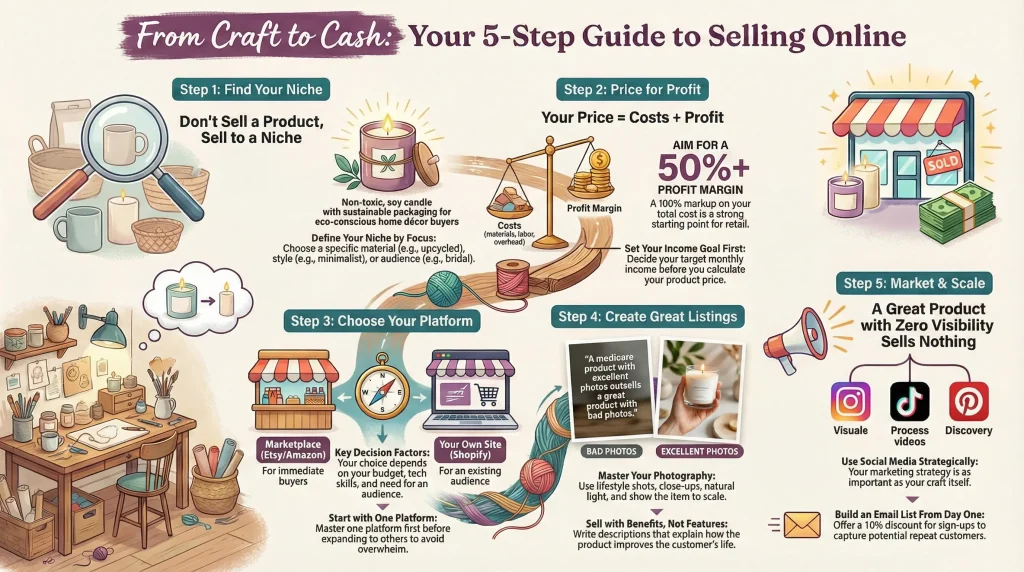
Step 1: Find Your Craft Niche (Not a Product Category)
Don’t just decide “I’ll sell jewelry.” Jewelry is 15% of the Etsy market, and it’s crowded.
Instead, find your micro-niche:
- Material focus: Upcycled jewelry, sustainable materials, ethical sourcing
- Style focus: Minimalist, bohemian, vintage-inspired, modern art
- Audience focus: Bridal market, corporate gifts, sustainable-conscious millennials
- Price point focus: Budget-friendly vs. luxury vs. investment pieces
Research method:
- Go to Etsy’s bestsellers in your category
- Read customer reviews (what do people love? What problems do they mention?)
- Analyze top sellers’ branding, pricing, and product photos
- Identify gaps: What are people asking for that no one’s offering?
Example: Instead of “candles,” the niche is “non-toxic, hand-poured soy candles with sustainable packaging for eco-conscious home décor buyers aged 25-40.”
Step 2: Calculate Your Pricing & Profit Goal
Work backwards from your income target.
Set your financial goal first:
- Do you want a $500/month side income? $2,000/month? Full-time ($4,000+)?
Then calculate your pricing:
- Material cost per unit – Add up everything: yarn, clay, packaging, labels
- Labor cost – How long does it take? If you make 5 items/hour and want $20/hour, that’s $4/item
- Overhead – Utilities, workspace rental, platform fees (amortized)
- Profit margin – Aim for 50%+ on retail (so material + labor + overhead = 50%, profit = 50%)
Example: Handmade candles
- Wax, wicks, scent: $3/candle
- Labor (30 min per candle at $15/hr): $7.50
- Packaging & shipping supplies: $2
- Overhead (platform, utilities): $1.50
- Total cost: $14
- Minimum retail price: $28 (100% markup)
- Competitive research: Similar candles on Etsy: $24-45
- Your price: $32-38 (premium positioning for quality)
Step 3: Choose Your Selling Platform
Use this checklist:
Questions to ask:
- Do I have an existing audience? (If yes: Shopify, WooCommerce)
- Do I need immediate buyers? (If yes: Etsy, Amazon)
- Do I want passive income or active growth? (Passive = marketplace; active = own site)
- What’s my budget? (Low budget = Etsy or Facebook; higher budget = Shopify)
- Am I tech-savvy? (No = Etsy/Shopify; Yes = WooCommerce)
- Am I selling locally only? (If yes: Facebook)
Pro move: Start with one platform (usually Etsy or Shopify), then add others once you have your system down.
Step 4: Create Compelling Product Listings
This is where most sellers fail. A mediocre product with excellent photos outsells a great product with bad photos.
Photography rules for mobile shoppers:
- Lifestyle shots: Show the product in use (candles on a shelf, jewelry on a hand)
- Close-ups: Zoom in on details and craftsmanship
- Scale reference: Include a hand or common object for size context
- Multiple angles: 5-7 photos minimum; first photo is critical
- Lighting: Natural light; no harsh shadows
- Consistency: Same background, similar angles, cohesive aesthetic
Descriptions that sell (SEO + persuasion):
- Start with benefits, not features (“Calming lavender scent reduces stress” vs. “made with lavender essential oil”)
- Include dimensions, materials, weight, and care instructions
- Answer common questions (Is it vegan? Handmade? Sustainable?)
- Tell the story (Why did you start making these? What inspired this design?)
- Use keywords naturally (your niche terms, not stuffed)
Title optimization:
- Format: [Adjective] [Product] + [Material] + [Size/Color] – [Brand]
- Example: “Handmade Minimalist Gold Hoop Earrings – 14K Gold Filled – Sustainable Fashion – by [Your Name]”
- Keywords: Include what people search for (handmade, sustainable, gold, minimalist, etc.)
Step 5: Market & Scale Your Business
A great product with zero visibility sells nothing. Your marketing strategy is as important as your craft.
Social media is mandatory:
Instagram (best for visual crafts like jewelry, home décor, fashion):
- Post 3-5 times per week (mix product photos, behind-the-scenes, customer features)
- Use hashtags strategically (#handmade, #etsy, #sustainable, niche-specific tags)
- Engage with followers (respond to comments, follow similar brands)
- Stories/Reels: Short, authentic content performs best
TikTok (fastest-growing platform for young demographics):
- Craft process videos (satisfying “making” content)
- Trending sounds (use trending audio with your product)
- Educational content (how-to, tips for your niche)
- Consistency beats perfection; post 3-4x weekly
Pinterest (underutilized but powerful for discovery):
- Create pins for each product (vertical, high-quality, text overlay)
- Link to your shop
- Join group boards in your niche
- Schedule pins consistently
Email marketing:
- Build an email list from day one (offer 10% off first purchase for signup)
- Send weekly emails (new products, behind-the-scenes, exclusive discounts)
- Personalize (address by name, segment by interests)
- Aim for a 2-3% conversion rate
Emerging trend: Craft-along videos and DIY kits. Create short tutorials, then sell kits with materials for followers to recreate your designs. Monetize via YouTube, Patreon, or direct sales.
Top Trending Craft Categories for 2026
Not all crafts are equally profitable online. Consumer preferences are shifting, and understanding trends helps you position your products for success.
1. Sustainable & Eco-Friendly Products
- Consumer priority: 67% of shoppers prioritize sustainable materials
- Opportunities: Upcycled fashion, reusable beeswax wraps, organic cotton items, reclaimed wood decor
- Price premium: Buyers pay 20-30% more for certified sustainable products
- Platforms: Etsy, Faire (B2B), specialty eco-shops
2. Personalized & Custom Items
- Trend: Buyers want something made specifically for them, not mass-produced
- Opportunities: Monogrammed gifts, custom pet portraits, bespoke jewelry, engraved items
- Pricing: Custom commands 2-3x the price of standard items
- Fulfillment: Made-to-order keeps inventory low while increasing perceived value
3. Vintage & Upcycled Items
- Appeal: Nostalgia, uniqueness, and sustainability combined
- Growth: Vintage-inspired products see consistent demand
- Niche examples: 1960s-70s fashion, retro home décor, vintage jewelry
- Profit: Lower sourcing cost if you’re upcycling; higher margin potential
4. Subscription Boxes & DIY Kits
- Model: Monthly craft kits or curated product bundles
- Revenue: Recurring income; customer lifetime value increases dramatically
- Examples: Seasonal craft kits, personalized gift boxes, paint-by-number kits
- Platforms: Shopify, Cratejoy, Subbly
5. Handmade Fashion & Accessories
- Volume: One of the highest-selling categories consistently
- Niches: Ethical fashion, sustainable clothing, statement jewelry, custom headwear
- Platforms: TikTok Shop (trendy), Etsy, Instagram Shop
Marketing Your Crafts: Beyond Platform Listings
Relying solely on platform discovery is a mistake. Successful sellers build their own audiences.
Email marketing (highest ROI):
- Aim to collect 100+ emails in the first 3 months
- Provide value: tips, exclusive discounts, early access to new products
- Segment your list (customers vs. interested followers)
- Send 1-2 emails per week
- Monitor open rate (aim for 25%+)
Influencer collaborations:
- Partner with micro-influencers (10K-100K followers) in your niche
- Send free products for honest reviews
- Negotiate discount codes for their followers
- Track conversion rates by influencer
Content marketing:
- Start a blog (if using Shopify or WooCommerce)
- Write about your craft, materials, inspiration, and process
- Optimize for search: “How to choose sustainable jewelry,” “best eco-friendly candle brands,” etc.
- Long-form content (1,500+ words) ranks better
Local presence:
- Attend craft fairs and pop-up markets (offline ≠ dead)
- Build an email list at in-person events
- Share photos on social media
- Connect with local media for feature stories
Common Mistakes to Avoid
1. Pricing too low to compete
You cannot out-Walmart Walmart. Don’t compete on price. Instead, compete on uniqueness, craftsmanship, and story. Customers who buy on price alone are exhausting; customers who value handmade quality are loyal.
2. Poor product photography
Your photos are your only sales tool. Invest in good lighting, editing apps (Canva, VSCO), or hire a photographer for product shoots. One professional photo session pays for itself in increased conversions.
3. Ignoring mobile optimization
63.8% of buyers shop on mobile. If your product photos are too small, descriptions are hard to read, or checkout is clunky on mobile, you lose sales.
4. Not building direct relationships
Platforms change algorithms and raise fees. Build an email list, connect on social media, and remember customers’ names. Your real asset is your audience, not the platform.
5. Spreading too thin
Don’t list on 10 platforms simultaneously as a beginner. Master one (usually Etsy), then add Shopify, then expand. Quality beats quantity.
6. Inconsistent branding
Your logo, colors, tone, and aesthetic should be instantly recognizable. This builds trust and makes you memorable.
Key Takeaways: Your 2026 Action Plan
- Start with realistic numbers. Calculate your target income, work backwards to pricing, then figure out how many sales you need. Most people underestimate traffic requirements.
- Choose one platform to start. Etsy for immediate audience and feedback; Shopify for long-term control. Both are valid.
- Invest in photography. This is your single biggest ROI. Bad photos kill sales; great photos increase conversion by 40%+.
- Build your own audience simultaneously. Email list, Instagram, TikTok, or Pinterest. Don’t be 100% dependent on platform algorithms.
- Price for profitability, not competition. Find your 50+ margin and stick to it. The customers worth keeping will pay it.
- Leverage trending categories. Sustainable, personalized, and vintage products command premium prices in 2026.
- Stay consistent. Most sellers quit after 3-6 months when sales don’t explode overnight. Treat it like a real business: systems, tracking, and iteration.
The bottom line: Selling crafts online is absolutely viable, the market is real, customers are ready, and platforms make entry painless. But success requires honesty about finances, strategy about marketing, and patience with growth. If you do these things, the profit will follow.

Sarah Whitman is the founder and lead editor of Keen Pocket. She holds a BS in Accounting and Finance and writes plain-English guides on budgeting, saving, debt, and beginner investing.