
Cashback Apps That Pay Real Money (7 Vetted Picks)

Last fact-checked: · Editorial standards
Search for cashback apps and you get two kinds of results: breathless lists promising easy money, and horror stories about apps that never pay out. Both leave you wondering which ones are real.
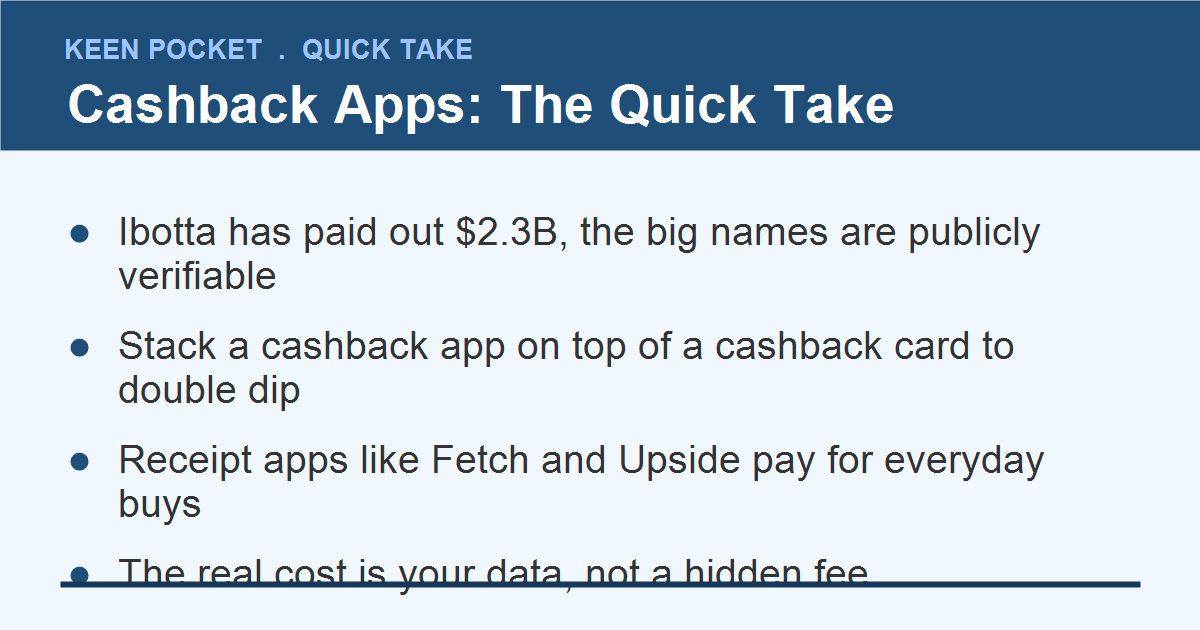
Here is the reassuring part. The biggest names are not a scam, and the proof is public. Ibotta, one of the largest cashback apps, is a publicly traded company, and its own filings with the Securities and Exchange Commission show it had credited about $2.3 billion in cash back to users by the end of 2024, across more than 52 million registered accounts.
So the real question is not whether cashback apps that pay real money exist. They do. The question is which ones are worth your time and your data, and how to spot the fakes that hide among them. This guide names the vetted apps, shows how they actually pay, and gives you a simple test for the ones that do not.
Are Cashback Apps Legit, or a Scam?
The honest answer is both, depending on the app. Established platforms like Rakuten, Ibotta, Fetch, and Upside have millions of users and years of verified payouts behind them. The scams are the copycats that borrow the same look.
The tell is almost always money moving the wrong direction. A real cashback app pays you and never asks you to pay first.
A legitimate cashback app never charges a membership fee and never asks you to pay to receive a payout. If money has to leave your pocket first, it is not a cashback app. It is a scam.
How Cashback Apps Make Money
Understanding the business model is the fastest way to tell real from fake. Real apps have an honest reason to pay you. Fake ones do not.
A retailer pays the app a commission for sending it a paying customer.
The app keeps part of that commission and passes the rest back to you as cash back.
You end up paying a little less for something you were going to buy anyway.
The reward is usually modest, from a few cents to a few dollars per purchase. Any app promising far more than that, for far less effort, is selling something other than cash back.
The 7 Cashback Apps That Actually Pay
These seven have long track records and real, documented payouts. Match the app to how you actually shop, since each one is strong in a different lane.
| App | Best for | Payout | Minimum |
|---|---|---|---|
| Rakuten | Online shopping | PayPal, check | Low |
| Ibotta | Groceries | PayPal, Venmo, bank | $20 |
| Fetch Rewards | Any receipt | Gift cards only | Low |
| Upside | Gas | Bank, PayPal | Low |
| Capital One Shopping | Price comparison | Gift cards | Varies |
| Checkout 51 | Grocery receipts | Check, PayPal | About $20 |
| RetailMeNot | Coupons + cash back | PayPal, Venmo | $5.01 |
If you only install two, make them Rakuten for online orders and Ibotta for groceries. Together they cover most of where the real money is.
Rakuten and Ibotta: The Two Heavyweights
These are the apps most worth your time, and the ones with the clearest paper trail. Rakuten pays cash back at more than 3,500 online stores, with some brands offering over 10% back, and it pays out quarterly through PayPal or a mailed check.
Ibotta focuses on groceries and everyday shopping. You activate offers before you shop, then redeem them after, and you can cash out once you hit $20.
Two extras are worth switching on. Rakuten’s free browser extension pops up at checkout so you never forget to activate an offer, and both apps run referral bonuses that pay you when a friend joins and makes a first purchase. Ibotta reaches well beyond groceries now too, with cash back at many major retailers when you shop through its linked stores.
The one habit that makes Rakuten pay is starting your online orders from inside the app or the extension. Forget that, and the store never credits your cash back, no matter how much you spend.
Receipt and Gas Apps: Fetch, Upside, and Checkout 51
These earn quietly on spending you already do. You do not shop differently, you just snap a receipt or tap once at the pump.
How to use them without any extra effort
None of these will change your life, but stacked on top of a card and Rakuten, the receipt apps turn spending you cannot avoid into a small steady trickle.
Cashback Apps vs Cashback Cards, and How to Stack Them
A cashback app and a cashback credit card are not rivals. They reward different things, and the real savers use both at once.
A flat-rate cashback card pays a steady 1.5% to 2% on everything you buy, no activation required. A cashback app pays extra at specific stores or on specific products, but only when you go through the app first. The card is the reliable base layer, and the app is the bonus on top.
You pay with a debit card and earn nothing back on a $100 online order.
You start at Rakuten, pay with a 2% card, and submit the receipt to a receipt app, stacking three rewards on the same $100.
Done consistently, that stacking habit can turn a normal 2% card purchase into 5% or more back, without spending a dollar you were not already spending. It is the single highest-value move in this whole guide.
How to Spot a Fake Cashback App
This is the part most “best of” lists skip, and it is the whole reason you searched with the word “real.” Fake cashback apps copy the branding of real ones, then trap your time or your money. Here is how to tell them apart in seconds.
Names the actual retailers it partners with.
Has a clear cashout method and threshold.
Costs nothing to join or to withdraw.
Charges a fee to sign up or to “release” your payout.
Buries the payout behind endless surveys you never finish.
Promises huge returns and shows no named partners.
When in doubt, check the payout threshold before you invest any effort. Scam apps set it just high enough that most people quit before reaching it. It also pays to read the recent app-store reviews, not the star rating: real complaints about missing or delayed payouts cluster in the newest one-star reviews, where a shiny overall score cannot hide them. The Better Business Bureau keeps a running list of the warning signs.
The Real Cost: Your Data
Even the legitimate apps are not truly free. You pay with information about what you buy, and that data is how they make money beyond retailer commissions.
For most people that trade is fine, but it is worth knowing the risk. Cashback platforms collect detailed records of your spending, and in a worst case that data can be exposed. In 2023, one large cashback company was fined after a breach exposed data on about 1.4 million people, a reminder from researchers who study these apps that the convenience has a price.
📌 Good to Know
Skim the privacy policy before you link a card. Look for whether the app sells your data or only uses it to serve offers, and prefer apps that let you earn by scanning receipts rather than linking your bank.
None of this means you should avoid cashback apps. It means you go in with open eyes and keep the number of apps that can see your spending small.
A 10-Minute Weekly Cashback Routine
Cashback only adds up when it becomes a habit instead of a scavenger hunt. The people who earn the most are not the ones with the most apps installed. They are the ones who spend a few minutes each week on a simple, repeatable routine.
Before you shop, open your main app and check the offers on the things already on your list. Add the ones that match. This is where receipt apps like Fetch and Ibotta earn their place, because you get rewarded for purchases you were making anyway.
For online orders, start at Rakuten or its browser extension so the click is tracked. Skipping that one step is the single most common reason a payout never shows up, so give it a few seconds before you check out.
After you shop, scan your receipt inside the app’s time limit, usually about seven days. Set a phone reminder so a busy week does not quietly cost you the reward.
Once a month, cash out to an account that actually helps you, ideally a high-yield savings account rather than straight back into spending. That one choice is what turns loose pocket change into a small but real cushion over a year.
If you only have time for one habit, make it the online-order step. A single tracked click on a big purchase, a flight, a laptop, a hotel stay, can pay back more than a whole month of scanning grocery receipts. Match the effort to the size of the buy, and do not feel obligated to chase every fifty-cent offer. Cashback is meant to be a quiet bonus on money you were already going to spend, not a second job that eats your evening.
One more habit worth building: keep a single note on your phone listing which app pays best at the stores you actually shop. Cashback rates shift, and the same purchase can pay two or three times more on one app than another. A thirty-second check against that list, refreshed every month or two, quietly lifts your average payout without adding any real work. Over a year, that small edge is often the difference between spare change and a cash-out worth celebrating.
How Much Can You Realistically Earn?
Set your expectations here, because this is where the hype does the most damage. Cashback apps are a pleasant bonus, not a paycheck.
What moves the number is mostly your online shopping volume and whether you remember to activate offers, not how many apps you install. Someone who buys a lot online and routes it through Rakuten will out-earn someone running six apps on groceries alone.
A consistent shopper who uses two or three apps can realistically pocket a few hundred dollars a year. Chase it harder than that and the time you spend comparing offers is worth more than the cash back you earn. The sweet spot is a small set of apps on autopilot, not a second job.
What Cashback Really Adds Up To
Small percentages feel pointless until you put a year of normal spending behind them. Here is a grounded example for a household that shops the way most do, using the low end of the rates above.
That $240 is not life-changing, but it is real money you would not have had, earned on purchases you were making regardless. The trick is what you do with it next.
Where to Put Your Cashback So It Counts
The easiest way to waste cashback is to spend it right back inside the same app on things you did not need. Give it a job the moment it lands instead.
A simple home for every payout
Routed that way, a few hundred dollars a year of cashback becomes a real cushion. The site’s guides on the best high-yield savings accounts and saving your first $1,000 show you where to send it so it earns even more.
Frequently Asked Questions
Which cashback apps actually pay real money?
Rakuten, Ibotta, Fetch, Upside, Capital One Shopping, Checkout 51, and RetailMeNot all have long records of real payouts. Ibotta’s public SEC filings alone show billions of dollars credited to users, which is about as verified as proof gets.
Are cashback apps a scam?
The major ones are legitimate. The scams are copycats that charge a fee, hide the payout behind endless surveys, or ask you to pay to withdraw. A real cashback app never takes money from you first.
How much can you make with cashback apps?
A consistent user with two or three apps typically earns $100 to $300 a year. Treat it as a bonus on spending you already do, not a way to make real income.
Do cashback apps sell your data?
Some use your shopping data to target offers, and policies vary on whether they sell it. Read the privacy policy, and favor apps that let you earn by scanning receipts instead of linking your bank account.
Do I have to pay taxes on cashback?
Cash back on your own purchases is generally treated as a rebate, a discount on what you bought, rather than taxable income. Referral bonuses and sign-up rewards can be different, so keep records if you earn a lot from those.
Bottom Line
Cashback apps that pay real money are easy to find once you know the test: the real ones pay you and never charge you, name their retail partners, and have a clear payout threshold. Start with Rakuten and Ibotta, add a receipt app if you want, and keep the list short to protect your data.
Quick recap
Used with clear eyes, cashback apps that pay real money turn everyday spending into a small, steady win. For more ways to trim your bills, the site’s guide to deal-hunting sites like Slickdeals pairs well with a good cashback app, and our cashback strategies for everyday bills put the same instincts to work on your monthly utilities and phone.

Sarah Whitman is the founder and lead editor of Keen Pocket. She holds a BS in Accounting and Finance and writes plain-English guides on budgeting, saving, debt, and beginner investing.