
Cashback Strategies for Everyday Bills Like Utilities and Phone (2026)

Last fact-checked: · Editorial standards
Rewards blogs love to talk about airport lounges and five-star hotels booked on points. Meanwhile, the bills you actually pay every single month, the phone, the internet, the electric, the streaming stack, get almost no attention. That is a missed opportunity hiding in plain sight.
These boring, predictable bills are the perfect place to earn steady money back, because you were going to pay them anyway. Good cashback strategies for everyday bills like utilities and phone turn a fixed cost into a small, automatic rebate. Do it right and it runs on autopilot for years.
There is one catch that most guides gloss over, and it can quietly turn a “reward” into a loss: fees. So before any card talk, we will sort out which bills are worth paying by card and which are not. Quick note first: this is general education, not personalized financial advice, so weigh it against your own situation.
Why everyday bills are the most overlooked cashback source
Travel points are exciting, but everyday bills are dependable, and dependable is what builds real money over time. You will pay for phone service, internet, and power for the rest of your life, so even a small percentage back compounds into something worth having.
The amounts are bigger than they feel. U.S. households average about $61 a month on streaming across roughly four services, per Deloitte, and cellular service alone runs around $1,000 a year for a typical household, based on federal spending data. Add utilities and insurance and you are steering thousands of dollars a year.
The other reason bills are a great target is consistency. Unlike shopping, which swings month to month, these payments are steady and unavoidable, so the rewards are predictable. You do not have to remember a promo or change your habits; the money flows to the same billers every month whether you optimize it or not.
💡 Quick Tip
Think of bill cashback as a raise you never have to ask for. Earning 2% on $5,000 of yearly bills is $100 back for changing how you pay, not what you pay.
First, know which bills are fee-free to pay by card
This is the step that separates a smart strategy from a losing one. Many billers accept credit cards with no fee, while others, especially utilities and government charges, tack on a processing fee that can wipe out your rewards. Sort your bills before you swipe.
As a rule, phone, internet, streaming, and most insurance let you pay by card for free, while electricity, water, gas, and property taxes often charge 2% to 3%. Policies vary by provider, so confirm yours, but the split below is the usual pattern.
| Usually fee-free to card | Often charge a 2% to 3% fee |
|---|---|
| Phone and cell service | Electricity |
| Home internet | Water and sewer |
| Streaming services | Natural gas |
| Most insurance | Property taxes |
| Gyms and memberships | Some city-run utilities |
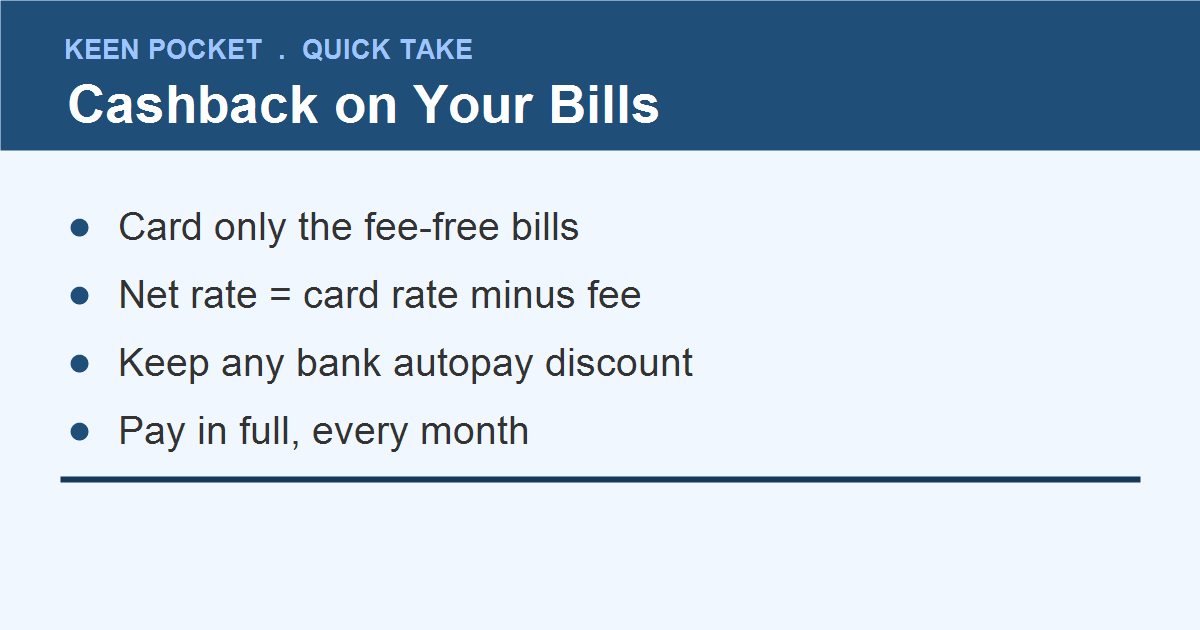
The takeaway is simple: card the fee-free bills, and pay the fee-charging ones straight from your bank account. You capture the rewards where they are free and dodge the fees where they are not.
The fee math: net value beats the headline rate
Here is the number nobody advertises. Your real reward is the card’s rate minus any fee, and that “net” rate is all that matters. A flashy 5% card can quietly become a 2% one, and a modest card can go negative.
See why the fee-free bills are the prize? On a phone or streaming bill with no fee, a 2% card really pays 2%, and a category card can pay far more. On a utility that charges 2.95%, even a great card barely breaks even, so those belong on bank autopay instead.
Put real dollars on it. A $70 internet bill with no fee on a 2% card earns $1.40 you keep in full. That same $70 on a biller charging a 2.95% fee would still hand back $1.40 but cost about $2.07 in fees, a net loss of 67 cents. Multiply that gap across a year of bills and you can see why the fee-free-first rule, not the flashiest card, is what actually pays.
This one habit, checking the net rate before you pay, is what separates real cashback strategies for everyday bills from the wishful thinking most people fall into. A “5% card” headline means nothing until you subtract the fee. Two seconds of math per biller protects every dollar you are trying to earn.
Match the card to the bill
Once you know which bills to card, the next move is choosing the right card for them. You do not need a wallet full of plastic; one flat-rate card plus maybe one category card covers almost everyone, and the CFPB’s free credit card tools can help you compare options. The examples below are just that, examples, and terms change, so always verify current details before applying.
| Card type | Typical rate | Best for | The catch |
|---|---|---|---|
| Flat-rate | 2% on everything | simplicity, all bills | not the highest rate |
| Choose-a-category | up to 5% | phone, utilities, streaming | quarterly cap, must activate |
| Streaming-focused | up to 6% on streaming | heavy streamers | often an annual fee |
| Business | up to 5% | internet, cable, phone | needs a business |
For most people, a no-fee 2% flat-rate card on every fee-free bill is the winning move, because it is simple and never expires. If you spend a lot in one category, like a big streaming habit or a high phone bill, a category card can add a bit more on top. Just make sure any annual fee is smaller than the extra rewards.
📌 Card examples last verified August 2026. Rewards rates, bonus categories, and annual fees change often, so treat the cards above as illustrations and confirm current terms on the issuer’s own site before you apply.
Resist the urge to over-optimize. Juggling five cards to squeeze an extra half-percent out of each bill usually costs more in mental effort and missed payments than it earns. One or two cards, set and forgotten, beats a complicated system you abandon in a month. The best strategy is the one you will actually keep running a year from now.
Set up your bill cashback in about 20 minutes
The whole system takes one short sitting to build, then runs itself. This is the entire setup for cashback strategies for everyday bills like utilities and phone, start to finish.
List your recurring bills. Phone, internet, streaming, insurance, electric, water, gas, and any memberships.
Mark which are fee-free. Log into each account and check whether card payment adds a fee or cancels an autopay discount.
Card the fee-free ones. Set those to autopay on your best cashback card, right inside each provider’s account.
Bank-pay the rest. Leave fee-charging utilities on free bank autopay, then set a yearly reminder to recheck fees.
That is it. Once the routing is set, the cashback accrues automatically while you do nothing, which is exactly what makes it stick.
Stack your rewards (and dodge the autopay trap)
Once the card is sorted, you can often layer a second reward on top. This is where good cashback strategies for everyday bills like utilities and phone go from decent to genuinely worthwhile, as long as you avoid one common mistake.
Pay fee-free bills with your best card.
Check a cashback app or portal for a bonus first.
Keep the bill on autopay so you never miss it.
Losing a bank-autopay discount to use a card.
Paying a 3% fee to earn 2% back.
Chasing rewards you will not actually redeem.
The autopay trap is sneaky. Many phone and internet providers give a $5 to $10 monthly discount for autopay from a bank account, and switching to a card can cancel it. A $10 discount is worth far more than 2% back on a $70 bill, so keep the discount and pay from the bank there. Our roundups of cashback apps that pay real money and round-up apps show where the extra layers live.
A realistic year of bill cashback
Numbers make it real, so let us run a typical household. Say your monthly bills are electric $120, water and gas $80, phone $100, internet $70, streaming $61, and insurance $150. The two utilities charge fees, so they go on bank autopay. The rest is fee-free and gets carded.
On a plain 2% card, those fee-free bills return about $90 a year. Add a category card at 5% on phone and streaming and you can push it toward $180, all for money you were spending anyway. The two fee-charging utilities earn nothing on a card, and that is fine, because paying them from the bank keeps you from losing to fees. Figures are illustrative and depend on your bills and cards.
Notice what did the work here. It was not a clever trick or a premium card, it was simply routing each bill to the payment method that pays the most after fees. That routing decision, made once, is worth more than years of chasing rotating bonus categories you have to remember to activate.
How we built this example: bill amounts are typical U.S. figures, with streaming reflecting Deloitte’s roughly $61-a-month average, and the reward range assumes fee-free bills paid on a 2% to 5% card. The two utilities are excluded because a 2% to 3% convenience fee would erase the rewards. Your results depend on your bills, cards, and providers.
Beyond credit cards: other ways to earn on bills
Cards are the main engine, but they are not the only lever. If you cannot or would rather not use a credit card, a few other cashback strategies for everyday bills still put money back in your pocket.
Paying an annual plan instead of monthly is a quiet winner for streaming and some insurance, often saving the equivalent of one or two months a year. And trimming a bill you no longer use beats any rewards rate, which is where our guide to canceling unused subscriptions pays for itself.
The rules that keep cashback from backfiring
Cashback only helps if it stays a net gain, and a few habits protect that. The biggest one is boring but non-negotiable, because a single mistake here erases years of rewards.
Keep it a win
Carrying a balance is the killer. At around 23% interest, one month of unpaid balance costs more than a year of 2% cashback earns, so this strategy is only for people who pay in full. It is also worth knowing that rewards are not sacred: the CFPB found rewards complaints jumped more than 70% versus pre-pandemic levels, driven by devaluation and fine print. If a card balance is already a problem, our guide to paying off credit card debt comes first.
Where your bill cashback should go
Earning $150 a year back is nice, but it only matters if the money lands somewhere useful instead of melting into everyday spending. Give it a job the moment it arrives, and a small rebate becomes real progress.
Card the fee-free bills, skip the fee-charging ones, pay in full, and send the cashback somewhere that grows. That is the whole game.
Sweep the cashback into savings, an extra debt payment, or even investing small amounts each month. Automated to a separate account, a steady trickle of bill rewards quietly funds a goal you actually care about, with money you never felt leave your pocket.
Most cards let you set rewards to deposit automatically into a linked bank account, so this takes one setting to arrange. Point it at your emergency fund or a sinking fund and the rebate compounds into something real over a few years, turning the most boring part of your budget into quiet, hands-off progress. Just make sure that linked account is not clawing the rewards back in fees; if it is, switch to one of the best bank accounts for people who hate fees.
Frequently asked questions
What are the best cashback strategies for everyday bills?
Pay fee-free bills like phone, internet, and streaming with a good cashback card, pay fee-charging utilities from your bank instead, keep any autopay discount, and always pay the card in full. The goal is net value, your reward rate minus any fee, not the flashiest headline rate.
Is it worth paying utilities with a credit card for cashback?
Only when the utility does not charge a fee that exceeds your rewards. Many electric, water, and gas companies add a 2% to 3% fee, which usually cancels out the cashback, so those are better paid from your bank account.
Which bills can I pay by card without a fee?
Phone, internet, streaming, and most insurance typically accept cards for free, making them the best targets for cashback. Utilities and government charges more often add a processing fee. Always confirm with your specific provider, since policies vary. And to shrink a big insurance bill at the source, see our guide to saving money on car insurance without reducing coverage.
What credit card is best for utilities and phone bills?
A no-fee flat 2% card works for almost everyone and never expires. If you have a large phone or streaming bill, a card offering up to 5% in a chosen category can add more, as long as any annual fee stays below the extra rewards you earn.
Can paying bills by credit card hurt my credit score?
Not if you pay in full and keep balances low. Large bills can raise your credit utilization temporarily, which can dip your score, so pay the card down before the statement closes if your limit is tight.
How much can cashback strategies for everyday bills actually earn?
For a typical household, roughly $90 to $180 a year on the fee-free bills, more if you use a category card on a big phone or streaming spend. It will not make you rich, but it is real money for a one-time setup on payments you were making anyway.
Do cashback apps work on top of card rewards?
Sometimes. Certain apps and shopping portals offer bonus cashback that can stack with your card’s rewards on eligible payments. It is worth a quick check before you pay, but do not let a small bonus talk you into a fee or an unwanted purchase.
The bottom line
Your monthly bills are not exciting, but they are the steadiest cashback source you have. The winning cashback strategies for everyday bills like utilities and phone are almost dull on purpose: card the fee-free bills, pay the fee-charging ones from the bank, never carry a balance, and automate the whole thing.
Set it up once and it pays you quietly for years. Point that cashback at a real goal, and money you were already spending starts working a second job on the way out the door.
None of this requires a finance degree or a wallet full of premium cards. It is a routing decision and a payment habit, both of which you can set today in the time it takes to pay this month’s bills. That is the quiet power of doing the boring part well.
Sarah is the founder and lead editor of KeenPocket, where she writes practical, jargon-free money guides for real, everyday budgets. Every figure in this article is tied to a named, current primary source such as the Federal Reserve, CFPB, IRS, or BLS, and the math is shown so you can check it. KeenPocket articles are educational and are not personalized financial advice; for choices about your own situation, consider speaking with a licensed professional.
Last reviewed: August 2026 · Card details change often; verify current terms before applying.

Sarah Whitman is the founder and lead editor of Keen Pocket. She holds a BS in Accounting and Finance and writes plain-English guides on budgeting, saving, debt, and beginner investing.