
No-Spend Challenge Ideas for Beginners: 15 Easy Picks

Last fact-checked: · Editorial standards
A no-spend challenge is one of the fastest ways to reset your spending, but the classic thirty-day version scares a lot of beginners off before they start. The good news is that a no-spend challenge does not have to be a whole month, and it does not have to be all-or-nothing. There are dozens of gentler versions, and the right first one is whichever feels almost too easy.
The idea is simple: for a set stretch of time, you pause all nonessential spending. You still pay for the basics, food, housing, utilities, and getting to work, but the extras go on hold. Even a short run does two things at once. It gives your savings a quick bump, and it shows you exactly where your money quietly leaks.
That awareness matters, because a lot of households have almost no cushion. In the Federal Reserve’s 2023 survey, about 37% of adults said they could not cover a surprise $400 expense with cash. A no-spend challenge is one of the least painful ways to start closing that gap. Below are 15 no-spend challenge ideas for beginners, sorted from easiest to most ambitious, so you can pick one and start this week.
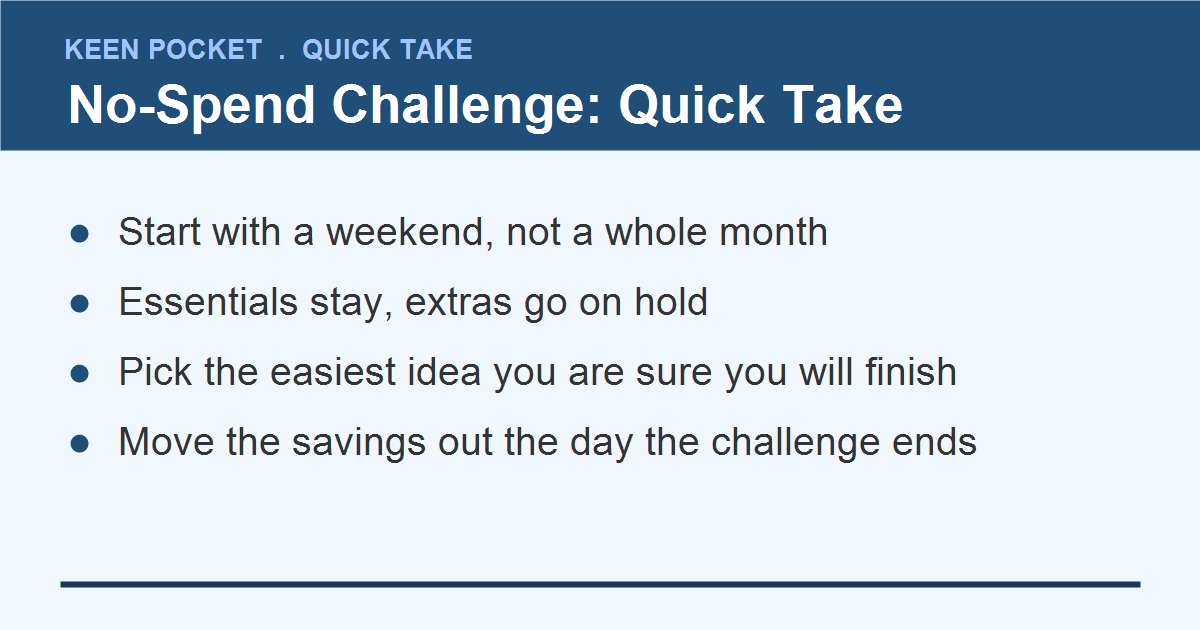
- The best no-spend challenge is the one you finish, so start with a weekend of no spend weekend ideas that still feel fun, not a month.
- Essentials stay (housing, food, transport); the nonessential extras go on hold.
- There are 15 beginner variations here, from a no-spend weekend to a pantry week to a full month.
- Write your allowed list before day one, and plan free fun so it never feels like punishment.
- Move whatever you save out the day the challenge ends, or it quietly drifts back.
Reviewed and updated for 2026. Savings-behavior figures come from the Federal Reserve and the U.S. Bureau of Economic Analysis.
How a No-Spend Challenge Actually Works
Before the ideas, get the rules straight, because a fair challenge needs clear lines. The point is not to stop living. It is to stop the unplanned, automatic spending that adds up without you noticing.
- Rent, mortgage, and utilities
- Groceries and essential household items
- Gas, transit, and commuting costs
- Medicine and childcare
- Bills and planned obligations
- Takeout, coffee, and eating out
- Impulse and online orders
- New clothes and decor
- Nonessential subscriptions
- Anything you would call a want, not a need
Easy No-Spend Challenge Ideas to Start With
If you have never done one, start here. These are short enough that you almost cannot fail, which is exactly the point for a beginner.
- The No-Spend Weekend. Two days, no nonessential spending. A perfect first taste that fits into any life.
- The No-Spend Day. Pick one day a week where you buy nothing extra. Repeat it weekly and the savings quietly stack.
- The No-Takeout Week. Keep everything else normal, but cook every meal for seven days. This one alone often saves $50 to $100.
- The Coffee-Shop Freeze. One week making coffee at home instead of buying it. Small, but it proves the concept fast.
Week-Long No-Spend Challenge Ideas
Once a weekend feels easy, stretch it to a full week. Seven days is long enough to change a habit but short enough to stay motivated.
- The 7-Day No-Spend Week. The classic starter. No nonessential spending for one full week, essentials only.
- The Pantry Week. Eat only what is already in your freezer and cupboards, buying just fresh basics like milk and eggs.
- The No-Online-Shopping Week. Keep normal life, but log out of every shopping app and site for seven days.
- The Cash-Only Week. Put the cards away and spend only physical cash on essentials, which naturally slows impulse buys.
Month-Long No-Spend Challenge Ideas
When you are ready for real results, a month is where the savings get serious. These take more grit, so save them for after a few smaller wins.
- The Classic No-Spend Month. Thirty days of essentials only. The deepest reset and the biggest one-month savings.
- The No-Eating-Out Month. Spend normally on everything except restaurants, delivery, and takeout for the whole month.
- The No-Spend Weekdays. Allow small planned fun on weekends, but keep Monday through Friday spend-free.
- The Subscription Freeze. Pause or cancel every nonessential subscription for a month and see which ones you never miss.
Themed Challenges to Level Up
These add a twist that keeps a no-spend challenge from getting boring, and they target specific habits.
- The No-New-Clothes Challenge. Go 30 or even 75 days without buying clothing, wearing only what you already own.
- The Rotating Category Challenge. Pick a different spending category to freeze each week, so no single week feels too hard.
- The 30-Day Rule Challenge. Buy nothing nonessential on impulse. Instead, write it on a list and wait 30 days. Most urges fade.
The 15 Ideas, Compared
Here is the whole lineup in one view, so you can match a challenge to your energy and your goal. Savings ranges are typical, not guarantees.
| Challenge type | Length | Difficulty | Typical save |
|---|---|---|---|
| No-spend weekend | 2 days | Very easy | $20-60 |
| No-takeout week | 7 days | Easy | $50-100 |
| 7-day no-spend week | 7 days | Moderate | $75-200 |
| Pantry challenge | 1-2 weeks | Moderate | $60-150 |
| No-spend month | 30 days | Hard | $200-600 |
| No-new-clothes (75 day) | 75 days | Themed | Varies |
How to Pick Your First No-Spend Challenge
The best no-spend challenge idea for beginners is the one you will actually finish, so bias toward easy. A completed weekend beats an abandoned month every time.
- Match the length to your track record. Never done one? Start with a weekend or a no-takeout week, not a full month.
- Pick a clear reason. Saving for a specific goal, even a small one, makes the sacrifice feel worth it.
- Set your allowed list in advance. Decide before you start what counts as essential, so you are not negotiating with yourself mid-week.
- Tell someone or find a partner. A little accountability roughly doubles the odds you finish.
- Plan the money’s destination. Decide now where the saved cash goes, or it will quietly drift back into spending.
How to Enjoy a No-Spend Challenge Without Feeling Broke
A no-spend challenge fails fastest when it feels like punishment. The trick is to swap paid habits for free ones, not to sit at home wanting things. There is far more free fun available than most people ever use.
Raid your local library, which lends much more than books now, including movies, e-books, museum passes, and events, all free with a card. Look up free community happenings, since park days, farmers-market browsing, free museum hours, and trail walks can fill a whole weekend at zero cost. At home, plan a game night, a movie marathon from what you already own, or a cook-off using only pantry ingredients.
Reframe the challenge as a scavenger hunt for free enjoyment rather than a spending ban. People who plan their free fun in advance finish challenges far more often than those who just white-knuckle it. The goal is a fuller month, not an emptier one, minus the spending you would not have missed anyway.
Prep Work That Makes a No-Spend Challenge Stick
Most challenges are won or lost before day one, in the prep. A little setup removes the temptations that would otherwise break your streak in a weak moment.
Start with food, since that is where most no-spend runs crack. Plan your meals for the week, do one essentials-only grocery trip, and prep a few things ahead so a tired evening does not end in takeout. Then clear the digital tripwires: unsubscribe from store marketing emails, delete shopping apps for the duration, and remove saved cards from your browser so buying takes real effort.
Finally, tell the people around you. Let friends know you are doing a no-spend week so a dinner invite becomes a potluck instead of an awkward no. A challenge that fits your real life, rather than fighting it, is one you will actually finish.
A Realistic First No-Spend Week
Here is what a beginner’s first 7-day no-spend week often looks like, using middle-of-the-road numbers rather than a best case.
- Before: A normal week includes about $45 in takeout, $18 in coffee, and $40 in impulse and online buys, roughly $103 in extras.
- During: You cook, brew at home, and pause the online cart. Essentials stay the same, extras drop to near zero.
- The catch: You overspend slightly on groceries, about $15, because you are eating in more. Fair enough.
- Result: A realistic net saving around $85 for one week, moved straight to savings before it can vanish.
Match Your No-Spend Challenge to a Goal
A no-spend challenge with a clear target is far easier to finish than a vague one, because the sacrifice suddenly has a point. Tie your challenge to something specific and the daily choices get simpler.
If you have no cushion at all, aim the savings at a starter emergency fund. The Consumer Financial Protection Bureau notes that even a small emergency fund meaningfully lowers financial stress and the odds of turning to high-cost debt, which makes a no-spend month one of the fastest ways to build that first buffer.
Other beginners point a challenge at paying down a credit card, funding holiday gifts without debt, or covering a bill that usually stings. A no-spend run of the right length can knock out a small goal in one clean sweep. Name the goal, write it at the top of your tracker, and let it pull you through the harder days.
From One Challenge to a Lasting Habit
The real prize is not a single good month, it is a permanently calmer relationship with spending. A one-time challenge shows you what is possible, and a couple of small habits make it stick.
The simplest is a recurring no-spend week, one week every month, which keeps your spending honest without the grind of a full-time restriction. Another is the 30-day rule: any nonessential want goes on a list, and you buy it only if you still want it a month later. Most urges quietly fade on their own.
With the U.S. personal saving rate hovering around 4.6% in 2024, per the Bureau of Economic Analysis, building even a light no-spend habit puts you well ahead of the average household. Stacked over a year, these small habits often save far more than any single dramatic month, and they do it without the willpower tax. The challenge was the training. The habit is the payoff.
Doing a No-Spend Challenge as a Family
A no-spend challenge is easier and more fun with the whole house on board. Turn it into a shared game rather than a rule you impose. Kids especially respond to a visible chart and a small non-money reward waiting at the finish line.
Give everyone a role, let the family vote on the weekend’s free activities, and track the growing savings somewhere visible so the whole household sees the progress. When the challenge ends, decide together where the money goes, whether that is a family goal or a small celebration that still fits the budget. Shared effort turns a restriction into a memory, and it teaches kids a money skill that outlasts any single month.
The Real Point Is Not the Empty Month
Here is the shift that separates people who do one no-spend challenge from people who change their finances: the savings are not the real prize. The awareness is.
A no-spend week or month is really a diagnostic. By removing the automatic spending, it shows you, in sharp relief, exactly which habits were running on autopilot, the daily coffee, the bored online orders, the “treat” that had quietly become a routine. Most people finish a challenge and are genuinely surprised by one or two categories. That surprise is worth more than the month’s savings, because it keeps paying off every month afterward.
So do not judge a no-spend challenge only by the dollars in your account at the end. Judge it by what it taught you about where your money actually goes. Keep the two or three cuts that turned out painless, let the rest of your spending resume, and you have converted a temporary sprint into a permanent, lower baseline. The empty month is the lesson. The lower baseline is the payoff.
Common Mistakes Beginners Make
- Starting with a whole month. Too big, too soon. A weekend or a week builds the confidence a month requires.
- Fuzzy rules. If you never defined essential, every purchase becomes a debate you will lose.
- Stockpiling right before. Buying a cart of extras the day before does not count. Start where you are.
- Not moving the savings. If the money stays in checking, it gets respent. Transfer it out the moment the challenge ends.
What to Do With What You Save
A no-spend challenge only pays off if the money you freed up goes somewhere on purpose. The win is not the empty spending, it is where the savings land.
If you want the full month-long version with rules, a meal plan, and a free tracker, our guide on how to do a no-spend month walks through it step by step. Send what you save to a starter emergency fund using how to save your first $1,000, and stack the habit with our tiny habits that save $500 a month. On a tight budget, the easy savings challenge for low income families pairs well with a gentle no-spend run.
Frequently Asked Questions
What is the easiest no-spend challenge for a beginner?
A no-spend weekend. Two days is short enough that almost anyone can finish it, and it proves the concept without upending your life. Once that feels easy, step up to a full no-spend week.
What counts as essential during a no-spend challenge?
Your basics: housing, utilities, groceries, transportation, medicine, childcare, and existing bills. Everything else, from takeout to online orders to new clothes, goes on hold. Decide your exact list before you start so there is no debate later.
How much can a beginner save with a no-spend challenge?
It depends on your usual extras, but a no-spend week commonly saves $75 to $200, and a full month often saves $200 to $600. The bigger long-term win is spotting where your money leaks, which keeps paying off after the challenge ends.
How often should I do a no-spend challenge?
A no-spend week once a month is a popular rhythm that keeps spending in check without burning you out. Others prefer one longer reset a few times a year. Do whatever you can repeat without dreading it.
Can I do a no-spend challenge if I live with roommates or family?
Yes, and it often works better with others involved. Agree on shared rules for common costs like groceries, plan free activities together, and keep a visible tally of the savings. Even if not everyone joins fully, your own no-spend run still counts.
What is the difference between a no-spend challenge and a budget?
A budget is an ongoing plan for every dollar, while a no-spend challenge is a short, intense reset that pauses nonessential spending. Think of the challenge as a sprint that jump-starts awareness and a budget as the steady routine you keep afterward. They work best together.
Do subscriptions count during a no-spend challenge?
Essential subscriptions you already pay for, like phone service, usually stay. The move is to pause or cancel the nonessential ones, streaming, apps, and boxes, for the challenge and see which you actually miss. Many people never resubscribe, which turns a one-month challenge into permanent savings.
Is a no-spend challenge worth it if I already budget carefully?
It can be. Even careful budgeters use a short no-spend challenge to break a creeping habit, reset a category that has crept up, or hit a goal faster. Treat it as a focused tune-up rather than a fix for a broken budget.
The Bottom Line
The best no-spend challenge ideas for beginners all share one trait: they are small enough to finish. Start with a weekend or a no-takeout week, set clear rules about what counts as essential, and move whatever you save somewhere it cannot drift back into spending. Stack a few easy wins and a full no-spend month stops looking scary. Pick one idea from the list above, name your reason, and start this weekend.

Sarah Whitman is the founder and lead editor of Keen Pocket. She holds a BS in Accounting and Finance and writes plain-English guides on budgeting, saving, debt, and beginner investing.