How to Do a No-Spend Month: Rules, Meal Plan & Printable Tracker

Last fact-checked: · Editorial standards
Most people think a no-spend month means eating crackers in the dark for 30 days. It doesn’t. You still pay rent. You still buy groceries, and a cheap meal plan on a tight budget keeps that bill small. You still keep the lights on. What changes is everything else — the $7 lattes, the late-night Amazon scrolling, the “treat yourself” Target run that turns into $87.
And here’s the part that surprises people: most folks who try it save more money in 30 days than they did in the previous six months combined.
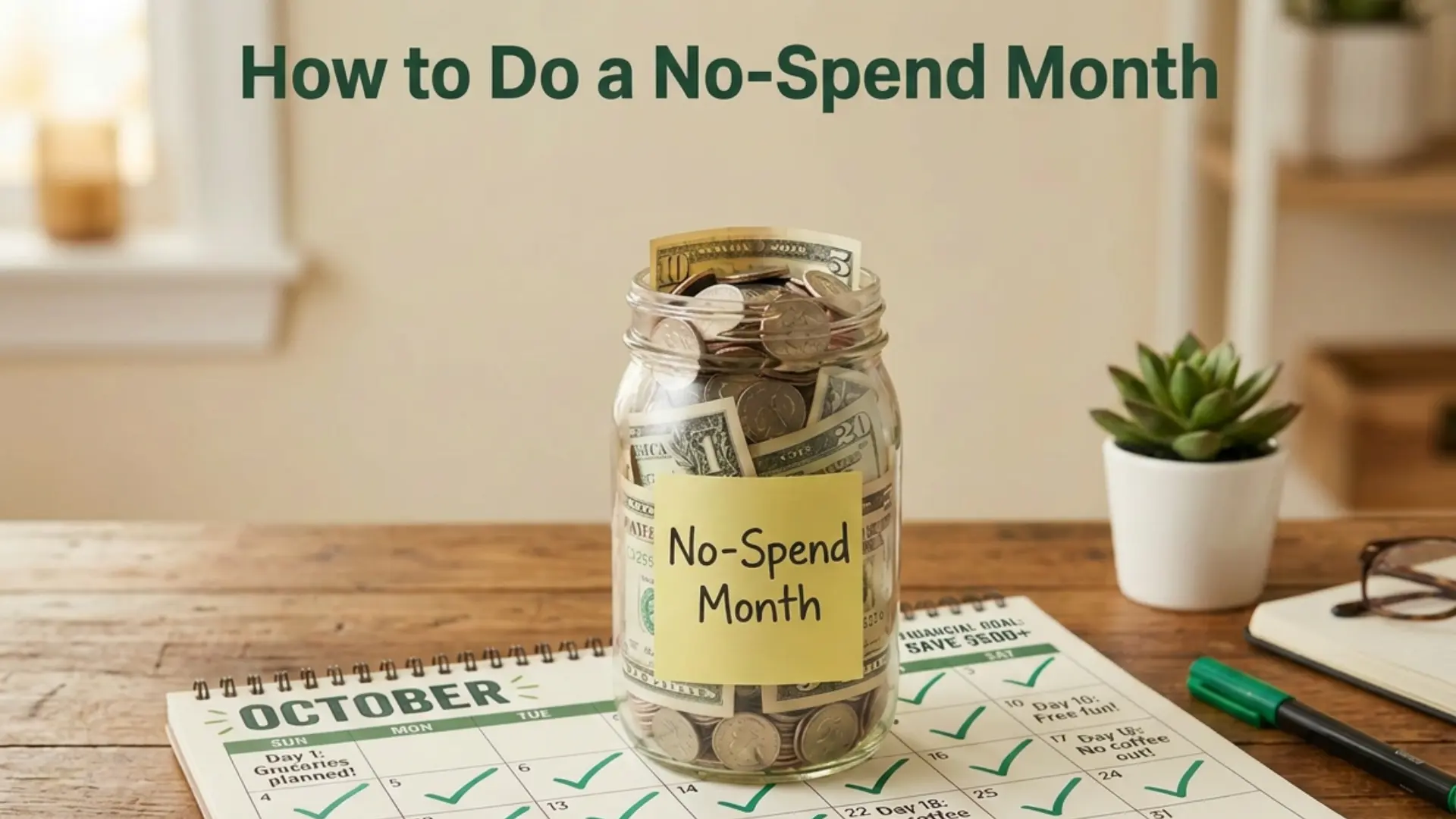
If you’re wondering how to do a no-spend month without losing your mind (or your social life), this guide walks you through it the way an actual human would — not a finance robot. Let’s get into it.
What Is a No-Spend Month?
A no-spend month is a 30-day challenge where you only spend money on true essentials. Rent, utilities, groceries, gas, insurance, medications, and existing debt payments stay. Everything else — takeout, new clothes, streaming upgrades, impulse buys — goes on pause.
It’s not a diet. It’s a reset.
The average American spent about $282 a month on impulse purchases in 2024, which adds up to roughly $3,381 a year in stuff nobody planned to buy. A no-spend month surfaces every dollar of that.
Why a No-Spend Month Actually Works
Your brain isn’t broken. It’s wired for short-term rewards. Every time you tap “buy now,” you get a small dopamine hit — the same chemical that makes social media addictive. Retailers know this. That’s why one-click checkout exists.
A no-spend month interrupts the loop. Instead of relying on willpower to say “no” 50 times a day, you make one big decision upfront: nothing extra for 30 days. That single rule kills decision fatigue, and after about two weeks, the urge to buy quietly fades.
There’s also a psychology principle called loss aversion at play. Once you commit publicly (even just to yourself in a tracker), breaking the streak feels worse than skipping the purchase. That’s why people who write the challenge down — or share it with a friend — finish it far more often than those who keep it in their heads.
How Much Can You Actually Save in 30 Days?
This is the part nobody wants to over-promise on, so let’s use real numbers.
According to the Bureau of Labor Statistics, the average U.S. household spent $78,535 in 2024, or about $6,545 a month. Roughly 16% of that goes to discretionary stuff — entertainment, apparel, dining out, miscellaneous shopping. That’s around $1,000 a month sitting in the “could pause it” column for the average household.
Realistic Savings Ranges
- Single, lower spender: $200–$500
- Single, average spender: $500–$900
- Couple or family, average: $800–$1,500
- High spender / heavy takeout household: $1,200–$2,500+
Real Examples From 2024–2025
One credit union member documented saving $248.17 in a single no-spend month — small, but enough to fully fund a starter emergency buffer.
A Gen Z creator in New York, Chiara Lucia, finished her no-spend month with around $2,000 saved after seeing her credit card bill cut nearly in half. She’s done three rounds since.
A Clever Girl Finance writer banked over $500 her first time through and said the bigger win was realizing how few of her “must-haves” were actually necessary.
The point isn’t hitting a magic number. It’s discovering that the leak in your budget is bigger than you thought.
How to Do a No-Spend Month in 7 Steps
Step 1 — Pick Your “Why”
“Save money” isn’t a strong enough reason. Your brain will negotiate that away by day four. Pick something specific and emotional.
Examples that actually stick:
- Build a $1,000 starter emergency fund (still missing for 27% of Americans, per Bankrate)
- Pay down one credit card by $600
- Save for a specific trip with a date attached
- Stop the paycheck-to-paycheck cycle (which 67% of Americans were in by 2025)
Write it on a sticky note. Put it on your bathroom mirror. You’ll need it around day 12.
Step 2 — Audit the Last 60 Days
Before you cut, look. Pull up your last two months of bank and credit card statements. Sort every transaction into three buckets: fixed essentials, variable essentials, and everything else.
That “everything else” column is your real challenge target. Most people are genuinely shocked here. The $4 coffee three times a week is $50/month. The two food delivery orders a week are $200+. The “small” Amazon habit is often $150 you can’t even account for.
Step 3 — Define Essentials vs. Non-Essentials
Write your rules down before day one. Vague rules collapse fast.
Typical “allowed” list:
- Rent or mortgage
- Utilities, phone, internet
- Groceries (with a set weekly cap)
- Gas and transit
- Prescriptions and basic toiletries
- Insurance premiums
- Existing debt minimums
Typical “banned” list:
- Restaurants, takeout, coffee shops
- Clothing, shoes, makeup
- New subscriptions (and ideally pause unused ones)
- Books, decor, gadgets
- Salon, spa, non-essential services
- Anything bought through Klarna, Afterpay, or Affirm
That last one matters more than people realize. Buy Now, Pay Later financed $18.2 billion in U.S. holiday spending in 2024, and 42% of BNPL users made a late payment in 2025. These apps disguise impulse buys as “free” because no money leaves your account today. They count. Treat them as off-limits.
Step 4 — Pick the Right Month (Calendar Strategy)
Don’t start in December. Don’t start the month of a wedding or your kid’s birthday. Set yourself up to win.
Best months to try a no-spend challenge in the U.S.:
- January — post-holiday reset, low social calendar
- February — the shortest month, less time to slip
- September — back-to-routine energy after summer
Pro move: Time your no-spend month for the weeks before your tax refund hits. The IRS issued an average refund of around $3,000 in 2024. If you’ve already trained yourself not to spend, you’ll save the refund instead of blowing it.
Step 5 — Set Behavioral Safeguards
Willpower is overrated. Friction works.
- Delete shopping apps from your phone (Amazon, SHEIN, Temu, anything with one-tap checkout)
- Unsubscribe from every retail email list (Unroll.Me makes this fast)
- Move credit cards out of your wallet and out of saved browser forms
- Unfollow influencers whose whole vibe is making you want stuff
- Pre-fill your week with free plans so boredom doesn’t push you to scroll (our no spend weekend ideas are a good starter list)
A Gen Z TikToker who did three no-spend months credited her success to “behavioral rules” — not buying without a list, no mall trips for fun, no browsing online. Change the environment, not just the intent.
Step 6 — Track Daily, Review Weekly
Use whatever works: a notes app, a paper calendar, a budgeting tool like YNAB or Monarch, or a free printable. The key is visibility.
Check in every Sunday with three questions:
- What did I almost buy this week?
- What did I learn about my triggers?
- What’s the running total saved?
That weekly review is where the real behavior change happens. The math is just a side effect.
Step 7 — Decide Where the Saved Money Goes (Before You Save It)
This is the step almost everyone skips, and it’s the difference between a real reset and a temporary stunt.
If the money just sits in checking, it gets spent in February. Move it the moment you save it. Good destinations:
- A high-yield savings account earning 4%+ APY
- A targeted sinking fund (vacation, car repairs, holidays)
- An extra credit card payment
- Roth IRA or 401(k) contribution if your emergency fund is already in place
The money has to have a job before it shows up.
No-Spend Month Rules: The Quick Reference
If you forget everything else, remember these:
- Bills get paid. Rent, utilities, insurance, minimum debt payments — all yes.
- You still eat. Groceries are fine; restaurants and delivery are not.
- Basic hygiene counts. Toothpaste runs out, replace it. New makeup palette? No.
- No new subscriptions. Pause the ones you’re not using.
- Use what you already own first. Pantry, closet, beauty drawer — shop your home.
- BNPL is spending. Klarna and Afterpay are off the table.
- Real emergencies are real. Car breaks down, kid needs a doctor — handle it without guilt.
Some people add a “one free pass” rule — a single planned exception (a friend’s birthday dinner, a wedding gift). That’s fine, as long as you decide on it before day one, not in the middle of a craving.
The Hardest Part — and How to Push Through
Almost everyone hits a wall around day 10–14. The novelty wears off, the urges sharpen, and your brain starts whispering, “one little thing won’t hurt.“
This is where the challenge is actually won.
The boredom trap. A lot of spending isn’t about wanting things — it’s about filling time. If shopping is your default downtime activity, you need a replacement. Walks, library books, that hobby you abandoned in 2022, calling a friend. Boring on paper, effective in practice.
Social pressure. Friends invite you out. You don’t have to disappear. Suggest hosting instead, pick the cheap coffee shop, or just be honest: “I’m doing a no-spend month — can we do a walk instead?” Most people respect it. A few will join you.
The 44% regret problem. Research shows 44% of people regret impulse purchases. Next time you’re about to break the challenge, pull up your tracker first. Seeing the running total of what you’ve saved usually beats the urge.
If you slip up: Don’t quit. Don’t restart from day one and torture yourself. Just keep going. A no-spend month with one bad day is still 29 days of better habits than the month before.
No-Spend Month Ideas: Free Fun That Doesn’t Feel Like Deprivation
The fastest way to fail is to sit at home staring at the wall. Build a backup list before day one.
Free or near-free things to do:
- Library visits — books, movies, even passes to local museums
- State and national parks (many have free admission days)
- Hiking, biking, or walking somewhere new
- Game nights and potlucks at home
- Free community events — check Eventbrite and Facebook
- Cook something ambitious from a recipe you’ve never tried
- Movie marathons with stuff you already own or subscribe to
- Declutter and sell — Facebook Marketplace, Poshmark, OfferUp turn clutter into cash
Pantry challenge: Make a game of using up what’s already in your kitchen. The average U.S. household throws out about $1,500 a year in food waste. A no-spend month is a great time to eat from the freezer.
Doing a No-Spend Month as a Couple or Family
If you live with someone, this works best as a team sport. Trying to white-knuckle it solo while your partner orders DoorDash three nights a week is a recipe for resentment.
For couples:
- Agree on the rules together, in writing, before day one
- Define the savings goal as a shared “we” goal, not “my” goal
- Build in one weekly date night that’s free or already paid for
- Don’t keep score on each other’s slip-ups — that ends marriages, not no-spend months
For families with kids:
- Frame it as a fun challenge, not a punishment (“we’re trying to save up for ___”)
- Let kids help plan free activities
- Take a picture of toys they ask for instead of buying — many lose interest within a week
- Use the month to involve them in cooking, decluttering, and choosing what to donate
What to Do When the Month Ends (Avoid the Backslide)
The danger zone isn’t day 15. It’s day 31.
A no-spend month works like a diet — and like a diet, going straight back to old habits undoes most of the gains. The point isn’t 30 perfect days. The point is a permanent shift.
When you finish, ask yourself:
- Which “needs” turned out to be wants?
- What did I not miss at all?
- What’s one rule I want to keep forever?
Some great post-challenge moves:
- Keep one “no-spend day” per week
- Maintain a 30-day wishlist rule — anything over $50 waits a month
- Cancel the subscriptions you didn’t miss
- Keep the apps deleted
Plenty of people who do one no-spend month end up making it a recurring habit — once a quarter, once a year, every January. It becomes less of a challenge and more of a tune-up.
Frequently Asked Questions
How much money can you save in a no-spend month?
Most people save between $300 and $1,500, depending on their normal spending. Households with heavy takeout, shopping, or subscription habits often save more. Real-world results range from around $250 on the low end to over $2,000 on the high end.
What counts as essential during a no-spend month?
Housing, utilities, groceries, gas, insurance, prescriptions, basic toiletries, and existing debt minimums. Define your own list in writing before day one to avoid mid-month negotiations.
Is a no-spend month a good idea?
Yes, especially if you feel like money disappears without explanation, you’re trying to build savings or pay down debt, or you’ve fallen into impulse buying or BNPL habits. It’s not meant to be permanent — it’s a reset.
What’s the hardest part of a no-spend challenge?
The mid-challenge dip around days 10–14, plus social situations and boredom. Behavioral safeguards (deleting apps, unsubscribing from emails, pre-planning free activities) handle most of it.
Can you do a no-spend month if you have kids?
Yes — frame it as a family challenge, build in free activities, and define ahead of time what counts (kids growing out of shoes is essential; a new toy is not).
What’s the best month for a no-spend challenge?
January (post-holiday reset), February (shortest month), or the weeks leading into your tax refund are the most strategic windows for U.S. households.
Final Thought
A no-spend month isn’t about proving how disciplined you are. It’s about seeing your money clearly — maybe for the first time in years. Thirty days is short enough to commit to, long enough to break a real habit, and just uncomfortable enough to teach you something.
You don’t need a perfect month. You just need to start one.

Sarah Whitman is the founder and lead editor of Keen Pocket. She holds a BS in Accounting and Finance and writes plain-English guides on budgeting, saving, debt, and beginner investing.