

How to Save Money When Rent Is High (2026)

Last fact-checked: · Editorial standards
When rent swallows a third or even half of your paycheck, the usual advice to just save more can feel like a joke. The money is gone before you can save it, because the biggest line in your budget is fixed and unforgiving. If that is your situation, you are not doing anything wrong, and you are far from alone.
The scale of this is staggering. According to Harvard’s America’s Rental Housing 2024 report, half of U.S. renters are cost-burdened, meaning they spend 30% or more of their income on housing, a record 22.6 million households. For renters earning under $30,000 a year, the average cost-burdened household has just $170 left each month after housing to cover everything else. High rent is a structural problem, not a personal failing.
Still, knowing how to save money when rent is high really comes down to two levers: shrinking the rent itself, which is the biggest, and cutting hard around everything else. This guide covers both, so you can start building a cushion even when housing eats most of your check.
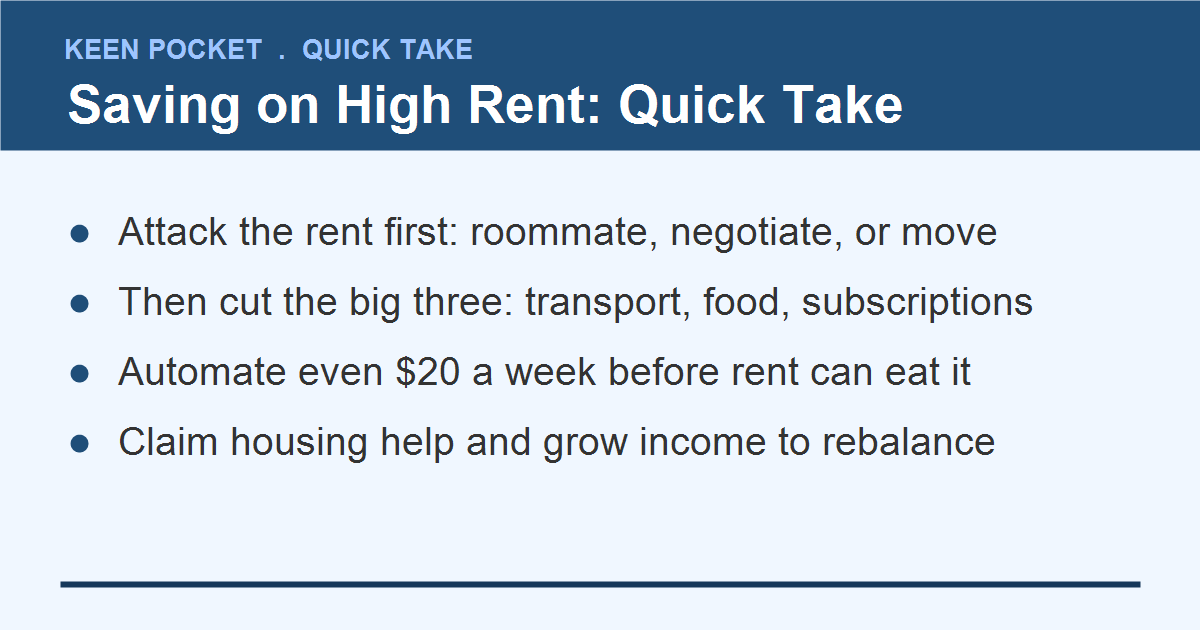
- Half of U.S. renters are cost-burdened. High rent is structural, not a personal failing.
- Attack the rent itself first, through a roommate, a negotiation, or a strategic move. It is the biggest lever by far.
- Then cut the big three: transportation, food, and subscriptions.
- Automate even $20 a week so savings happen before rent-related spending can claim it.
- Claim housing and utility help you qualify for, and grow income to rebalance the ratio.
Reviewed and updated for 2026. Rent-burden figures come from Harvard’s Joint Center for Housing Studies and HUD.
Why Saving Feels Impossible When Rent Is High
The problem is simple math. Experts consider housing affordable at around 30% of your income, but millions pay far more. When rent is 40% or 50% of what you earn, the money left for food, transportation, and everything else is stretched thin before you even think about savings.
That is why the usual tips, skip the coffee, pack a lunch, feel so hollow to rent-burdened households. Those cuts are real, but they are small compared to the size of the rent. To actually save when rent is high, you have to think bigger than the little stuff, and that starts with the rent itself.
First, Attack the Rent Itself
Because rent is your largest expense, a small percentage change there beats months of tiny cuts everywhere else. This is where the real money hides, so start here even though it is harder.
Negotiate your renewal
Landlords often prefer a reliable tenant to the cost and risk of a vacancy. Before your lease renews, research comparable rents nearby, and if they are lower, politely ask for a reduction or no increase. Offering to sign a longer lease can strengthen your case. Even a $50 monthly reduction is $600 a year saved.
Add a roommate or rent a room
Splitting a two-bedroom or renting out a spare room is the single most powerful rent-cutting move available. It can cut your housing cost nearly in half overnight, which no amount of coupon-clipping can match. If your space and living situation allow it, this one change can rebuild your whole budget.
Consider a strategic move
If your lease is ending and your rent is far above the local norm, moving to a cheaper unit or neighborhood can permanently reset your biggest bill. Factor in moving costs, but a lower rent pays that back fast. Sometimes the highest-return financial decision is a different address.
How to Negotiate Your Rent (What to Say)
Negotiating rent feels intimidating, but landlords do it constantly, and a calm, prepared ask often works. The key is to come with evidence and make saying yes easy.
Start a month or two before your lease renews. Gather three or four comparable listings nearby that rent for less, and note how long you have paid on time. Then reach out in writing with a simple, friendly message: thank them, say you would like to stay, point to the comparable rents, and ask whether they can hold the rent flat or lower it. Offering to sign a longer lease gives them the stability they value in return.
If they cannot move on price, ask for value another way, a waived fee, a free parking spot, a small upgrade, or a flexible move-out option. You are negotiating from a stronger position than you think, because turnover is expensive for a landlord. The worst outcome is the rent you already expected, and the upside is hundreds of dollars a year back in your pocket.
House Hacking: Make Your Space Pay You
If you cannot lower the rent, the next best thing is to make your home help pay for itself. House hacking simply means turning part of your space into income.
The biggest version is renting out a spare bedroom to a roommate, which can offset a large chunk of your rent every month. Smaller versions add up too: renting a parking spot or driveway in a busy area, offering storage space, or listing a spare room for occasional guests where your lease and local rules allow it.
Always check your lease and local regulations first, since some landlords and cities restrict subletting or short-term rentals. But when it is allowed, house hacking is one of the few moves that meaningfully offsets a high rent without you changing homes or jobs. Your largest expense quietly becomes a little smaller every month.
Then, Cut Hard Around a High Rent
Once you have squeezed the rent, turn to the other big categories. On a tight housing budget, the goal is meaningful cuts, not token ones.
The Rent-Saver Priority List
Here is where to focus first, ranked by how much a typical high-rent household can save. Ranges are typical, not promises.
| Move | Typical monthly save | Effort |
|---|---|---|
| Add a roommate | $400-800 | High |
| Move to a cheaper unit | $200-500 | High |
| Cut the food budget | $150-300 | Medium |
| Negotiate the renewal | $0-100 | Low |
| Transport and utilities | $80-230 | Medium |
Automate Tiny Savings So Rent Cannot Eat Them
When rent is high, any money left over gets absorbed fast unless you move it out of reach first. The fix is to pay your savings before rent-related spending can claim it.
Set a small automatic transfer to a separate savings account for the day after payday, even if it is just $10 or $20. It feels too small to matter, but on a high-rent budget, the habit matters more than the amount, and a protected $20 a week is over $1,000 a year. Keep it in a high-yield savings account at a different bank so it is a little harder to raid on a tight week.
A Realistic Plan When Rent Is 40% of Your Income
Numbers make it concrete. Say you take home $2,800 a month and rent is $1,120, a heavy 40% of your income. Here is a realistic path to saving anyway.
- Rent: $1,120. You negotiate no increase at renewal, holding the line for the year.
- Food: trimmed from $550 to $420 with a meal plan, freeing $130.
- Transport and subscriptions: shaved by $90 through insurance shopping and canceling unused services.
- The result: about $220 a month freed up, automated into savings the day after payday, which is roughly $2,640 saved in a year without touching the rent.
That is a genuine emergency fund built in a single year, on a budget where rent takes 40% of the check. It is not easy, but it is possible, and the automatic transfer is what makes it stick. Renting shapes how big that fund should be, too, which we compare in our guide to emergency fund rules for renters vs homeowners.
Rebalance the Ratio by Earning More
Cutting has a floor, and when rent is high you can hit it fast. The other side of the equation is income, which has no ceiling. Even a modest raise changes the rent-to-income ratio in your favor.
Ask for the raise or extra shift you have been putting off, since a $2 an hour bump is roughly $320 a month before tax, often more than months of cutting. A flexible side hustle can fund your savings directly while your main job covers the rent. When rent is the fixed problem, growing the income around it is sometimes the only lever with real room left.
Should You Move? Run the Math
Moving is disruptive, so it only makes sense when the numbers are clearly in your favor. A quick calculation tells you whether it is worth it.
Add up the one-time costs of moving: the deposit, application fees, movers or a truck, and any overlap in rent. Then compare that to your monthly savings at the new place. If a cheaper unit saves you $250 a month, that is $3,000 a year, and a $1,500 move pays for itself in six months. After that, the savings are pure gain, every month, for as long as you stay.
Weigh the non-money factors too, like commute, safety, and how close you are to work and family. But if your rent is far above the local average and your lease is ending, a strategic move is often the single highest-return financial decision available to a rent-burdened household.
Protect Yourself From the Next Rent Hike
Saving when rent is high is harder if the rent keeps climbing, so it helps to plan for the next increase before it lands. A little foresight keeps a hike from erasing your progress.
Ask your landlord early about expected increases so you are not blindsided, and if you find a rent you can afford, consider locking in a longer lease to freeze it. Keep a small rent-cushion line in your budget, a few dollars a month set aside specifically for a future increase, so a bump becomes an inconvenience rather than a crisis. And keep your options open by knowing the local market, since the best protection against an unfair increase is the credible ability to move.
Help That Exists for High Housing Costs
Before you cut to the bone, make sure you are not missing help you qualify for. Programs exist precisely because housing costs have outpaced incomes for years, and using them is smart.
Look into rental assistance and housing programs through HUD, which vary by area and income. Many utilities run assistance programs that lower a fixed bill, and dialing 211 connects you to local rent, utility, and food resources in a single call. Every dollar these cover is a dollar that can finally go toward savings instead of just keeping you afloat.
The Number Nobody Runs: Your Rent-to-Income Ratio
Generic “save money” advice obsesses over small cuts because they are easy to write about. But when rent is high, the only number that really matters is your rent-to-income ratio, and almost no one calculates it on purpose.
Here is why it changes your strategy. If rent is 40% of your take-home pay, you cannot coupon your way to comfort, because the coffee and the streaming service are rounding errors next to housing. The ratio, though, has two sides, and you can improve either one. Trim $100 off the rent and add a $2-an-hour raise, and a $2,800 income at $1,120 rent shifts from a punishing 40% toward a far healthier low-30s, freeing real money every month. A year of small cuts rarely moves the needle that much.
So run the number, then work both sides deliberately: push the rent down through sharing, negotiating, or moving, and push income up through a raise or a side hustle. Fixating on lattes while ignoring the ratio is the single most common way rent-burdened households stay stuck. Fix the ratio, and everything else in the budget suddenly has room to breathe.
Common Mistakes When Rent Is High
- Only cutting small stuff. Coffee cuts cannot offset a huge rent. Attack the rent and the other big categories first.
- Waiting to save until it feels affordable. It never will on its own. Automate a tiny amount now and grow it later.
- Renewing without asking. Landlords often negotiate, but only if you ask before the lease rolls over.
- Ignoring income. When rent is fixed and high, earning more is often the fastest path to breathing room.
Where to Put What You Save
On a high-rent budget, the money you free up is precious, so it has to land somewhere it cannot leak back out. Give it a clear job the moment you free it.
The first target is a small emergency fund, since a high fixed rent leaves no room for surprises. Our guide on building an emergency fund on a tight income shows how to start small, and keeping it in a high-yield savings account lets it grow while it waits. If rent has you living paycheck to paycheck, our plan to stop living paycheck to paycheck pairs directly with this one, and how to save money on a low income goes deeper on the cuts.
Frequently Asked Questions
How do I save money when rent is high and there is nothing left?
Start with the rent itself, since it is the biggest lever, through a roommate, a negotiated renewal, or a move. Then automate a tiny savings transfer, even $10 a week, so the habit exists before the money can be spent. Small and automatic beats waiting for a surplus that never comes.
What percent of income should go to rent?
The common benchmark is no more than 30% of your income on housing, but half of U.S. renters now pay more than that. If you are above 30%, cutting the rent through sharing or moving, or raising your income, is usually the highest-impact fix.
Can I really negotiate my rent?
Often, yes. Landlords weigh a reliable tenant against the cost of a vacancy, so it is worth asking, especially at renewal. Bring comparable local rents, offer a longer lease, and be polite. The worst answer is no, and even a small reduction adds up over a year.
Is it worth moving to save on rent?
If your rent is well above the local average and your lease is ending, moving can permanently reset your biggest expense. Weigh the moving costs against the monthly savings. A $250 monthly reduction is $3,000 a year, which usually dwarfs the one-time cost of moving.
How much should I have saved before renting an expensive apartment?
A common guideline is enough for the deposit and first month plus a small emergency fund, ideally a few months of rent. When rent is high, that cushion matters even more, since one missed paycheck is harder to absorb. Build toward it slowly if you are not there yet.
Does high rent hurt my ability to build credit or save for a home?
It makes both harder by leaving less room each month, but neither is impossible. Automating even small savings keeps a home fund growing, and some services let you build credit by reporting your on-time rent payments, turning your biggest expense into a small credit benefit.
What is the fastest way to save money when rent is high?
Cut the rent itself first, since it is your biggest expense. Adding a roommate or negotiating a lower renewal frees far more than any small cut, and the savings repeat every month. Pair that with an automatic transfer of even $20 a week, and you build a real cushion faster than trimming coffee ever could.
Should I use a credit card to cover rent when money is tight?
Avoid it if you can. Rent charged to a credit card you cannot pay off in full adds high interest to an already high cost, which deepens the hole. If you are regularly short on rent, prioritize cutting the rent, claiming assistance, and raising income over borrowing to cover it.
The Bottom Line
Learning how to save money when rent is high is less about tiny sacrifices and more about the big levers. Shrink the rent itself first, through a roommate, a negotiation, or a strategic move, then cut hard on transportation, food, and subscriptions, and automate a small transfer so savings happen before the money disappears. Claim any housing help you qualify for, and grow your income where you can. Rent may be the hardest expense to change, but even a burdened budget can build a real cushion, one automatic dollar at a time.

Sarah Whitman is the founder and lead editor of Keen Pocket. She holds a BS in Accounting and Finance and writes plain-English guides on budgeting, saving, debt, and beginner investing.