
High-Yield Savings Account vs. CD: Which Wins in 2026?

Last fact-checked: · Editorial standards
If you have a few thousand dollars sitting in cash right now, you have probably run into this exact question: park it in a high-yield savings account, or lock it into a CD? The rate charts on comparison sites make it look like a coin flip, a percentage point here, a percentage point there.
But the real decision has almost nothing to do with which number is bigger. It has to do with whether you can predict when you will need that money, and what happens to your plan if you guess wrong.
In 2026, that question matters more than usual. Rate cuts are already priced into the market, online banks are still advertising APYs several times higher than the national average, and CDs are paying a small but real premium over savings accounts for the first time in a while. Here is a real high-yield savings account vs. CD comparison, with real 2026 numbers, and a simple way to decide which one fits your situation.
High-Yield Savings Account vs. CD: The Quick Answer
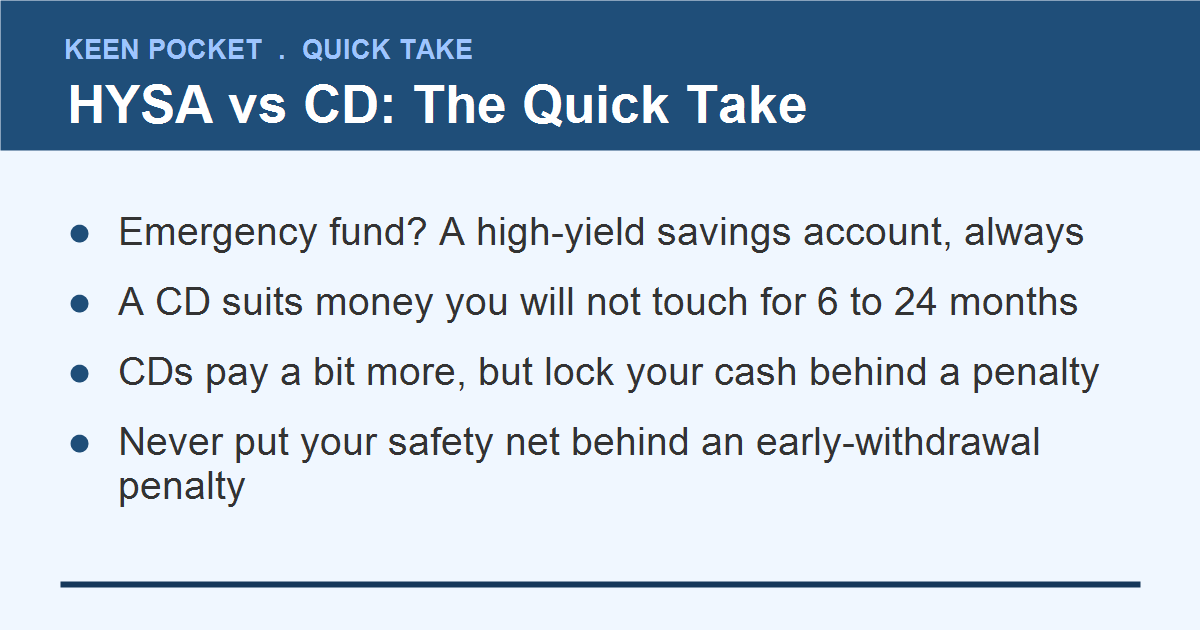
A high-yield savings account (HYSA) is almost always the better home for money you might need on short notice, like an emergency fund. A CD makes sense for money you already know you will not touch for six months to two years, especially if you think rates are about to drop.
You are building or holding an emergency fund.
You might need the cash with no warning.
You have not saved 3 to 6 months of expenses yet.
You are saving for a known expense 6 to 24 months out.
You want a guaranteed rate before cuts happen.
The money is genuinely extra, on top of a full emergency fund.
What a High-Yield Savings Account Actually Is
A high-yield savings account works like any other savings account. You deposit money, you can withdraw it whenever you want, and the bank pays you interest on the balance. The difference is the rate.
Online banks skip the cost of running branches, so they pass more of that savings back to you as interest. That is why a HYSA can pay 4% APY or more while a brick-and-mortar bank down the street pays a fraction of a percent on the same type of account.
💡 Quick Tip
A top online savings rate can run more than ten times the national average. The catch is that it is variable, so it can slide within a few weeks of a Federal Reserve rate cut.
The tradeoff is that the rate is variable. The bank can lower it at any time, and usually does within a few weeks of a Federal Reserve rate cut. Nothing about the rate is locked in, which is the price you pay for full access to your money.
What a CD Actually Is
A certificate of deposit is a fixed-term account. You agree to leave a set amount of money in the bank for a specific period, anywhere from three months to five years, and in return the bank guarantees you a fixed rate for that entire term.
That guarantee is the whole point. Even if the Fed cuts rates twice while your CD is open, your rate does not move. You know exactly what you will earn on the day you open the account.
The cost of that certainty is flexibility. Pull your money out before the term ends and you will pay an early withdrawal penalty, usually calculated as a set number of months of interest.
Early Withdrawal Penalties, by Term
| CD Term | Typical Early Withdrawal Penalty |
|---|---|
| 3 to 6 months | 1 to 3 months of interest |
| 1 year | 3 to 6 months of interest |
| 2 years | 6 to 12 months of interest |
| 5 years | 12 to 18 months of interest |
On a short-term CD, that penalty can eat most or all of what you earned, and on rare occasions it can dip into your original deposit. Always check a bank’s specific penalty schedule before you open a CD, since it varies by institution.
High-Yield Savings vs. CD: 2026 Rate Comparison
Rates move constantly, so treat these as a snapshot rather than a promise. As of mid-2026, top online savings accounts are generally paying in the 4.00% to 4.75% APY range, while top CDs run slightly higher, often 4.50% to 5.25% APY depending on the term.
That national average savings rate of 0.39% is not a rough guess. It comes directly from the FDIC’s National Rates and Rate Caps report, which tracks what insured banks actually pay across the country. Most people with cash sitting in a traditional bank account are earning close to that number, not the 4%-plus rate that gets advertised everywhere.
Real Numbers: What $10,000 Earns in a Year
Rate percentages are abstract until you see them in dollars. Here is what $10,000 earns over one year in each option, using representative 2026 rates.
| Account | Rate | Interest in 1 Year |
|---|---|---|
| Traditional savings account | 0.39% APY | $39 |
| High-yield savings account | 4.50% APY | $450 |
| 1-year CD | 5.00% APY | $500 |
Two things stand out. First, moving money out of a traditional savings account and into a HYSA is worth roughly $411 a year on just $10,000, for zero extra risk and zero loss of access. That is the single easiest upgrade in this entire comparison.
Second, the CD’s advantage over the HYSA here is about $50. That is real money, but it only shows up if rates hold steady and you never touch the CD before it matures. If the HYSA rate stays flat, or if you need to break the CD early, that math can flip in the savings account’s favor fast.
When a High-Yield Savings Account Wins
Choose a HYSA when access matters more than squeezing out the last quarter point of yield.
A HYSA is the right call when
For most people reading this, the HYSA is not a compromise. It is simply the right tool, and the small rate gap versus a CD is the price of keeping your safety net actually accessible in a real emergency.
When a CD Wins
A CD earns its place when you already know the shape of your future, not just your current balance.
- You have a specific expense coming, like a car purchase or a tax bill, on a date you can predict within a few months.
- You expect rates to fall and want to lock in today’s number before that happens.
- You know yourself well enough to admit that easy access to savings sometimes turns into easy access to spending, and the penalty gives you a reason to leave it alone.
- You already have a full emergency fund sitting in a HYSA and this is genuinely extra cash.
A CD should never hold your emergency fund. If your only accessible cash sits behind an early withdrawal penalty, you have built a safety net with a hole in it.
The CD Ladder: A Middle Path
If the CD’s rate is tempting but locking up all your cash for a year feels risky, a CD ladder splits the difference.
Divide your CD money into four equal parts.
Open a 3-month, 6-month, 9-month, and 12-month CD with one part each.
When the 3-month CD matures, roll it into a new 12-month CD at the current rate.
Repeat every three months as each rung matures.
After the first year, you have a CD maturing every three months, so a quarter of your money is always coming free, while the rest keeps earning CD-level rates. It is not as liquid as a HYSA, but it beats locking everything into one long-term CD and hoping you never need it early.
The Tax Detail Most Comparisons Skip
Interest from a HYSA and interest from a CD are taxed the same way: as ordinary income, in the year you earn it, whether or not you actually withdraw the money. That is confirmed directly in IRS Tax Topic 403. Your bank sends a Form 1099-INT if you earn $10 or more in interest, but you owe tax on all of it either way.
📌 Good to Know
An early withdrawal penalty is not only a loss. It shows up in Box 2 of your 1099-INT and is deductible on Schedule 1, which lowers your adjusted gross income and softens the hit at tax time.
Here is the part almost nobody mentions. If you pay an early withdrawal penalty on a CD, that penalty is not just a loss, it is a tax deduction. It does not erase the penalty, but it softens it slightly at tax time, and most comparison articles never bring it up.
What About Money Market Accounts and T-Bills?
The high-yield savings account vs. CD choice is the most common one, but two close cousins are worth a quick mention, because they sometimes fit better.
A money market account behaves much like a high-yield savings account, often with check-writing or a debit card attached, and pays a similar variable rate. If you want savings-account flexibility with a little more spending access, it is a reasonable swap for a HYSA. Just watch for higher minimum balance requirements.
Treasury bills are the other option, and they can quietly beat both. A T-bill is a short-term loan to the U.S. government, sold in terms from a few weeks to a year, and its interest is exempt from state and local tax, which lifts your real return in a high-tax state. Like a CD, you commit for a set term, but there is no bank penalty, you simply sell on the secondary market if you need out early. For a deeper look at these and other safe starter options, see our guide on low-risk ways to invest your first $100.
A Simple Way to Decide, Tied to Your Emergency Fund
Start with the number that matters most: how much you actually need in an emergency fund for your income and situation. If you have not worked that out yet, this guide to sizing your emergency fund and the site’s own emergency fund calculator will get you an exact target in a couple of minutes.
Keep your full emergency fund in a high-yield savings account. Only money you have already decided not to touch belongs in a CD.
Once you have that number, the split gets simple. Keep your full emergency fund target in a high-yield savings account, no exceptions. Anything genuinely extra, money you will not touch even in a bad month, is a reasonable candidate for a CD or a CD ladder.
If you are not there yet and your full emergency fund is still a work in progress, skip CDs entirely for now. There is no rate high enough to justify a penalty on money you might need next month.
How to Choose in 60 Seconds
If you want the whole decision boiled down, run these three questions in order.
- Is this your emergency fund? If yes, stop here. It belongs in a high-yield savings account, no exceptions.
- Do you know the exact month you will spend it, roughly 6 to 24 months out? If yes, a CD or a CD ladder can lock in a slightly higher rate.
- Not sure when you will need it? Default to the HYSA. Flexibility is worth more than a fraction of a percent whenever the timing is uncertain.
Nine times out of ten, that first question settles it. The high-yield savings account is the safe default, and a CD is the deliberate exception for money you have genuinely set aside.
Common Mistakes to Avoid
Most of the ways people lose money here are avoidable. The pattern is almost always the same: reaching for a slightly higher rate at the cost of access or clarity.
Read the fine print on any headline APY.
Keep emergency cash in a HYSA.
Set aside part of your interest for taxes.
Chasing a top rate that only covers a small first tier or requires monthly transactions.
Locking emergency savings into a CD and its penalty.
Leaving cash in a 0.39% account you could easily beat, or forgetting a long CD can lock you out of better rates later.
Frequently Asked Questions
High-yield savings account vs. CD: which is better right now?
In most 2026 rate environments, CDs pay a bit more than high-yield savings accounts, often around half a percentage point. For money you need to keep accessible, the HYSA still wins because that small rate gap rarely outweighs the value of flexibility.
Can you lose money in a CD or a HYSA?
Not through market losses, since both are FDIC insured up to $250,000 per depositor, per bank. The only way to come out behind is an early CD withdrawal penalty large enough to offset the interest you already earned.
What happens to my HYSA rate if the Fed cuts rates?
Online banks typically lower HYSA rates within a few weeks of a Fed rate cut. Your balance stays the same, but the interest you earn going forward drops along with the new rate.
Do I have to pay taxes on CD or savings account interest?
Yes. All interest income is taxable in the year you earn it, per the IRS, regardless of whether you receive a 1099-INT. If you paid an early withdrawal penalty, that amount is deductible.
How much of my money is FDIC insured?
Up to $250,000 per depositor, per insured bank, per ownership category, for both high-yield savings accounts and CDs.
Is it worth splitting money between a HYSA and a CD?
Often, yes. A common approach is to keep your full emergency fund in a high-yield savings account for access, then put any genuinely extra cash into a CD or CD ladder for a slightly higher, locked-in rate. That way you get flexibility where you need it and a bit more yield where you do not.
Bottom Line: High-Yield Savings Account vs. CD
A high-yield savings account and a CD are not competing for the same job. The HYSA is where your emergency fund and near-term savings belong, full stop. A CD is a tool for money you have already decided you will not need for a while, and it works best once your safety net is already solid.
Check today’s best high-yield savings account rates if you are ready to move your emergency fund, or compare no-penalty CD options if you want a little more yield without giving up all your flexibility.

Sarah Whitman is the founder and lead editor of Keen Pocket. She holds a BS in Accounting and Finance and writes plain-English guides on budgeting, saving, debt, and beginner investing.