
Low Risk Ways to Invest 100 Dollars (7 Safe Picks)

Last fact-checked: · Editorial standards
You do not need thousands of dollars, a finance degree, or a big appetite for risk to start investing. You need $100 and a willingness to begin. The catch is that starting small and starting safe are two different goals, and this guide is about doing both at once, growing that first $100 without lying awake worrying it will vanish.
Low-risk investing will not make you rich overnight, and that is the point. These options protect your money first and grow it second, which is exactly what a beginner with $100 should want. Many of them are backed by the U.S. government or insured by the FDIC, so the odds of losing your principal are extremely low.
Below are seven genuinely low risk ways to invest 100 dollars in 2026, each with its real return, how safe it is, and how to actually buy it. This is educational information, not personalized advice, so weigh each option against your own situation before you move money.
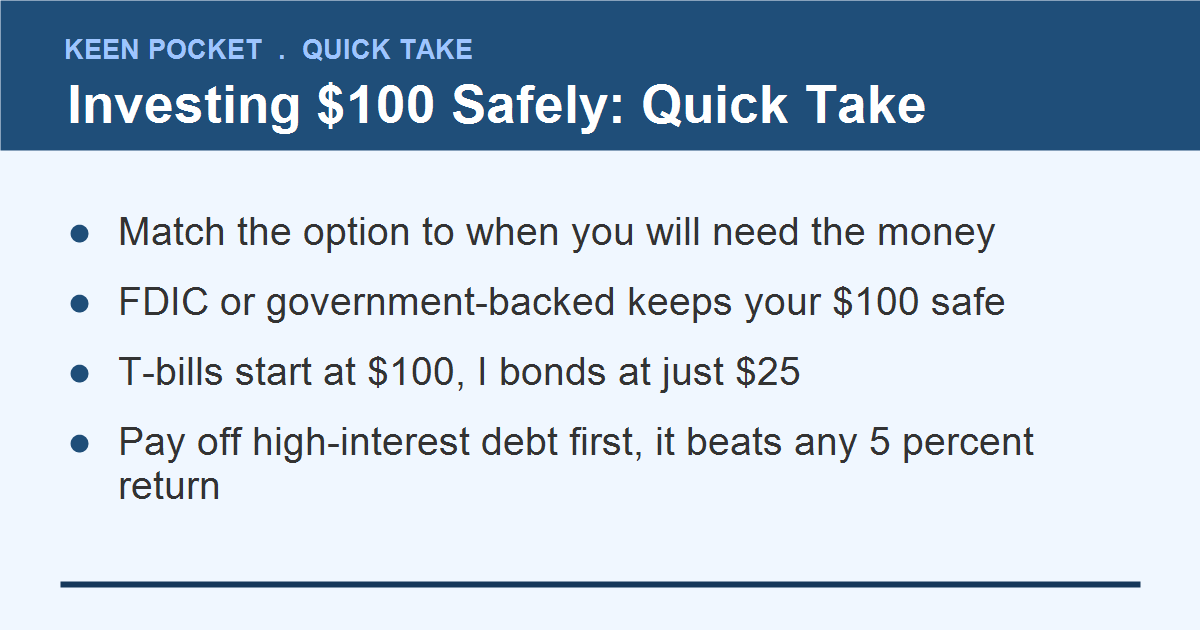
- You can start with $100, but the habit of adding to it matters far more than the first deposit.
- Match the option to your timeline: a high-yield savings account (4.5-5%) or a T-bill (~4.3%) for money you may need soon.
- T-bills start at $100, I bonds at $25, and both are backed by the U.S. government.
- Pay off high-interest debt first, since avoiding 22% beats earning 5% with zero risk.
- Capture any 401(k) match before anything else. It is an instant 100% return.
Reviewed and updated for 2026. Rates were checked against TreasuryDirect, the FDIC, and the SEC’s Investor.gov, and can change. This is educational information, not personalized advice.
What “Low Risk” Actually Means
Before the options, get clear on the trade-off. In investing, risk and return move together. The safest choices pay modest, steady returns, while the ones that can double your money can also cut it in half. Low-risk investing deliberately picks the calm end of that spectrum.
For your first $100, low risk usually means one of two protections. Either the money is insured by the FDIC up to $250,000, as in a bank account or CD, or it is backed by the full faith and credit of the U.S. government, as with Treasury securities. Both make losing your principal extraordinarily unlikely, which is why they are the right home for money you cannot afford to gamble.
7 Low-Risk Ways to Invest $100
These run from the most liquid and flexible to the longer-term. Rates are current for 2026 and will change, so confirm the number before you commit.
1. High-yield savings account
The simplest starting point. Online high-yield savings accounts pay around 4.5% to 5% in 2026, are FDIC-insured, and let you withdraw anytime with no lock-up. Your $100 earns real interest while staying completely available, which makes this the natural first stop for beginners and emergency money alike.
2. Treasury bills
Treasury bills are short-term loans to the U.S. government, and they are sold in increments of $100, which makes them almost tailor-made for this budget. A 3-month T-bill recently yielded around 4.3%, is backed by the government, and matures in under a year. You can buy them directly at TreasuryDirect with no fees.
3. Certificate of deposit
A CD locks your $100 for a set term, from a few months to several years, in exchange for a fixed rate, often around 4% to 4.5% in 2026. It is FDIC-insured and predictable, and the main catch is an early-withdrawal penalty. Choose a CD only for money you know you will not need until it matures.
4. Series I savings bonds
I bonds are built to keep pace with inflation, and their rate adjusts twice a year, sitting near 3.1% in 2026. You can start with as little as $25 through TreasuryDirect. The trade-off is patience: you cannot cash out in the first year, and redeeming before five years costs you three months of interest.
5. Money market funds
A money market fund holds very short-term, high-quality debt, often U.S. Treasury and government paper, and pays a yield in the same neighborhood as a high-yield savings account. Government money market funds are considered extremely safe, though unlike a bank account they are not FDIC-insured. They are easy to buy inside any brokerage.
6. Fractional shares of an index fund
This is the one growth option on the list, and it carries more risk than the others, so treat it accordingly. A fractional share lets your $100 buy a slice of a broad index fund that owns hundreds of companies. Over long periods the stock market has trended up, but it can and does fall in any given year, so this is money you plan to leave alone for years, not months.
7. Your employer’s retirement match
If you have a job with a 401(k) match, putting your $100 there is the closest thing to free money in personal finance. A dollar-for-dollar match is an instant 100% return before the market does anything. It is technically invested in funds, so it carries market risk, but the match itself is an edge no other option can touch.
The 7 Options, Compared
Here is how the choices stack up on return, safety, and how quickly you can get your money back. Rates are typical for 2026.
| Option | Typical return | Risk | Access |
|---|---|---|---|
| High-yield savings | 4.5-5% | Very low, FDIC | Anytime |
| Treasury bills | ~4.3% | Very low, gov | At maturity |
| CD | 4-4.5% | Very low, FDIC | At term end |
| Series I bond | ~3.1% | Very low, gov | After 1 year |
| Money market fund | ~4-5% | Low | A few days |
| Index fund slice | Varies, higher | Higher | A few days |
Where Should Your First $100 Go?
The best choice depends on one question: when will you need the money back? Match the option to your timeline and the decision gets easy.
- Need it anytime: a high-yield savings account keeps it safe, insured, and instantly available.
- Do not need it for a few months: a Treasury bill or a short CD pays a bit more for a short wait.
- Will not touch it for a year or more: an I bond hedges inflation, or a CD locks a fixed rate.
- Investing for years and can ride out dips: a fractional index fund offers real growth potential.
- Have a 401(k) match: capture that first. Nothing else pays an instant 100%.
How to Actually Buy Each One
The mechanics are simpler than they sound. None of these require a broker on the phone or a big minimum.
- Savings account or CD: open an account at an online bank in minutes and transfer your $100 from checking.
- Treasury bills or I bonds: create a free account at TreasuryDirect, the government’s own site, and buy directly with no fees.
- Money market fund or index fund: open a brokerage account, most have no minimum now, and buy the fund or a fractional share.
- 401(k) match: log in to your workplace plan and set your contribution to at least capture the full match.
Should You Pay Off High-Interest Debt First?
Before you invest your first $100, ask one question: do you carry high-interest debt? If you have a credit card charging 22%, paying it down is mathematically the best low-risk investment you can make, because avoiding a 22% cost beats earning a 5% return every single time.
Think of it this way. A safe investment might pay 4% to 5% a year, while credit card interest quietly charges you four or five times that. Putting $100 toward the card is a guaranteed, tax-free return equal to the interest rate you escape, with zero market risk. No savings account can compete with that math.
The one exception is a starter emergency fund. It usually makes sense to hold a small cushion, even $500, before you attack debt hard, so the next surprise does not send you right back to the card. But once that tiny buffer exists, high-interest debt is the highest-return, lowest-risk place your first $100 can go.
Micro-Investing Apps and Robo-Advisors
If choosing among seven options feels like a lot, technology can do the deciding for you. Micro-investing apps and robo-advisors are built for exactly the person starting with $100.
Micro-investing apps let you invest spare change or small fixed amounts automatically, buying fractional shares so no sum is too small. Robo-advisors go a step further, asking a few questions about your timeline and comfort with risk, then building and managing a diversified portfolio for you, often for a small annual fee around 0.25%.
These tools shine for beginners who want to start the habit without learning every detail first. Just watch the fees, since a flat monthly charge can be a large percentage of a $100 balance, and read what you are actually buying. Used well, they turn investing from a decision you keep postponing into something that simply happens in the background.
What $100 Can Realistically Grow Into
A single $100 will not change your life, but the habit it starts can. Here is a realistic picture using steady, low-risk returns, not a lottery-ticket best case.
- $100 alone at 4.5%: grows to about $125 in five years. Modest, but it beats losing value in a checking account.
- $100 plus $25 a month at 4.5%: reaches roughly $1,780 in five years, mostly from the habit of adding to it.
- The same habit at a market-like 7% over 20 years: can grow past $13,000, though with real ups and downs along the way.
The lesson is clear. The first $100 matters far less than the routine of adding to it. Low-risk investing keeps that growing balance safe while the habit does the heavy lifting.
The $100 Is Not the Point, the Autopilot Is
Most “how to invest $100” guides treat the $100 as the achievement. It is not. A single $100 at 5% earns about five dollars in a year, which changes nothing. The move that actually builds wealth is invisible in that framing: setting up an automatic monthly contribution.
Look at the difference. That lone $100 grows to roughly $125 in five years. Add just $25 a month on autopilot and the same account reaches around $1,780, almost entirely from the recurring habit rather than the market. Stretch the habit over decades at market-like returns and it can pass five figures. The first $100 is a rounding error next to what a small, automatic, repeated contribution does over time.
So if you do one thing after reading this, do not just park $100 and feel done. Open the account, then set a recurring transfer, even $10 or $20, for the day after payday. The $100 gets you in the door. The autopilot is what turns getting started into actually getting somewhere.
Common Mistakes New Investors Make
- Chasing a get-rich scheme. If a $100 investment promises to double fast, it is a red flag, not an opportunity.
- Leaving it in checking. Money in a zero-interest account quietly loses value to inflation. Even a savings account beats that.
- Locking up money you will need. Do not put next month’s rent in a one-year CD or an I bond. Match the timeline.
- Stopping at $100. The real growth comes from adding a little every month, not from the first deposit.
How Taxes Work on Low-Risk Investments
Even safe investments come with a small tax footnote, and knowing it up front avoids a surprise. The interest you earn is generally taxable income, but the details differ by type.
Interest from a savings account, CD, or money market fund is taxed as ordinary income at both the federal and state level. Treasury securities are friendlier: the interest on Treasury bills and I bonds is exempt from state and local tax, and you buy them directly through TreasuryDirect, the government’s own platform. I bond interest can even be federal-tax-deferred until you cash out.
At a $100 starting balance, the tax is tiny, often just a few dollars, so do not let it stop you. As your balance grows, holding taxable investments inside a tax-advantaged account like an IRA can shield more of the return. For now, simply know the interest counts as income, and keep any tax forms your bank or broker sends.
Watch Out for Fees and Scams
The fastest way to lose money on a small investment is not a market crash. It is fees and fraud, and both are avoidable with a little care.
On fees, a flat monthly charge or a high expense ratio can eat a meaningful slice of a $100 balance, so favor no-fee accounts and low-cost index funds while your balance is small. On fraud, treat any pitch promising guaranteed high returns with no risk as a scam, because genuine low-risk investments pay modest, honest rates. The SEC’s free Investor.gov site even lets you check whether an investment or adviser is registered before you hand over a dollar.
The safe options in this guide, backed by the FDIC or the U.S. government, carry none of these traps, which is exactly why they are the right place for a beginner’s first $100.
The Next Step After Your First $100
Once your first $100 is working, the path forward is about consistency and, eventually, a bit more growth. The goal is to keep the safe money safe and let long-term money do more.
If you have no emergency fund yet, that comes first, and our guide on building an emergency fund shows how to start small. Keep that cash in a high-yield savings account so it earns while it waits. When you are ready to grow beyond capital-preservation options, our how to start investing with little money guide is the natural next read, and passive income ideas covers where small investments can lead.
Frequently Asked Questions
What is the safest way to invest $100?
A high-yield savings account or a Treasury bill. Both protect your principal almost completely, one through FDIC insurance and the other through the U.S. government, while still paying real interest. For a beginner, either is an excellent first move.
Can you really invest with just $100?
Yes. Treasury bills start at $100, I bonds at $25, and most brokerages now let you buy fractional shares with no minimum. The idea that you need thousands to begin is outdated. What matters is starting and then adding to it.
Is $100 in a savings account really investing?
It is the safest end of investing. A high-yield savings account puts your money to work earning interest instead of losing value to inflation. It will not grow like the stock market, but for money you may need soon, that safety is the whole point.
How can I grow $100 with low risk?
Pick a safe, insured option that matches your timeline, then add a small amount every month. Steady contributions plus a modest 4% to 5% return compound over time, and the automatic habit does far more than the initial $100 ever could. To turn that into a monthly routine, see our guide to investing 50 dollars a month for beginners.
How much can $100 earn in a year in a safe investment?
At today’s rates of roughly 4% to 5%, a safe $100 investment earns about $4 to $5 in a year. That is small on its own, but it beats losing value in a no-interest account, and it grows meaningfully once you add to the balance each month.
Are Treasury bills or savings accounts better for $100?
Both are excellent and very safe. A savings account wins on flexibility, since you can withdraw anytime, while a Treasury bill may pay slightly more if you can leave the money untouched until it matures. If you might need the cash soon, choose the savings account.
Do I need a brokerage account to invest $100?
Not always. A high-yield savings account or CD only needs a bank, and Treasury bills and I bonds are bought directly at TreasuryDirect. You only need a brokerage account for money market funds, index funds, or fractional shares, and most now open free with no minimum.
The Bottom Line
There are more low risk ways to invest 100 dollars than most beginners realize, and nearly all of them protect your money while it grows. Match the option to your timeline: a high-yield savings account or Treasury bill for money you may need soon, a CD or I bond for money you can leave alone, and a 401(k) match whenever it is on the table. Then do the one thing that actually builds wealth, add a little every month. Your first $100 is not the goal. It is the start of the habit that gets you there.

Sarah Whitman is the founder and lead editor of Keen Pocket. She holds a BS in Accounting and Finance and writes plain-English guides on budgeting, saving, debt, and beginner investing.