
Investing 50 Dollars a Month for Beginners: A Simple 2026 Guide

Last fact-checked: · Editorial standards
Fifty dollars can feel too small to bother with. The finance world loves to talk about maxing out retirement accounts and six-figure portfolios, which makes a modest monthly amount seem pointless. It is not.
Here is the quiet truth the headlines skip: consistency beats size every time. Investing 50 dollars a month for beginners works because of two forces that do not care how much you start with, compounding and time. Start small, stay steady, and the math does the heavy lifting.
This guide is built for the hesitant beginner. We will walk through what $50 a month can actually grow into, where to put it, the apps that make tiny amounts easy, and the couple of things to handle first. One quick note before we dive in: this is general education, not personalized investment advice, so weigh it against your own situation.
Is investing $50 a month even worth it?
This is the question that keeps people on the sidelines for years, and the answer is a clear yes. Not because $50 is a lot, but because starting the habit early is worth far more than starting bigger later. Momentum compounds along with the money.
You are also in good company. About 61% of U.S. adults owned stock in 2023, the highest share since 2008, according to Gallup, and most of them hold it through everyday funds, not hot stock picks. Small, boring, and regular is how normal people actually build wealth.
There is a psychological win too. Investing 50 dollars a month for beginners turns a scary, someday project into a small thing you already do, like a subscription that pays you back. Once the first automatic transfer goes through, investing stops being an intimidating idea and becomes a normal part of your month, which is exactly the shift most people need.
The best time to start investing was years ago. The second best time is this month, with whatever you can spare, even if it is just $50.
The compounding math: what $50 a month becomes
Numbers make it real, so let us look at what a steady $50 a month could grow into. The table below assumes a 7% average annual return, a common and reasonably conservative long-term assumption. Returns are never guaranteed and markets rise and fall, so treat these as illustrations, not promises.
| After | You put in | Could grow to (at 7%) |
|---|---|---|
| 10 years | $6,000 | about $8,700 |
| 20 years | $12,000 | about $26,000 |
| 30 years | $18,000 | about $61,000 |
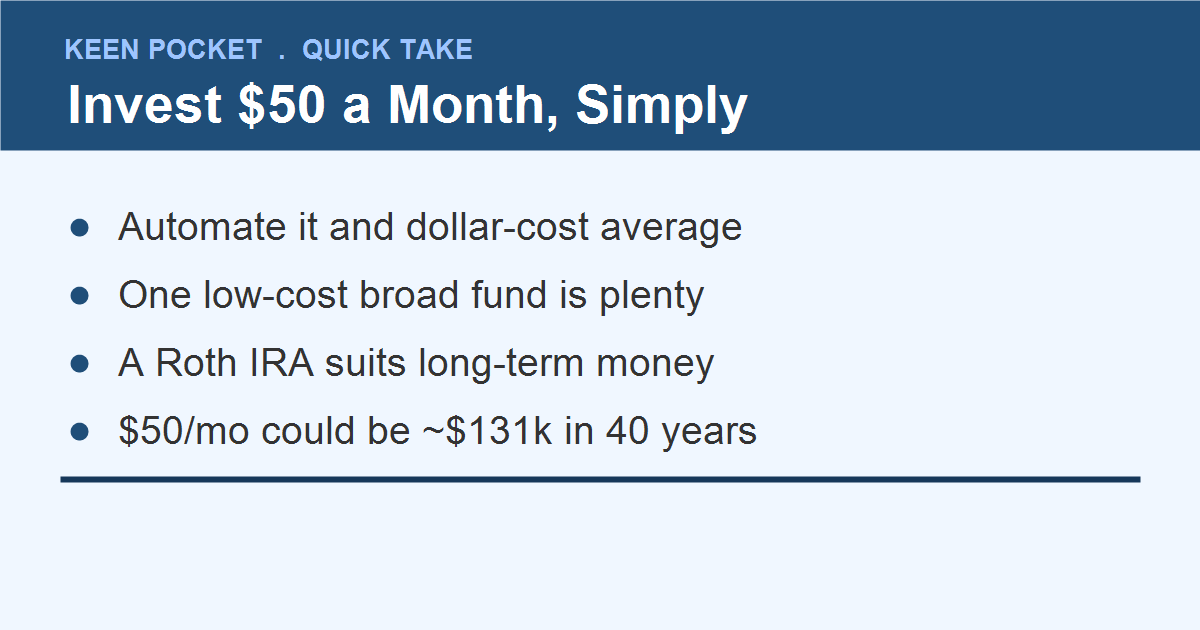
| 40 years | $24,000 | about $131,000 |
Look at the 40-year row. You contributed $24,000, but the balance is around $131,000. That gap is compounding, your money earning money, then that money earning more. The earlier you start, the more of that gap you get to keep, which is the entire case for beginning now instead of waiting.
How we calculated this: projections assume a 7% average annual return compounded monthly, a common conservative long-term assumption, and are illustrations rather than promises. Markets rise and fall and can lose value in any year. You can run your own figures with the SEC’s free compound interest calculator.
What to actually buy: index funds and ETFs, simply
Picking individual stocks is stressful and risky, and beginners rarely beat the market doing it. The easier path is a fund that holds hundreds of companies at once, so a single bad company barely dents you. You can learn the basics of how markets and funds work at the SEC’s Investor.gov, which is free and jargon-light.
Any one of these is a reasonable, diversified starting point, and you do not need all three. The historical long-run return of a broad U.S. index has been strong, around 10.5% a year for the S&P 500 since 1957, though the future is unknowable and any given year can be negative. Keep costs low by favoring funds with tiny expense ratios.
Where to put it: a Roth IRA or a regular brokerage
The fund is what you buy. The account is where you hold it, and for beginners the choice usually comes down to two. Both let you invest $50 a month; they just handle taxes and access differently.
| Question | Roth IRA | Taxable brokerage |
|---|---|---|
| Taxes | pay now, growth is tax-free | tax on gains and dividends |
| Access | best left until retirement | withdraw anytime |
| Your $50/month | $600/yr, far under the limit | no contribution limit |
| Best for | long-term retirement money | flexible, any-goal money |
For most beginners aiming at the long term, a Roth IRA is a fantastic home for $50 a month, because that growth comes out tax-free later. The 2025 contribution limit is $7,000 for those under 50, per the IRS, so your $600 a year leaves plenty of room to grow the habit.
Opening either account is free and usually takes about fifteen minutes online, with no minimum balance at most major brokerages. If you are torn, remember you can open one now and add the other later. The important move is starting, not picking the theoretically perfect account on day one.
The apps that make $50 a month easy
Not long ago, $50 was too little to buy a share of many funds. Fractional shares changed that, letting you buy a sliver of a fund with whatever you have. Today three kinds of apps make investing 50 dollars a month for beginners genuinely simple.
Whichever you pick, check the fees first, since a flat monthly fee can quietly eat a big slice of a small account. Our roundup of apps that round up purchases is a gentle on-ramp if automating the habit is your main hurdle.
Here is a quick example of why fees matter at this size. A $5 monthly app fee on a $50 deposit is a 10% drag before you have earned a cent, which no market return can reliably beat. Favor apps that charge nothing or a tiny percentage, and you keep almost all of what compounding builds. At $50 a month, low cost is not a nice-to-have, it is the whole ballgame.
Dollar-cost averaging: why $50 on autopilot wins
The fancy term for investing the same amount on a schedule is dollar-cost averaging, and it is a beginner’s best friend. Instead of guessing when to buy, you buy every month no matter what the market is doing.
You wait for the “right” moment, feel anxious, and often miss the good days entirely.
You buy more shares when prices dip and fewer when they spike, with zero decisions.
When the market drops, your $50 quietly buys more shares on sale. When it climbs, you buy fewer. Over years, that evens out your cost and removes the emotion that wrecks most beginner portfolios. Automation is not just convenient, it is a genuine edge.
It also protects you from yourself. The biggest threat to a small portfolio is not a market crash, it is the investor panic-selling at the bottom or freezing up and never starting. A recurring $50 that buys automatically sidesteps both. You are never trying to be clever, just consistent, and consistency is what actually compounds.
Before you invest a single dollar
Investing is powerful, but it is not always the first move. Two things usually deserve your money before the market does, and skipping them can turn a good habit into a stressful one.
Handle these first
None of this means waiting for years. You can build a small cushion and invest at the same time. If a card balance is the blocker, our guides on paying off credit card debt and building an emergency fund clear the runway first.
Your first-year starting plan
Ready to actually begin? The whole setup takes one afternoon, and after that it runs itself. This is the simplest version of investing 50 dollars a month for beginners, start to finish.
Open an account. A Roth IRA or a beginner-friendly brokerage app, whichever fits your goal.
Automate the $50. Set a recurring transfer for the day after payday so it happens without thinking.
Buy one broad fund. Pick a single low-cost index or target-date fund and set the $50 to invest automatically.
Then ignore it. Do not check daily. Let a full year pass, raise the amount when you can, and stay the course.
That is genuinely the entire plan. The magic is not in clever moves, it is in showing up every month and letting time work.
How to grow beyond your first $50 a month
Fifty is the starting line, not the finish. The real power of investing 50 dollars a month for beginners is that it builds a habit you can scale up painlessly as your life changes. The account and the automation are already there; you just change one number.
A simple trick is to raise your monthly amount by $10 or $25 every time your income rises, so you never feel the pinch. Direct a tax refund or a birthday check into the same account and the balance jumps without touching your budget. The habit carries the weight; you just feed it more over time.
The risks every beginner should understand
Honesty matters more than hype, so here is the other side. Investing is not a savings account, and pretending otherwise sets you up to panic. Understanding the risks up front is what lets you stay calm and stay invested.
⚠️ Watch Out
Your balance will fall sometimes, occasionally a lot in a single year. That is normal, not a sign you did something wrong. Money you might need within five years generally does not belong in the market at all; keep that in savings instead.
The 7% and 10% figures in this guide are long-run averages, not a promise for any given year. Some years are strongly positive, some are negative, and nobody can predict the order. This is also why a low-cost, broadly diversified fund matters: it spreads your risk across hundreds of companies instead of betting on one. When done with money you will not need soon, investing 50 dollars a month for beginners is a reasonable long-term habit, not a gamble.
Common beginner mistakes with small investments
A few avoidable errors trip up new investors putting in small amounts. Sidestep these and you keep more of what compounding builds.
Automate it and leave it alone for years.
Favor low-fee, broadly diversified funds.
Raise the amount whenever your income does.
Chasing meme stocks or crypto tips with it.
Panic-selling the first time it drops.
Paying high fees that eat a small balance.
Boring is the goal. The most successful small investors are the ones who set it up, resisted tinkering, and let a decade go by. Dull and consistent beats exciting and erratic.
Frequently asked questions
Is investing 50 dollars a month for beginners actually worth it?
Yes. At a 7% average return, $50 a month could grow to roughly $26,000 in 20 years and about $61,000 in 30, and the habit itself often matters more than the amount. Starting now, small, beats waiting until you can invest more.
How much is $50 a month after 20 or 30 years?
Assuming a 7% average annual return, around $26,000 after 20 years and about $61,000 after 30, on total contributions of $12,000 and $18,000. Returns are not guaranteed, and real results depend on the market and your fees.
Where should a beginner invest $50 a month?
A low-cost, broad index fund or target-date fund held inside a Roth IRA is a common, sensible starting point for long-term money. If you want flexible access instead, a taxable brokerage works. Keep fees low and diversification high. If you are early in your career, our guide to retirement planning on a low income in your 30s shows how that same habit builds a nest egg.
What is the best app to invest $50 a month?
The best app is the one you will actually use and whose fees are low relative to your balance. Robo-advisors, fractional-share brokerages, and round-up apps all handle $50 a month well. Watch for flat monthly fees that take a large bite out of a small account.
Should I invest $50 a month or pay off debt first?
Tackle high-interest debt, like credit cards, before investing, since it usually costs more than investments reliably earn. Grab any employer 401(k) match first, keep a small emergency cushion, then invest. You can often do a little of each at once.
Can I lose money investing $50 a month?
Yes, in the short term your balance can drop, sometimes sharply in a bad year. Over long periods a diversified fund has historically recovered and grown, but nothing is guaranteed. That is why you invest only money you will not need for at least five years and keep short-term cash in savings.
How do I invest $50 a month in a Roth IRA?
Open a Roth IRA at a brokerage, set a recurring $50 transfer, and choose one low-cost index or target-date fund to buy automatically. Your $600 a year sits far under the 2025 limit of $7,000, so there is plenty of room to increase it later.
Do I need a lot of money to start investing?
No. Fractional shares and no-minimum apps mean you can start with $50 or even less. The barrier used to be real, but it is mostly gone now, which is exactly why small, steady investing has become so accessible.
The bottom line
You do not need a windfall to become an investor. You need a small amount, a boring fund, and the patience to keep going. That is the whole secret behind investing 50 dollars a month for beginners, and it is available to almost anyone.
Handle your high-interest debt and a small cushion first, then open an account, automate your $50, buy one broad fund, and let time do the rest. Future you, decades from now, will be very glad you started with the small amount instead of waiting for a big one.
Sarah is the founder and lead editor of KeenPocket, where she writes practical, jargon-free money guides for real, everyday budgets. Every figure in this article is tied to a named, current primary source such as the Federal Reserve, CFPB, IRS, or BLS, and the math is shown so you can check it. KeenPocket articles are educational and are not personalized financial advice; for choices about your own situation, consider speaking with a licensed professional.

Sarah Whitman is the founder and lead editor of Keen Pocket. She holds a BS in Accounting and Finance and writes plain-English guides on budgeting, saving, debt, and beginner investing.