

How to Build an Emergency Fund on Minimum Wage

Last fact-checked: · Editorial standards
When your paycheck barely covers rent and groceries, “just save three to six months of expenses” sounds like a cruel joke. On minimum wage, most of your money is spoken for before it even lands. How big your fund should be also depends on your housing, which we break down in our guide to emergency fund rules for renters vs homeowners.
You are not imagining the difficulty. About 83% of hourly workers in the U.S. have less than $500 saved, and among households earning under $60,000, more than four in ten have no emergency savings at all. The system is genuinely stacked against small paychecks.
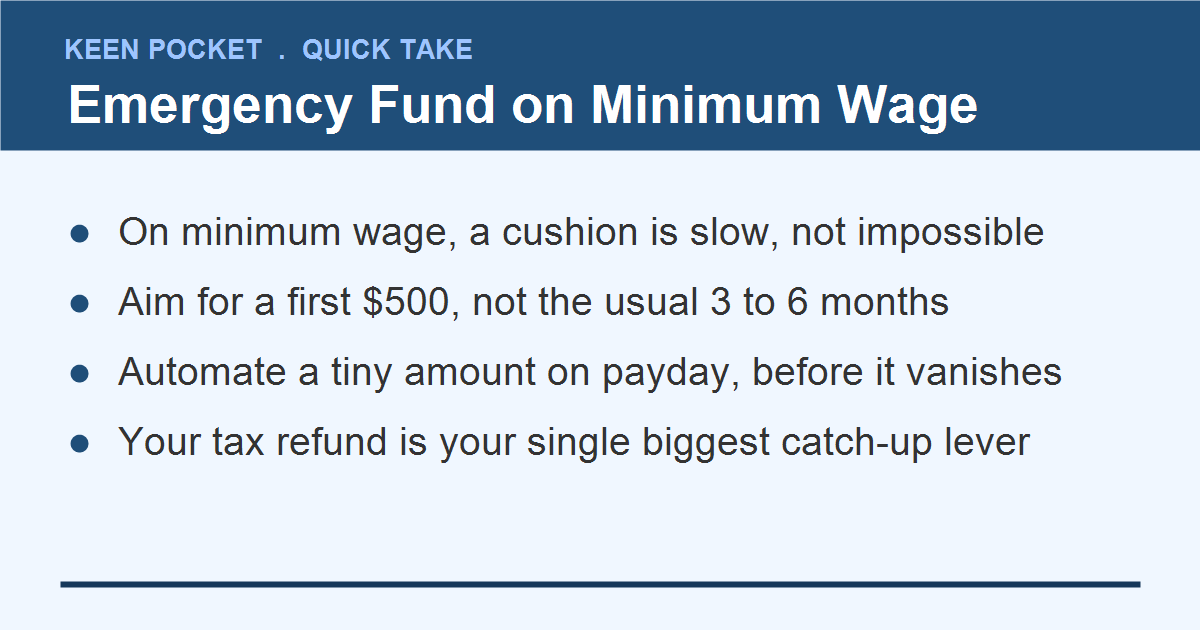
But here is the part nobody tells you: building a cushion on minimum wage is slow, not impossible, and there is one lever most guides skip entirely that can fund the whole thing at once. This guide shows how to build an emergency fund on minimum wage with real numbers, a realistic timeline, and no shame about starting tiny.
Yes, It Is Possible: Set a Realistic First Goal
Forget three to six months for now. That target is built for higher incomes, and chasing it on minimum wage just makes you quit. Aim for a first milestone you can actually reach.
Your first goal is $500. That single number covers most real emergencies, a car repair, an urgent bill, a trip to urgent care, and it is close enough to touch. Hit it, and you have already left the most dangerous financial zone behind.
On minimum wage, your first target is $500, not six months of expenses. A small cushion you actually reach beats a huge one you give up on by spring.
The Minimum-Wage Math: What You Can Realistically Save
Let’s be honest about the numbers. The federal minimum wage is still $7.25 an hour, frozen since 2009, which is about $290 a week before taxes for full-time work, or roughly $1,100 a month after them. Many states pay more, up to $17.13 in Washington and $17.95 in Washington, D.C., and 30 states plus D.C. now sit above the federal floor, which changes the math a lot depending on where you live.
Here is what a first $500 looks like at different wages, saving only what a very tight budget can spare.
| Hourly wage | Weekly (40 hrs, gross) | Realistic save/week | Time to $500 |
|---|---|---|---|
| $7.25 (federal) | about $290 | $5 to $10 | 12 to 24 months |
| $10 | about $400 | $10 to $15 | 8 to 12 months |
| $12 | about $480 | $15 to $20 | 6 to 8 months |
| $15 | about $600 | $20 to $30 | 4 to 6 months |
| $17 (top states) | about $680 | $25 to $40 | 3 to 5 months |
Yes, at the federal wage this can take a year or two. That is slow, but it is still a straight line to a real cushion, and the tax refund below can shorten it dramatically.
Start Small and Automate It on Payday
The amount matters less than the automation. If saving depends on willpower left over at the end of a broke week, it will not happen. Take the decision off the table.
Open a separate, free savings account, ideally at a different bank so it is out of sight.
Set an automatic transfer of $5 to $10 for the day after each payday.
Leave it alone. Treat that account like it does not exist until a real emergency.
Moving the money the day after payday, before the bills hit, is the whole trick. What you never see in checking, you never miss.
Find the First $5 When There Is Nothing Left
If your budget genuinely has no room, the first dollars have to come from somewhere other than cutting spending. There are two places to look: benefits that free up cash you are already spending, and money you already have sitting around.
Ways to free up the first $100
None of these are permanent income, but they do the hardest job of all: getting the first $100 through the door. Once the account is not empty, watching it grow becomes its own motivation.
Your Secret Weapon: The Tax Refund
This is the lever most minimum-wage guides skip, and it is the single fastest path to a full emergency fund. Many low-wage workers qualify for the Earned Income Tax Credit, which can turn a tax refund into a several-hundred or even several-thousand-dollar lump sum.
The move is simple: file your taxes, claim every credit you qualify for on the IRS Earned Income Tax Credit page, and send a chunk of the refund straight to savings before it disappears into everyday spending. For many minimum-wage workers, one refund does what a year of $10 weeks would.
Cut the Big Three, Not the Small Stuff
On a tight budget, skipping coffee will not build a fund. The real money is in your three largest bills: housing, transportation, and your phone. Shave those and the savings dwarf any latte.
Where the real savings hide
You do not have to change all three. Trimming even one of your big bills by $20 a month frees up more than most people save in a year of small sacrifices, and it goes straight into your fund.
Free Help That Frees Up Money to Save
One of the fastest ways to find room in a minimum-wage budget is not to cut harder, it is to claim help you may already qualify for. Every dollar a program covers is a dollar you can redirect toward your fund.
Start with the Earned Income Tax Credit. Many minimum-wage workers qualify and never claim it, leaving hundreds or even thousands of dollars on the table each year. Free filing services like the IRS Free File program or a local VITA site will check for you at no cost.
Then look at your ongoing costs. SNAP can free up part of your grocery budget, and most states run assistance programs for utilities, phone service, and internet that quietly lower your fixed bills. Dialing 211, a free nationwide helpline, connects you to local food, rent, and utility resources in a single call.
None of this is a handout in any shameful sense. These programs exist precisely so a rough month does not turn into a debt spiral. Using them to protect your budget while you build a cushion is exactly the kind of smart move that gets you off minimum wage faster.
A Realistic Timeline to Your First $500
Here is what steady progress looks like at $10 a week, the middle of what most minimum-wage budgets can spare. No dramatic sacrifice, just a line that keeps moving.
Now add a tax refund partway through, or a few extra shifts, and that year can shrink to a few months. The line only ever moves in one direction, which is the point.
Where to Keep Your Emergency Fund
Where you park the money matters more than you might think. Your emergency fund should be separate from your checking account, close enough to reach in a day or two, but not so close that you spend it by accident.
A high-yield savings account at an online bank is the sweet spot. It pays far more interest than a regular account, often more than twenty times as much, and a transfer to your checking usually clears within one to two business days. That small delay is a feature, not a flaw, because it gives you a beat to decide whether the expense is truly an emergency.
Avoid two extremes. Do not leave the fund in your everyday checking, where it blends in with spending money and vanishes. And do not lock it in an investment account or a CD, where a bad week could force you to sell at a loss or pay a penalty. An emergency fund has one job: to be there, in full, the moment you need it.
Make It Slightly Hard to Reach
On a tight budget, the biggest threat to your emergency fund is not a real emergency. It is the small temptation to dip in for something that only feels urgent. A little friction protects you from yourself.
Open the account at a different bank from your main checking, ideally one without a linked debit card. When the money is not one tap away in the same app, you pause before moving it. Give the account a plain, boring name like Do Not Touch, so every time you see it you remember what it is for.
Automate the deposits so building the fund takes no willpower, but make withdrawals take a deliberate step. That imbalance, easy to add to and slightly annoying to raid, is what quietly turns a few dollars a week into a cushion that is still there when the real emergency finally comes.
What to Do After Your First $500
Reaching $500 is the hard part, and it changes your whole financial life. Once it is there, keep the same automatic habit and raise the target in stages.
📌 Good to Know
Keep your fund in a high-yield savings account, not a checking-linked pot earning almost nothing. It stays safe and FDIC insured while paying you a little extra. After $500, aim for $1,000, then slowly build toward one month of expenses.
The site’s guides on saving your first $1,000, how much emergency fund you actually need, and the best high-yield savings accounts map every step after this one.
What Happens When You Have to Use It
Here is the mindset shift that keeps people going: spending your emergency fund is not failure. It is the fund doing its job. The whole point of those months of tiny deposits was to have cash ready when the car died or a shift got cut, instead of reaching for a credit card or a payday loan.
So when you do have to use it, do not feel like you are back to zero in the way that matters. You avoided debt, and that is the win. The only rule is to start rebuilding the moment the crisis passes, at the same small automatic amount you used before.
Restarting is far easier than starting, because you already have the account, the habit, and the proof that it works. Most people who use their fund once end up saving faster the second time around, simply because they have felt, first-hand, how much calmer a rough week is when a cushion is waiting.
Save First, or Pay Off Debt First?
If you carry a balance on a high-interest credit card, you may wonder whether saving even makes sense before it is gone. On minimum wage, the answer is almost always to do a little of both at once.
Build a small starter fund first, even just $500, before you throw everything at the debt. Here is why: without any cushion, the next surprise expense goes straight back onto the card, and you never actually make progress. A tiny buffer breaks that cycle.
Once that first $500 is set aside, shift most of your extra money to the highest-interest debt while keeping the automatic savings deposit running, even at a few dollars a week. Paying 25 percent interest is its own kind of emergency, so it deserves priority, but never at the cost of having zero dollars between you and the next flat tire.
Common Mistakes on a Tight Budget
A few avoidable slips stall most minimum-wage savers. Sidestep these and the slow plan keeps working.
Automate a tiny amount you will not miss.
Bank a chunk of your tax refund on arrival.
Keep the fund at a separate bank.
Chasing a three-month goal from day one and quitting.
Using a payday loan when a small cushion would do.
Spending the refund before any of it is saved.
Frequently Asked Questions
How much emergency fund do I need on minimum wage?
Start with $500, which covers most common emergencies. Once you reach it, build toward $1,000, then slowly toward one month of essential expenses. Three to six months is a later goal, not a starting one.
How long does it take to save $500 on minimum wage?
At the federal $7.25 wage, saving $5 to $10 a week takes roughly 12 to 24 months. In higher-wage states, or if you bank a tax refund, it can drop to just a few months.
What is the fastest way to build an emergency fund on low pay?
Claim your tax credits and save a big share of your refund. For many minimum-wage workers, one refund, especially with the Earned Income Tax Credit, builds more of a cushion than a full year of weekly transfers.
Should I pay off debt or save first on minimum wage?
Build a small $500 buffer first, so the next emergency does not create new debt. Then attack high-interest debt, and keep a little going to savings at the same time.
Where should I keep an emergency fund on a low income?
In a free, no-minimum high-yield savings account, kept separate from your everyday checking. That keeps it safe, earning, and a little harder to spend by accident.
Bottom Line
Learning how to build an emergency fund on minimum wage comes down to a realistic first goal, an automatic tiny transfer, and using your tax refund as the lever it is. It is slow, and it still works.
Quick recap
Start with one automatic transfer this week, however small, and let the tax refund do the heavy lifting. If you want the bigger picture, the site’s guide to saving on a low income covers the habits that make every dollar go further.

Sarah Whitman is the founder and lead editor of Keen Pocket. She holds a BS in Accounting and Finance and writes plain-English guides on budgeting, saving, debt, and beginner investing.