
Best Budgeting Apps for Couples on One Income (2026)

Last fact-checked: · Editorial standards
Living on one income does not mean you cannot budget well as a couple. It means the tool you choose has to work a little harder. When one paycheck covers two people, every dollar is shared, every category is a joint decision, and the partner who does not bring home a check still needs to see exactly where the money goes. The right app makes that visibility automatic instead of a monthly argument.
That matters more than most people admit. In Fidelity’s 2024 Couples and Money Study, 45% of partners said they argue about money at least occasionally, and one in four called money their single greatest relationship challenge. A shared budgeting app will not fix a relationship, but it does remove the number-one trigger: one person feeling in the dark.
This guide covers the best budgeting apps for couples on one income, ranked by how well they handle shared visibility, how affordable they are, and how forgiving they are when the single paycheck has to stretch. Every pick below works for a household where one person earns and both people spend.
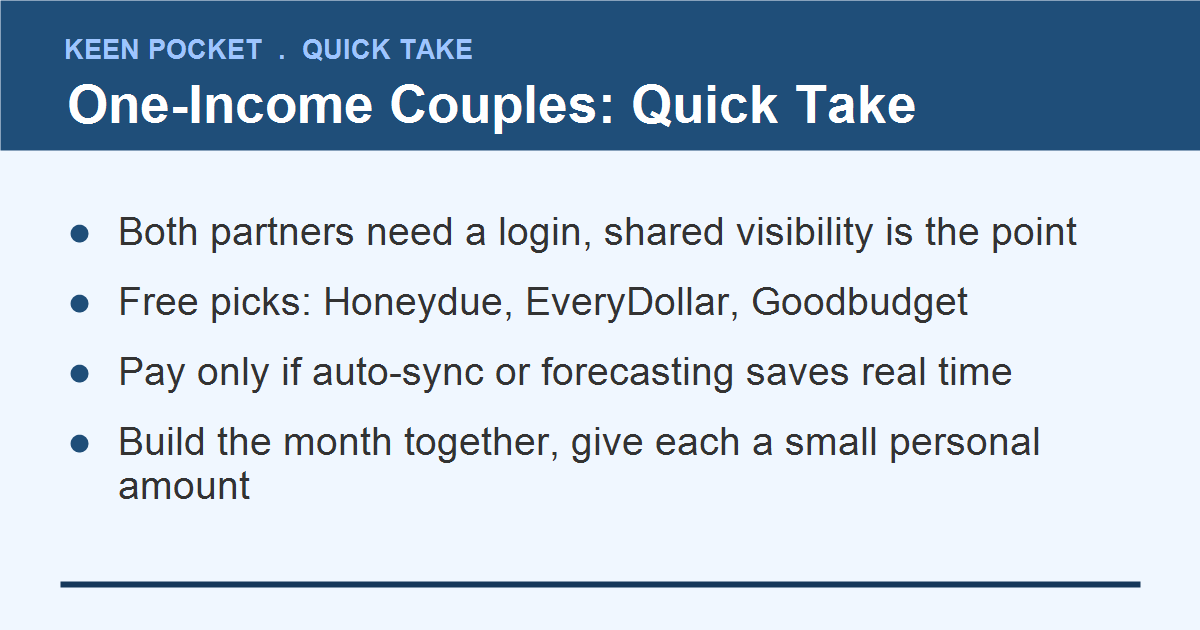
- On one income, an app’s most important job is shared visibility, so both partners see the same live budget, not a weekly verbal update.
- Start free. Honeydue, EveryDollar, and Goodbudget cover most single-income couples at $0.
- Pay only if it saves real time. Monarch or YNAB (about $99 a year) are worth it for automatic sync or forecasting, not for their own sake.
- Give the non-earner an equal login and each person a small no-questions personal amount.
- Send whatever you free up to an emergency fund, then a high-yield savings account.
Reviewed and updated for 2026. App prices and features were compared against each provider’s current terms and can change, so confirm pricing before you subscribe.
Why One Income Changes the App You Need
Single-earner households are now the minority. In Bureau of Labor Statistics data for 2024, both spouses worked in about half of all married-couple families, so living on one income already means running against the grain. A two-earner couple can get away with a loose system, because there is slack in the budget. On one income there usually is not. That changes what you should look for in three specific ways.
Shared visibility is not optional. The partner who stays home, studies, job hunts, or raises kids is still half the budget. They need their own login and a live view of the same numbers, not a weekly verbal update. Apps that give each partner a separate login under one subscription are built for exactly this.
Affordability is part of the math. Paying $15 a month for a budgeting app is easy to justify on two incomes. On one, that is $180 a year the household could have saved. Several excellent apps are free, and for a single-income couple, free is often the smart starting point.
Flexibility beats rigidity. One income tends to be tighter and sometimes irregular, especially if the earner is hourly or self-employed. An app that lets you roll money between categories without feeling like you failed keeps the habit alive through a rough month.
What to Look For in a Single-Income Couples App
Before comparing names, get clear on the features that actually matter when one paycheck runs the whole house. Use this as a quick checklist while you try free trials.
- Two logins, one bill. Both partners see the same live budget without paying twice.
- A free or low-cost tier. Ideally under $100 a year, or genuinely free.
- Real-time sync. A purchase shows up for both people within minutes, not at a weekly sit-down.
- Flexible categories. Easy to move money between envelopes when the paycheck is tight.
- Bill and subscription tracking. One place to catch the recurring charges that quietly drain a single income.
- A method you both understand. Zero-based, envelopes, or flexible, as long as both of you get it.
The 7 Best Budgeting Apps for Couples on One Income
These seven cover every style, from hands-off automation to strict every-dollar planning. Prices are current for 2026 and can change, so confirm before you subscribe.
1. Monarch Money, best overall shared dashboard
Monarch is the strongest all-around pick for couples on one income. Both partners get separate logins under a single subscription, and you land on the same household dashboard the moment either of you opens the app. It supports both flexible and category budgeting, so a spender and a planner can share one system without fighting over the rules. At around $99 a year or $14.99 a month, it is not free, but for a couple who wants one clean shared source of truth, it earns its keep.
2. YNAB, best for giving every dollar a job
YNAB runs on zero-based budgeting, where you assign every dollar of the one paycheck to a specific job before you spend it. That discipline is exactly what a tight single income needs. One subscription covers up to six people, so both partners are fully included. It costs $14.99 a month or $109 a year, and it has the steepest learning curve here, but couples who stick with it tend to find the missing money fast.
3. Honeydue, best free app built for couples
Honeydue was designed from the ground up for two people, which is rare. It is free, both partners see shared accounts and bills, and you can chat about a transaction right inside the app. For a single-income couple who mainly needs to coordinate and stay on the same page without paying anything, Honeydue is the easiest yes.
4. Goodbudget, best envelope system with no bank link
Goodbudget brings the old cash-envelope method into an app, and it does not connect to your bank at all, which some couples strongly prefer for privacy. You fund virtual envelopes from the one paycheck and both phones stay in sync. The free tier covers a generous number of envelopes, and Plus runs about $10 a month or $80 a year if you outgrow it.
5. EveryDollar, best simple free planner
EveryDollar keeps zero-based budgeting simple and offers a genuinely usable free version. You build the month, give every dollar a line, and track by hand. Couples can share the plan, and if you later want automatic bank sync you can upgrade through Ramsey+ for about $79.99 a year. For a one-income household that wants structure without a learning curve, it is a friendly starting point.
6. Simplifi by Quicken, best flexible spending plan
Simplifi is built around a flexible spending plan rather than strict envelopes, which suits couples whose single income wobbles month to month. It projects your cash flow forward, flags upcoming bills and subscriptions, and updates as money moves. It usually runs around $4 to $6 a month, often cheaper on an annual plan, making it one of the more affordable paid options.
7. Rocket Money, best for automation and canceling waste
Rocket Money is less a strict budget and more a money autopilot. It tracks spending, surfaces every recurring charge, and can even help cancel subscriptions you forgot about, which is a quiet win on one income. The core app is free, and premium is a pay-what-you-want $6 to $12 a month. Pair it with a stricter app if you want both automation and a real plan.
All 7 Apps Compared Side by Side
Here is how the picks stack up on the things that matter most to a single-income couple. Treat prices as typical 2026 rates, not promises.
| App | Free tier? | Typical cost | Method | Best for |
|---|---|---|---|---|
| Monarch | Trial only | ~$99/yr | Flexible or category | One shared dashboard |
| YNAB | Trial only | $109/yr | Zero-based | Every dollar a job |
| Honeydue | Yes | Free | Shared tracking | Free coordination |
| Goodbudget | Yes | Free or ~$80/yr | Envelopes | No bank link |
| EveryDollar | Yes | Free or ~$80/yr | Zero-based | Simple structure |
| Simplifi | Trial only | ~$4-6/mo | Flexible plan | Irregular income |
| Rocket Money | Yes | Free or $6-12/mo | Automation | Canceling waste |
How to Set Up a Shared Budget on One Income
The app is only half the job. A single-income budget works when both people help build it and both people can see it. Here is the setup that keeps the peace.
- Add the one income as household money. The moment the paycheck lands, it belongs to the budget, not to the earner. Naming it that way in the app matters more than it sounds.
- Give both partners a login. Whichever app you pick, set up separate access so the non-earner is never asking for a screenshot.
- Build the month together. Sit down once and assign the paycheck to categories as a team. Shared ownership is what stops the blame later.
- Automate the fixed bills. Rent, utilities, and insurance get their own protected categories so the flexible money is what is truly left.
- Set a no-questions personal amount for each of you. Even $20 each keeps a single income from feeling like a leash.
- Do a 10-minute weekly check-in. Open the app together, glance at the numbers, adjust, and move on.
A Realistic Monthly Setup: One Income, Two People
Numbers make it concrete. Say the single paycheck brings home $3,800 a month for a couple with no kids. Here is a middle-of-the-road plan, not a best case, using a rough 50/30/20 split adjusted for real life.
| Where it goes | Monthly amount | Share |
|---|---|---|
| Rent, utilities, insurance | $1,900 | 50% |
| Groceries, gas, phone | $760 | 20% |
| Fun, personal, eating out | $380 | 10% |
| Savings and emergency fund | $570 | 15% |
| Personal spending, $95 each | $190 | 5% |
That plan puts about $570 a month toward savings, which is roughly $6,840 a year on a single income. It is not effortless, but it shows the point of a shared app: when both partners can see that $570 line growing, the sacrifices in the fun category stop feeling like a fight and start feeling like a team win.
Free vs Paid: What One-Income Couples Actually Need
You do not have to pay to budget well as a couple. For a lot of single-income households, a free app is not a downgrade, it is the right call. Here is the honest split.
- You mainly need shared visibility and coordination
- Every $80 to $180 a year matters right now
- You are new to budgeting as a couple
- Honeydue, EveryDollar, or Goodbudget cover you
- Automatic bank sync saves you both real time
- You want one polished shared dashboard
- The income is irregular and needs forecasting
- Monarch, YNAB, or Simplifi fit how you think
Keeping the Non-Earner an Equal Partner
On one income, the partner who does not earn can quietly start to feel like a guest in the household finances. That feeling, more than any spreadsheet, is what turns budgeting into conflict. The right app helps, but the mindset around it matters more.
Start by naming the non-earner’s work out loud. Raising kids, running the home, studying, or job hunting are all real contributions, and the budget should treat that partner as a full co-owner of every dollar. A shared login is the smallest, most concrete way to say exactly that.
Give both people a real vote. When you build the month together, the non-earner should have equal say in the categories, not a summary handed over afterward. Couples who decide together are far less likely to resent the result later.
Protect equal personal spending. Even when the amounts are small, each partner getting the same guilt-free number, agreed on jointly, removes the sense that one person holds the purse. It is one of the simplest ways to keep a single income from turning into a quiet power imbalance.
Finally, review together, not as a report card. The weekly check-in works best as two teammates looking at the same screen, not one person explaining the numbers to the other. That small habit is what keeps the best budgeting app for couples on one income doing its real job, which is keeping you both on the same side.
What Most App Roundups Get Wrong
Most “best budgeting apps for couples” lists rank by features and pretty dashboards. For a one-income household, that is the wrong test entirely, and following it is why so many couples download an app, use it for two weeks, and quit.
On a single paycheck, only two things actually decide whether an app works. First, will both of you open it, not just the organized one? An app the non-earner never logs into has already failed, no matter how powerful it is. Second, does the cost make sense against a tight budget? A $15-a-month app that saves you nothing you could not do free is a subscription you will resent by spring.
So invert the usual advice. Do not start with the highest-rated app and force your life around it. Start with the free option you will both realistically use, prove the habit for a month, and only pay to remove friction you have actually felt. On one income, the boring, free app you both open beats the brilliant one that sits unused every single time.
Common Mistakes One-Income Couples Make
Most single-income budgets do not fail because of the app. They fail because of a few habits that are easy to fix once you name them.
- Only the earner has the login. This quietly makes the non-earner feel like a dependent instead of a partner. Always set up shared access.
- No personal spending money. A budget with zero guilt-free cash for each person never survives. Build in a small amount, even if it is tiny.
- Chasing the perfect app forever. The best budgeting app for couples on one income is the one you both actually open. Pick a free option and start this week.
- Forgetting the subscriptions. Recurring charges are where single incomes leak. Review them monthly, or let an app like Rocket Money surface them.
Where to Put What You Save
An app tells you what is left. The next step is deciding where it goes so the effort compounds instead of drifting back into spending. On one income, three destinations matter most.
First, build a starter emergency fund, since a single paycheck has no backup. Even a small cushion changes how a rough month feels. Our guide on building an emergency fund on a tight income lays out a realistic path. Second, park that fund somewhere it grows, not in checking. A high-yield savings account pays far more than a regular one. Third, once the cushion is set, start small on the future with our beginner investing guide. If you are still choosing a system, the broader best budgeting apps roundup and our budgeting tips for beginners pair well with this one.
Frequently Asked Questions
What is the best free budgeting app for couples on one income?
Honeydue is the easiest free pick because it was built for two people to share and coordinate. EveryDollar and Goodbudget are also free and strong if you want more structure through zero-based budgeting or virtual envelopes.
Should a one-income couple use joint or separate accounts in the app?
For a single income, a shared household view is almost always simpler, since all the money comes from one place. Keep a small personal spending category for each person so nobody feels monitored, but budget the paycheck as one team.
Is it worth paying for a budgeting app on one income?
Only if the paid features save you real time or stress. Automatic bank sync, forecasting for irregular pay, and one polished dashboard can be worth about $99 a year. If you just need visibility, a free app does the job.
How do we budget if the one income is irregular?
Budget off your lowest recent month, not your best one, and let the extra from bigger months fill savings first. Simplifi and YNAB both handle uneven income well because they plan forward and let you assign money only once it actually arrives.
Can we budget on one income without any app at all?
Yes. A simple shared spreadsheet or even a printed budget planner works if you both keep it current. An app mainly saves time and updates the numbers automatically. If free apps feel like too much, a paper planner you fill in together is a perfectly good place to start.
The Bottom Line
The best budgeting apps for couples on one income all share one trait: they make the money visible to both people, not just the earner. Start with a free option like Honeydue, EveryDollar, or Goodbudget, build the month together, and give each of you a little guilt-free cash. If automatic sync or forecasting would genuinely help, Monarch, YNAB, and Simplifi are worth the modest yearly cost. Whatever you choose, the app that works is the one you both open, because on a single income, being on the same page is the whole point.

Sarah Whitman is the founder and lead editor of Keen Pocket. She holds a BS in Accounting and Finance and writes plain-English guides on budgeting, saving, debt, and beginner investing.