

How to Stop Living Paycheck to Paycheck on Low Income

Last fact-checked: · Editorial standards
When your paycheck is gone before the next one arrives, the advice to just spend less can feel like a slap. On a low income, most of your money is already committed to rent, food, and getting to work before you have a single real choice to make. This is not a willpower problem. It is a math problem, and math problems can be solved. And if your income is irregular on top of tight, our guide to budgeting for irregular income tackles the swings directly.
You are also not alone in it. According to the Bank of America Institute, about 29% of lower-income households were living paycheck to paycheck in 2024, up from 27% two years earlier, as wages for lower earners rose only about 1% while the cost of living climbed near 3%. The ground is genuinely moving under people, and it is not your fault.
This guide is a plan for how to stop living paycheck to paycheck on low income, built around the one thing that actually breaks the cycle: a small buffer. Not a fantasy budget, not a second job you do not have time for. A realistic, step-by-step path from surviving each month to finally getting a little ahead.
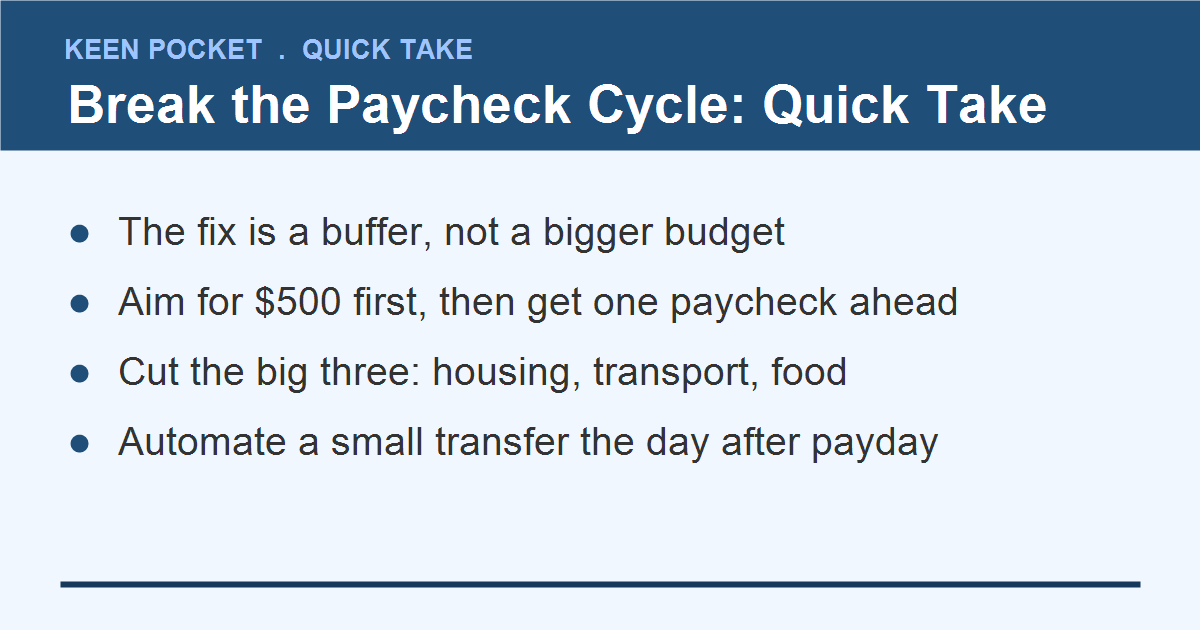
- The cycle breaks with a buffer, not a bigger budget. A $500 cushion turns most emergencies back into inconveniences.
- Aim for $500 first, then one full paycheck ahead. Skip the “three to six months” goal until later.
- Cut the big three, housing, transport, and food, not the small joys.
- Automate a small transfer the day after payday, so it happens before the money can vanish.
- Claim the EITC and local help you qualify for, and add income where you realistically can.
Reviewed and updated for 2026. Figures come from the Bank of America Institute, the CFPB, and the IRS.
Why the Cycle Is So Hard to Break on a Low Income
Breaking the paycheck-to-paycheck cycle on a low income is hard for a specific, structural reason, and naming it helps. When you have no buffer, every surprise becomes a crisis, and every crisis pushes you backward.
The car needs a repair, so the electric bill is late. The late fee eats next week’s grocery money. You put food on a credit card, and now the minimum payment is one more fixed cost. None of that is bad budgeting. It is what happens when there is zero cushion between you and the next unexpected bill.
That is why the fix is not another list of things to cut. It is building the one thing that stops a bad week from turning into a bad year: a small pool of money that absorbs the shock. Everything below is in service of that.
The One Move That Actually Breaks the Cycle
If you do nothing else from this guide, do this: build a small starter buffer, even slowly. A cushion of just $500 changes everything, because it turns most emergencies back into mere inconveniences. The flat tire stops being a debt spiral and becomes an annoying Tuesday.
The goal is not three to six months of expenses. That number is real, but it is a mountain when you are living on a low income, and staring at it just makes you quit. The first target is $500. The second is getting one full paycheck ahead, so you are spending money you earned last month, not money you need this second. Those two milestones, in that order, are what break the cycle for good.
Step 1: See Where the Money Actually Goes
You cannot fix a leak you cannot see. For two weeks, write down every dollar that leaves your account, no judgment, just facts. Most people are shocked by two or three categories that quietly add up.
You do not need an app or a spreadsheet if those feel like too much. A note on your phone or a scrap of paper by the door works. The point is not precision, it is awareness. Once you can see the money, you can direct it.
Step 2: Cut the Big Three, Not the Small Stuff
Cutting coffee will not save a low income. The money is in the big three: housing, transportation, and food. A small percentage off a big number beats giving up every tiny pleasure you have left.
Step 3: Build a $500 Buffer, Even Slowly
Take whatever you freed up in Step 2 and send it, automatically, to a separate savings account the day after payday. Even $15 a week gets you to $500 in about eight months, and every dollar in there is a dollar an emergency cannot turn into debt.
Keep this money somewhere slightly annoying to reach, ideally a high-yield savings account at a different bank than your checking. The one-day transfer delay is a feature, because it gives you a beat to decide whether a purchase is truly an emergency.
Step 4: Get One Paycheck Ahead
Once the $500 buffer stands, the next milestone is the real cycle-breaker: getting one full paycheck ahead. This means building up enough that you pay this month’s bills with last month’s income. When you get there, the constant “will it clear?” anxiety simply ends.
You do it the same slow way, by living on a little less than you earn and letting the gap accumulate in a dedicated account until it equals about one month of core bills. It can take a year or more on a low income, and that is fine. The day you cross it, you are no longer living paycheck to paycheck at all.
It helps to picture that finish line, because it carries you through the slow middle. Being one paycheck ahead means the rent money is already sitting in your account before the bill even arrives. It means a surprise expense becomes a decision instead of a panic. It means you can think a month out rather than a day out, and that mental space is where every bigger goal, paying off debt, saving for a car, moving somewhere better, finally becomes possible. A buffer does not just protect your money. It gives back the attention that constant money stress was quietly stealing.
Step 5: Add Income Where You Realistically Can
Cutting has a floor. Income does not. You cannot cut your way below your rent, so at some point the fastest path forward is earning a little more. On a low income, the highest-value moves are usually the boring ones.
Ask for the raise or the extra shift you have been avoiding, since a $1 an hour bump is roughly $160 a month before tax. Claim every credit you qualify for, especially the Earned Income Tax Credit, which many low earners leave unclaimed. And if you have any spare hours, a flexible weekend side hustle can fund the buffer faster without wrecking your main job.
Step 6: Automate So It Never Depends on Willpower
The final step is to make the whole system run without you. Willpower is a terrible savings plan, especially when you are tired and stressed. Automation does the remembering for you.
Set the buffer transfer to happen the day after payday, before the money can disappear. Put fixed bills on autopay so late fees stop stealing from you. The goal is a system where staying a little ahead is the default, not a decision you have to win every single week. And if you are paid once a month, our guide on how to manage money on a monthly paycheck applies the same idea to one big deposit.
The 6 Steps, Side by Side
Here is the whole plan in one view, roughly in the order that gives you the fastest relief per unit of effort.
| Step | Effort | Impact | Timeline |
|---|---|---|---|
| Track spending | Low | Foundational | 2 weeks |
| Cut the big three | Medium | High | 1 month |
| Build $500 buffer | Steady | Very high | 6-9 months |
| Get one month ahead | Steady | Cycle-breaking | 12+ months |
| Add income | Higher | High | Ongoing |
| Automate it all | One-time | Keeps it alive | 1 hour |
A Realistic Timeline to Breaking the Cycle
Say you free up $60 a month from the big three and automate it. Here is a realistic, not best-case, path out of the cycle from there.
- Months 1 to 2: Track spending, find the $60, open a separate high-yield account, and turn on autopay for bills. Nothing feels different yet, but the machine is built.
- Months 3 to 8: The buffer climbs past $300, then $500. The first small emergency hits and you cover it in cash instead of credit. That is the moment the cycle cracks.
- Months 9 to 18: With a raise or a few side-gig hours added, the surplus grows toward one month of core bills. Somewhere in here, you start paying this month with last month’s money.
- Month 18 and beyond: You are officially one paycheck ahead. The background anxiety is gone, and you can finally aim at bigger goals.
Claim the Help That Frees Up Cash
Before you try to cut deeper, make sure you are not leaving money on the table. Programs exist precisely so a low income does not become a debt trap, and using them is smart, not shameful.
The Earned Income Tax Credit is worth hundreds or thousands to many low earners and is often unclaimed. SNAP can free up part of your grocery budget, and most states run utility, phone, and internet assistance that quietly lowers fixed bills. Dialing 211 connects you to local resources in one call. Every dollar these cover is a dollar that can go straight to your buffer.
When You Come Up Short, Skip the Payday Loan
On a low income, a short month is not an “if,” it is a “when.” The worst possible move in that moment is a payday loan or a high-fee cash advance. According to the Consumer Financial Protection Bureau, a typical two-week payday loan can carry an annual rate around 400%, and most borrowers end up re-borrowing again and again, which is exactly the debt trap you are trying to escape.
Instead, work the problem in order. Cover the true essentials first: housing, utilities, food, and getting to work. Everything else can wait a beat. Then call the billers you cannot pay in full and ask for a due-date change or a payment plan, which is almost always cheaper than a loan. Many utilities and medical providers have hardship programs that are never advertised, so the only way to find them is to ask.
If you truly must borrow, a small-dollar loan from a credit union, a paycheck advance from your employer, or a fee-free advance app all beat a payday lender by a mile. The goal is to get through a hard month without bolting a 400% cost onto next month’s pile.
How to Ask a Landlord or Biller for Breathing Room
Most people never ask, and that is a costly mistake. Landlords, utilities, and lenders deal with short months constantly, and a calm, early conversation almost always goes better than silence followed by a missed payment.
Reach out before the due date, not after. Keep it brief and honest: say an unexpected expense came up, name the exact date you can pay, and ask whether a short extension or a split payment is possible. You are far more likely to get a yes when you arrive with a specific plan than when you go quiet and hope.
For rent, ask whether you can split this month into two payments, or shift your due date to line up with payday. For utilities, ask directly about budget billing, which smooths seasonal spikes into an even monthly amount, and about any hardship or low-income rate you might qualify for. For a credit card, one call to request a lower rate or a hardship plan can slow the bleeding while you rebuild the buffer. None of this is a sign of failure. It is exactly what financially stable people do, just earlier and without shame.
What Most Paycheck-to-Paycheck Advice Gets Wrong
Nearly every article on this topic opens with a budgeting worksheet and a lecture about skipping coffee. On a low income, that advice quietly assumes the problem is overspending. Usually it is not. The problem is that there is no cushion, so every surprise becomes new debt.
That distinction changes everything. If your issue were frivolous spending, a stricter budget would fix it. But when rent, food, and transport already eat almost the whole check, cutting a few dollars of “wants” does not touch the real mechanism trapping you, which is that a single unexpected bill has nowhere to land except a credit card. A tighter budget on top of no buffer just makes a hard life harder without breaking the cycle.
The fix is structural, not moral. Build the smallest possible buffer, automate it so willpower is not involved, and protect it fiercely. Once even $500 sits between you and the next emergency, the whole dynamic shifts, and the budgeting advice everyone leads with finally starts to work. Get the order right, and you stop treating a math problem as a character flaw.
Common Mistakes That Keep You Stuck
- Trying to save the big number first. Chasing six months of expenses feels hopeless and makes people quit. Aim for $500, then one paycheck.
- Cutting joy instead of cost. Slashing every small pleasure burns you out fast. Go after the big three instead.
- Relying on willpower. If saving depends on remembering, it will fail on a hard week. Automate it.
- Ignoring income. You can only cut so far. A raise, a shift, or a credit you qualify for often does more than months of trimming.
Where to Send the First Money You Free Up
The order matters. Put the first freed-up dollars into the $500 buffer, because that is what stops new debt from forming. Keep it in a high-yield savings account so it grows while it waits.
Once the buffer and the one-month cushion are in place, shift toward the future. Our guide on building an emergency fund on a tight income extends this plan, and how to save money on a low income covers deeper cost cuts. If debt is part of your cycle, the debt snowball method pairs well with the buffer. And if student loans are part of the squeeze, here are ways to lower student loan payments without refinancing.
Frequently Asked Questions
How do I stop living paycheck to paycheck on a low income if there is nothing left to save?
Start smaller than feels worth it. Even $5 a week builds the habit and the buffer, and pairing tiny automatic saving with one cut from the big three usually finds more room than expected. The goal at first is momentum, not amount.
How long does it take to break the cycle?
A $500 buffer typically takes six to nine months of small automatic transfers on a low income, and getting one paycheck ahead often takes a year or more. That is normal. Slow and steady is what actually lasts.
Should I pay off debt or build the buffer first?
Build a small $500 buffer first, then attack high-interest debt while keeping a tiny automatic transfer going. If a credit card is the culprit, here is exactly how to pay off 5000 credit card debt on low income. Without any buffer, the next emergency just puts new debt on the card, so the cushion has to come first.
Is it worth budgeting when income barely covers the basics?
Yes, because a budget shows you the two or three categories where a little room is hiding. On a low income, awareness plus one automated transfer is often the difference between staying stuck and slowly climbing out.
The Bottom Line
Learning how to stop living paycheck to paycheck on low income is not about a stricter budget or giving up every small comfort. It is about building one thing, a buffer, that stops each emergency from throwing you backward. Track the money, cut the big three, automate a small transfer, and aim for $500, then one full paycheck ahead. It is slow, and it is absolutely possible. The day a flat tire is just an annoyance instead of a disaster, you will know the cycle is finally broken.

Sarah Whitman is the founder and lead editor of Keen Pocket. She holds a BS in Accounting and Finance and writes plain-English guides on budgeting, saving, debt, and beginner investing.