
How to Manage Money When You’re Paid Once a Month

Last fact-checked: · Editorial standards
Getting paid once a month sounds simple until you are staring at day 19 with a checking account that has already given up. One big deposit has to stretch across rent, groceries, gas, bills, and everything else for thirty-plus days, and the math gets tense fast if you spend like the money is endless in week one.
You are also in the minority, which is part of why it feels harder. As of early 2023, only about 10% of U.S. employers paid monthly, while biweekly covered 43%, according to the Bureau of Labor Statistics. Most budgeting advice is written for people paid every two weeks, so a monthly schedule needs its own playbook.
The good news is that monthly pay is actually easy to manage once you treat it like a calendar problem, not a willpower problem. This guide shows you how to manage money on a monthly paycheck by planning the whole month up front, splitting it into two mini-paydays, and building a small buffer so the mid-month crunch simply stops happening.
Plan the whole month the day you get paid
On a monthly schedule, payday is the one moment you can see the entire month at once, so use it. Before you spend a dollar, give every dollar a job: fixed bills, savings, sinking funds, and what is left for spending. That single planning session is what keeps week four from being a panic.
A zero-based approach fits monthly pay perfectly, since you are assigning one lump instead of piecing together several. Income minus every planned expense and transfer should land at zero, with every dollar named. When the plan is done on day one, the rest of the month is just following it.
Pay or schedule your fixed bills right after payday
The safest place for your bill money is out of your account before you can spend it. As soon as your paycheck lands, pay or schedule every fixed bill you can: rent or mortgage, utilities, insurance, phone, and loan minimums. Front-loading them means the scary obligations are handled while the account is full.
Where a biller lets you choose the due date, move it to the first few days after your payday. If a payment falls awkwardly late in the cycle, a quick call to change the date can line everything up. The Consumer Financial Protection Bureau recommends this kind of automatic, front-loaded setup to keep a budget on track.
Handle on payday, in this order
Automating this once means you are not making the same decisions under pressure every month. The bills simply take care of themselves.
Split your month into two mini-paydays
This is the trick that changes everything for monthly pay. Instead of giving yourself all of your spending money on day one, split it in half and release the second half mid-month. You create a second payday out of thin air, and your brain stops treating week one like a windfall.
Say your discretionary spending for the month is $800. Keep $400 accessible now, and park the other $400 in savings or a separate account with a reminder to move it back on the 15th. When the money reappears mid-month, it feels like getting paid again, right when the first half is running low.
All your spending money on day one, gone by day 18, then two lean weeks of stress.
Half now, half on the 15th, so the money paces itself across the whole month.
If two feels too loose, split into four weekly releases instead. The point is the same: never hand your month-one self the whole month’s spending money.
Turn annual costs into monthly sinking funds
The expenses that blow up a monthly budget are the ones that do not arrive monthly. Car insurance every six months, registration, holiday gifts, the annual subscription: they feel like surprises, but they are perfectly predictable. Sinking funds tame them.
Add up your known once-a-year and twice-a-year costs, divide by twelve, and set that amount aside every payday into a labeled savings spot. When the big bill lands, the money is already waiting, and it never has to fight your rent for space in a single paycheck.
💡 Quick Tip
List every non-monthly bill, total it, and divide by 12. Transfer that amount to a sinking fund on payday so a $600 insurance bill is really twelve painless $50 set-asides, not one ugly month.
Build a one-week buffer to kill the mid-month crunch
The permanent fix for running out mid-month is to get one week ahead of yourself. A buffer of roughly a week of spending sits in your checking account and quietly absorbs the timing gaps, so a slow week or an early bill never tips you negative.
It matters because the margins are thin for a lot of people. In the Federal Reserve’s 2024 survey, only 63% of adults could cover a surprise $400 expense with cash on hand, meaning nearly four in ten could not. A small buffer is what turns a $400 scare into a shrug.
Get one week ahead and the mid-month crunch disappears. You start spending last month’s money, not this week’s.
Build it slowly by keeping a little unspent each month until the cushion holds. Once it exists, you are always operating from money you already have, not money you are waiting on.
Ration with separate accounts or envelopes
Willpower fades over thirty days, so let structure do the rationing for you. The cleanest setup uses separate accounts: one for bills, one for spending, and one for savings and sinking funds. When your payday transfers split the money automatically, each job has its own space and cannot borrow from another.
If you prefer cash, the envelope method does the same thing physically. Divide your spending into labeled envelopes at the start of the month, and when an envelope is empty, that category is done until next payday. Both approaches turn one overwhelming balance into small, clear limits.
A simple three-account split
Pick whichever you will actually keep up with. The best system is the one that survives a busy week, not the one that looks tidiest on paper.
Time your credit card to your payday
Used carefully, a credit card is a natural fit for monthly pay, because its billing cycle can act as a free short-term float. Cards typically give around a 21-day grace period between the statement closing and the due date, so charges you make can be paid off weeks later with no interest.
The rule that keeps this safe is simple: only charge what you already have the money for, and pay the statement in full every month from that same paycheck. Done right, you smooth out timing and maybe earn rewards. Done wrong, it becomes a slow-motion debt trap.
Charge only what your budget already covers.
Pay the statement in full every month.
Line the due date up with your payday.
Carrying a balance to “get through” the month.
Charging money you do not actually have.
Paying only the minimum and rolling interest.
If carrying a balance is a temptation, skip the card and stick to the split-and-buffer system. The float is only worth it when you never pay interest for it.
Survive the long month and payday drift
Monthly pay has two quiet traps built into the calendar. Some months are 31 days instead of 30, and paydays can shift when they land on a weekend or holiday, which occasionally stretches the gap between checks to five weeks. Either one can catch an unprepared budget.
Plan for the longest month, not the average one. If your buffer and plan can handle a 31-day stretch with a slightly late deposit, every normal month feels easy by comparison. Know your employer’s rule for weekend paydays so a shift never surprises you.
⚠️ Watch Out
Build your plan around a 31-day month and a possibly delayed payday. The buffer is what covers the extra days, so a long month becomes a non-event instead of an overdraft.
Every method compared at a glance
Here is the whole system in one view, so you can start with the piece that fixes your biggest pain point. None of these takes long to set up, and together they remove almost every reason a monthly budget falls apart.
| Method | What it fixes | Effort |
|---|---|---|
| Plan the month on payday | Overspending week one | 30 min monthly |
| Front-load fixed bills | Missing or late bills | One-time setup |
| Split into two mini-paydays | The mid-month crunch | Low |
| Monthly sinking funds | Surprise annual bills | Low |
| One-week buffer | Timing gaps and overdrafts | Builds over time |
| Separate accounts or envelopes | Categories bleeding together | Low |
Start with the split and the buffer if you only do two things. Those two solve the classic problem of money that vanishes long before the next deposit.
A realistic month on a monthly paycheck
Numbers make the system click. Picture a $3,000 monthly take-home paycheck, and watch how the same money paces itself when you plan and split it instead of spending freely.
Bills leave on day one, savings transfers before you can touch them, and your $800 of spending arrives as two $400 waves. That mid-month release lands right as the first half runs thin, so week three feels like a fresh start instead of a famine. Your real numbers will differ, but the shape is what matters.
Mistakes that sink a monthly budget
Most monthly-pay disasters come from the same handful of avoidable slips. Knowing them in advance is half the battle, because each one has a simple fix you have already read about above.
- ▸Treating week one like a windfall and spending fast while the account looks full.
- ▸Forgetting the annual bills, so a single insurance or registration charge wrecks a month.
- ▸Running with no buffer, so any timing gap or late deposit becomes an overdraft.
- ▸Leaving bills due late in the cycle, right when the account is at its emptiest.
Notice that none of these is about earning more. They are all about timing and structure, which is exactly what a monthly schedule lets you control. Fix the timing, and the same income suddenly stretches.
Where the leftover goes and what to do next
When you stop running out mid-month, something new happens: money is left over. That surplus is the whole reward, and where you send it decides whether monthly pay stays stressful or slowly builds real stability.
Plan the whole month, split it in two, and get one week ahead. That is the entire game for monthly pay.
Send the leftover somewhere with a purpose. Fill the buffer first, then build savings using our guide on breaking the paycheck-to-paycheck cycle, put every dollar to work with a zero-based budget template, and lean on the cash envelope system if you spend better with hard limits.
📌 How we researched this
Pay-frequency figures come from the U.S. Bureau of Labor Statistics, and the $400 emergency figure is from the Federal Reserve’s 2024 Survey of Household Economics and Decisionmaking, with budgeting guidance from the CFPB. The worked example uses round numbers for illustration; your real amounts will differ. This is general education, not personalized financial advice.
Frequently asked questions
How do I manage money on a monthly paycheck?
Plan the entire month on payday, pay or schedule your fixed bills immediately, and split your spending money into two mini-paydays by releasing the second half around the 15th. Add monthly sinking funds for annual bills and a one-week buffer, and the mid-month crunch mostly disappears.
How do I stop running out of money before the end of the month?
Two moves fix this. First, split your spending money so you do not hand week-one you the whole month’s cash. Second, build a one-week buffer so you are always spending money you already have. Together they end the classic mid-month scramble.
Should I split my monthly paycheck into two?
Usually yes, at least for spending money. Keeping half accessible and releasing the rest mid-month creates a psychological second payday that paces your spending. If two feels loose, split into four weekly amounts instead. Bills and savings still come out first, up front.
How big should my buffer be if I get paid monthly?
Aim to get about one week of spending ahead as a starting buffer, then grow it toward a fuller emergency fund. Even a small cushion covers a long month, a late deposit, or a surprise bill, which are exactly the things that overdraw a monthly budget.
When should I schedule my bills on monthly pay?
Right after your paycheck lands, when the account is full. Set fixed bills to auto-pay in the first few days, and move any awkward due dates to just after payday. Front-loading bills protects them from getting spent and keeps late fees off your record.
Is it harder to budget monthly than biweekly?
It feels harder because one lump must last longer, but it is arguably simpler once you plan it. You budget once a month instead of twice, and the split-the-month method rebuilds the natural pacing that biweekly pay gives you automatically.
What if my bills are due at all different times of the month?
You have two options. Call your billers and move as many due dates as you can to just after payday, which most companies allow. For the ones that will not move, cover them from your bills account, which you funded in full on payday, so their timing no longer matters to your spending.
The bottom line
Monthly pay is not a curse, it is just a different rhythm, and it rewards planning over willpower. When you learn how to manage money on a monthly paycheck, the stress of watching one deposit drain away gets replaced by a calm, repeatable system you set up once and follow.
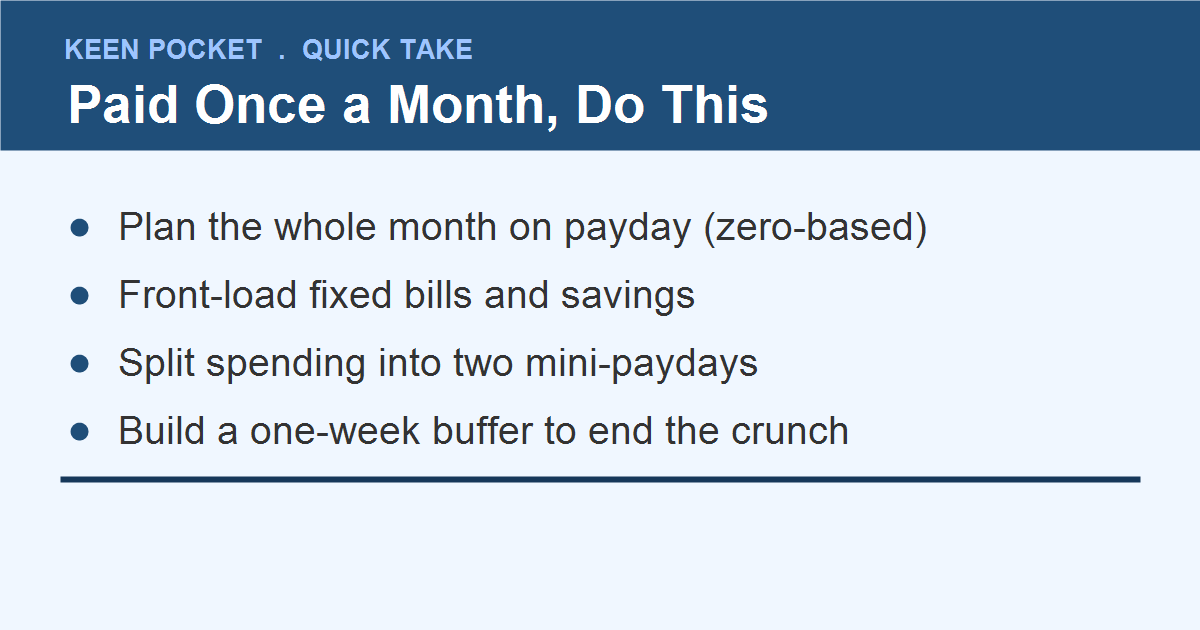
Plan the whole month the day you are paid, front-load your bills, split your spending into two mini-paydays, and build a one-week buffer. Do those four things and the mid-month crunch stops being your monthly reality, no matter how you happen to get paid.
Sarah is the founder and lead editor of KeenPocket, where she writes practical, plain language guides on budgeting, saving, and cash-flow timing for people making one paycheck stretch. KeenPocket articles are educational and are not personalized financial advice; for choices about your own situation, consider speaking with a licensed professional. Last reviewed: August 2026.

Sarah Whitman is the founder and lead editor of Keen Pocket. She holds a BS in Accounting and Finance and writes plain-English guides on budgeting, saving, debt, and beginner investing.