

Budgeting for Irregular Income: Freelancers and Gig Workers (7 Rules)

Last fact-checked: · Editorial standards
Nearly every budgeting guide quietly assumes the same thing: a steady paycheck that lands on the same day for the same amount. If you drive rideshare, freelance, or piece together gig work, that assumption is exactly what makes normal advice fall apart. Your income does not arrive on a schedule, so a budget built for one will not hold.
You are also in enormous company. About 64 million Americans freelanced in 2023, roughly 38% of the workforce, according to Upwork. Budgeting for irregular income is not a niche problem; it is how a huge share of the country actually gets paid.
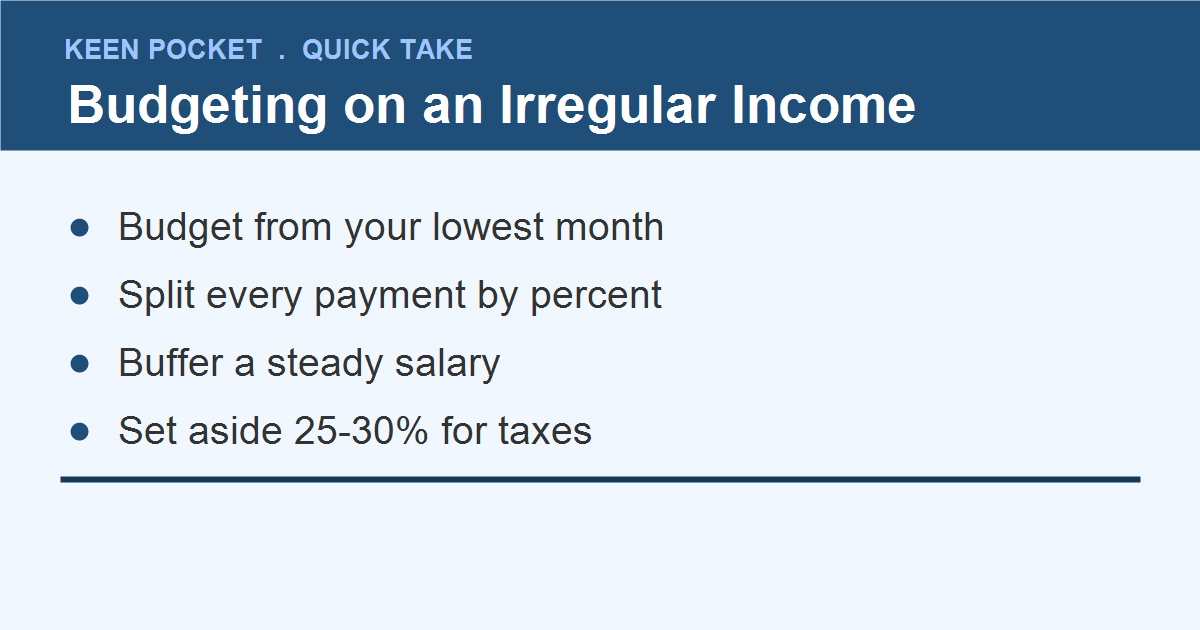
The fix is not more willpower. It is a system designed for the swings: budget from your lowest month, split every payment by percentage, and use a buffer to pay yourself a steady “salary.” This guide walks through seven rules for budgeting for irregular income freelancers and gig workers can actually stick to, plus a free spreadsheet. One note first: the tax figures here are general education, not personalized tax advice, so confirm your own numbers with a professional.
Why normal budgeting fails on a variable income
A standard budget starts with one number: your monthly income. When that number is different every month, the whole plan wobbles. You either overspend after a great month or panic after a slow one, and taxes lurk as a nasty surprise every spring.
The trap is emotional as much as mathematical. A $6,000 month feels like permission to relax; a $2,000 month feels like a crisis. Budgeting for irregular income means smoothing that rollercoaster so your spending stays calm even when your deposits do not.
💡 Quick Tip
Stop budgeting the money you hope to earn. Budget the money that has already landed. A variable-income plan reacts to real deposits, never to projections.
Rule 1: Budget from your lowest month, not your average
The single biggest shift is choosing the right baseline. Most people budget off their average month or, worse, a good one. On an irregular income, that quietly sets you up to overspend the moment a slow stretch hits.
Instead, look back over the last 6 to 12 months and find your lowest realistic monthly income. Build your essential budget, rent, food, utilities, minimums, to fit inside that number. Anything above it in a given month is a bonus, not the plan.
You commit to spending your $6,000 months, then scramble and borrow when a $2,000 month arrives.
Essentials fit your worst month, so every better month adds a cushion instead of a crisis.
This one change removes most of the fear. When your fixed life already fits your leanest month, a slow stretch stops being an emergency and becomes just a quieter month.
Rules 2 and 3: Split every payment, then pay yourself a salary
Here is the engine of the whole system, and the part most generic guides skip. Do not spend a payment when it lands. Split it by percentage first, then let a buffer account pay you a steady wage.
Every time money comes in, divide it before you touch it. A simple, reliable order looks like this.
Taxes first, about 25% to 30%. Move it to a separate tax account the moment you are paid, before it feels like yours.
Business costs next. Software, gas, supplies, fees. Set aside what this gig actually costs to run.
Fill your buffer. Send the rest to a buffer account whose only job is smoothing your income.
Pay yourself a set salary. Once a month, move a fixed amount from the buffer to checking. That is your paycheck.
The buffer is the magic. In fat months it fills up; in lean months it tops you off. You live on a steady, predictable salary while your actual income bounces around behind the scenes. That is the whole point of budgeting for irregular income: your lifestyle runs on a flat line, not a jagged one.
Rule 4: Set aside taxes on every single payment
This is the one that bites freelancers hardest, because no employer is withholding for you. On top of income tax, the self-employment tax alone is 15.3%, covering Social Security and Medicare, per the IRS. Skip the set-aside and April becomes a disaster.
Most gig workers owe estimated quarterly taxes, so keep that money in its own account and pay on schedule. Setting aside 25% to 30% of every payment is enough for most people earning a modest freelance income, and any leftover at year end is a pleasant surprise rather than a bill.
Rule 5: Separate your accounts into a simple system
Trying to run all of this from one checking account is chaos. The cleanest setup uses four accounts, each with one clear job, so the percentages actually happen instead of just being a good intention.
Money flows in one direction: income hits business, taxes and buffer are skimmed off, and a fixed salary lands in personal. Keeping business and personal separate also makes tax time far easier and your books far clearer, which matters more the more you earn.
You do not need fancy banking for this. Most online banks let you open several free savings accounts and nickname them, and many let you automate transfers by percentage the moment a deposit lands. Set those rules up once and the whole split happens on autopilot, which is exactly what keeps a busy freelancer from skipping it.
Rule 6: Build a bigger emergency fund than a salaried worker
A steady employee can lean on the classic three to six months of expenses. When your income itself is the unpredictable part, you need more runway, because a slow patch can last weeks with no warning.
| Question | Steady paycheck | Irregular income |
|---|---|---|
| Emergency fund | 3 to 6 months | 6 to 12 months |
| Why | income is predictable | income can pause for weeks |
| Extra buckets | usually just the one | plus a tax and buffer fund |
| Where to keep it | high-yield savings | high-yield savings |
Your buffer and your emergency fund are different tools. The buffer handles normal ups and downs from month to month; the emergency fund is for the real shocks, a dead laptop, a slow season, a medical bill. Build the buffer first, then grow the emergency fund from your surplus months.
How to survive a truly slow month
Even with a buffer, a long dry spell can drain it. That is not a failure of the system; it is exactly what the system is built to weather. The order you cut in matters, so decide it now, calmly, instead of in a panic later.
⚠️ Watch Out
Never raid the tax account to cover a slow month. That money is already owed. Trim discretionary spending first, then dip into the emergency fund, and leave the tax bucket untouched.
When the buffer runs low, drop to a bare-bones version of your budget: essentials only, pause the extras, and lean on the emergency fund if you must. Then rebuild the buffer first thing when work returns. Handled this way, budgeting for irregular income turns a scary month into an uncomfortable but survivable one.
A worked example: smoothing $2,000 and $6,000 months
Numbers make the buffer click. Picture a freelancer whose take-home swings between a $2,000 low month and a $6,000 high month, who decides to pay themselves a steady $3,000 salary. Here is how the buffer does the work. Figures are illustrative.
These figures are after taxes are already set aside, so the buffer only ever handles your take-home. A couple of strong months early on fills the buffer, and from then on it self-corrects: high months refill it, low months draw it down, and your paycheck never changes. That stability is worth more than any single big month.
How the numbers work: the example assumes take-home swings between $2,000 and $6,000 and a $3,000 monthly salary, after roughly 25% to 30% is already set aside for taxes per IRS guidance. Your own salary should come from your real lowest month.
Common budgeting mistakes freelancers make
Most budgeting for irregular income goes wrong in a handful of predictable ways, and every one is avoidable once you see it coming. Sidestep these and the system runs almost on its own.
Split every payment the day it lands.
Pay yourself the same salary in every month.
Keep tax money in its own untouchable account.
Inflating your lifestyle after one great month.
Mixing business and personal in one account.
Forgetting quarterly taxes until April.
Lifestyle creep is the sneakiest one. A run of strong months tempts you to raise your salary, but if you set it too high, the first slow patch breaks the whole system. Raise your salary only after the buffer is comfortably full, never before.
Rule 7: Give your surplus a job in the good months
The final rule is what turns survival into progress. In a strong month, once taxes, buffer, and salary are handled, you will have money left over. Decide where it goes before it arrives, or it quietly evaporates.
Live on your lowest month, save your best months, and let a buffer turn a jagged income into a steady paycheck.
Send surplus first to your emergency fund, then to debt, then to investing for retirement, which freelancers have to fund entirely themselves. Even investing small amounts each month compounds, and a zero-based budget gives every surplus dollar a job so none of it slips away.
Use the free irregular-income budget spreadsheet
Reading about the system is one thing; running it is easier with a template that does the math. The free spreadsheet below is built around these exact rules, so you can plug in each payment and watch it split itself.
What the spreadsheet does
⬇ Download the free irregular income budget spreadsheet (.xlsx)
Fill it in for one month and the system stops being abstract. You will see your real numbers do exactly what the rules promise, which is what makes budgeting for irregular income finally feel manageable.
Frequently asked questions
How do you start budgeting for irregular income?
Find your lowest realistic month from the last 6 to 12 months and build your essentials to fit it. Then split every payment as it arrives: taxes first, business costs, buffer, and a fixed salary. Living on that steady salary instead of your actual deposits is the core of the whole method.
What percentage of freelance income should I save for taxes?
Setting aside 25% to 30% of each payment covers most modest freelance incomes, since the self-employment tax alone is 15.3% on top of income tax. Keep it in a separate account and pay estimated taxes quarterly. Confirm your exact rate with a tax professional, since it varies by income and state.
What is a buffer fund and how big should it be?
A buffer is a holding account that smooths your income so you can pay yourself a steady salary. Aim to build it up to at least one full month of your salary, then grow it toward two or three. That cushion is what lets a low-earning month feel like nothing.
How much emergency fund do gig workers need?
More than salaried workers, usually 6 to 12 months of essential expenses, because your income can pause with little warning. Keep it separate from your buffer and your tax money, in an accessible high-yield savings account, and build it up during your stronger months.
Should I use the 50/30/20 rule with an irregular income?
You can, but apply it to your fixed salary rather than each fluctuating payment. Set your salary from your lowest month, then split that steady number into needs, wants, and savings. Applying percentages to your take-home salary is far more stable than applying them to unpredictable deposits.
How do I budget if I am brand new to freelancing with no income history?
Start conservative and adjust. Estimate the lowest amount you are fairly confident you can earn, build essentials to fit it, and set aside 30% for taxes from the very first payment. As a few months of real numbers come in, your lowest month becomes clearer and you can fine-tune the salary you pay yourself.
What is the best app for budgeting on a variable income?
The best tool is whichever you will actually use, and a simple spreadsheet like the one above beats a fancy app you ignore. Look for one that lets you budget by percentage and track separate buckets. The system matters far more than the software.
The bottom line
An unpredictable income is not a reason to skip budgeting; it is the reason to budget more deliberately. The seven rules here, budget from your lowest month, split every payment, buffer a steady salary, set aside taxes, separate your accounts, oversize your emergency fund, and give surplus a job, turn chaos into a calm, repeatable routine.
Start with one payment. Split it the moment it lands, move your salary from the buffer, and let the spreadsheet keep score. That is all budgeting for irregular income freelancers and gig workers really needs: a system that expects the swings instead of being surprised by them.
Sarah is the founder and lead editor of KeenPocket, where she writes practical, jargon-free money guides for real, everyday budgets. Every figure in this article is tied to a named, current primary source such as the IRS, Federal Reserve, or BLS, and the math is shown so you can check it. KeenPocket articles are educational and are not personalized financial or tax advice; for choices about your own situation, consider speaking with a licensed professional.
Last reviewed: August 2026

Sarah Whitman is the founder and lead editor of Keen Pocket. She holds a BS in Accounting and Finance and writes plain-English guides on budgeting, saving, debt, and beginner investing.