
How to Build Credit With a Secured Credit Card for Beginners

Last fact-checked: · Editorial standards
Starting from zero credit feels like a locked door with no key. Landlords, car lenders, even some phone plans want to see a track record you have not been allowed to build yet. A secured credit card is the tool that quietly opens that door, and it is one of the most beginner friendly ways in. As of early 2024, about 2.8 million Americans with no credit score or a thin file were using credit building products, and secured cards made up 76% of those accounts, according to a Federal Reserve analysis published in December 2024.
The idea is simple. You put down a refundable deposit, the bank gives you a small credit line, and every on time payment gets reported to the credit bureaus like any normal card. Do that for several months and a real score starts to form. This guide walks you through how to build credit with a secured credit card the safe way: how to pick one, how much to put down, how to use it each month, and when to move up to a regular card.
None of this is complicated, but the details matter. A card that does not report to all three bureaus, or a deposit that is too small, can waste months you did not have to waste. Let us get the four moves right the first time.
What a secured credit card actually is (and how it builds credit)
A secured card works almost exactly like a regular credit card, with one difference: you hand the issuer a cash deposit up front, and that deposit usually becomes your credit limit. Put down $300, and you get a $300 line. The deposit is the bank’s safety net, which is why approval is easy even with no history or a rough past. The Consumer Financial Protection Bureau lists secured cards as a standard first step to start or rebuild credit.
Here is the part that does the actual work. When the issuer reports your account and your on time payments to Equifax, Experian, and TransUnion each month, that history is what a score is built from. The deposit is not a fee and it is not gone. You get it back when you close the account in good standing or upgrade to an unsecured card.
That reporting is why a secured card builds credit and a prepaid or debit card does not. Prepaid cards spend your own loaded money and report nothing. The whole point of learning to build credit with a secured credit card is that positive monthly history landing on your report.
Step 1: Choose a card that will actually help you
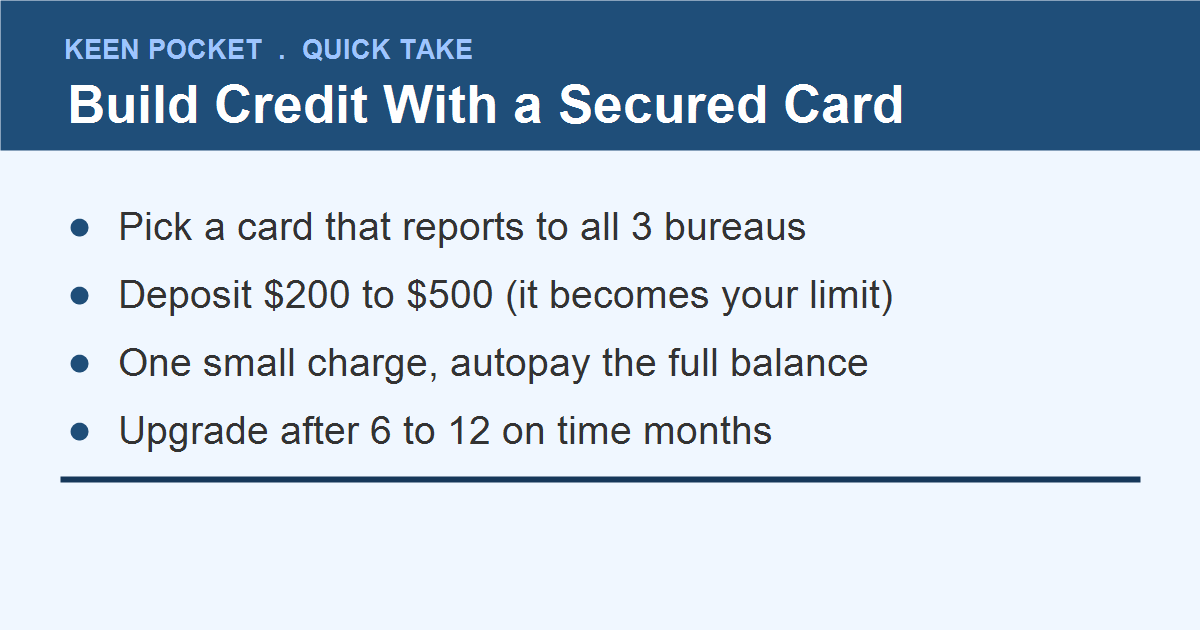
Not every secured card is worth your deposit. The single most important feature is boring but non negotiable: the card has to report to all three major bureaus. A card that reports to only one, or none, can leave you paying on time for a year with almost nothing to show for it. Before you apply, confirm this in the card’s terms or by calling the issuer.
Watch the fees too. A LendingTree review of 47 secured cards in 2024 found that 15 of them charged an annual fee, most commonly $29. A fee is not automatically a dealbreaker, but a plain no fee card that reports to all three bureaus does the same credit building job without the drag. Since payment history is 35% of your FICO score per myFICO, you are paying for reporting, not perks.
Check these four before you apply
One more thing to look for: an issuer that reviews your account for an upgrade on its own. Some cards start checking around the six month mark, which saves you from having to chase them later. That upgrade path is what turns a starter card into a long term account.
Step 2: Decide how much to deposit
Most secured cards set a minimum deposit around $200, though some go lower. Capital One, for example, has approved deposits as low as $49 for a starting limit, depending on your profile. Your deposit becomes your credit limit, so the amount you choose is really a decision about how much room you want on the card.
Bigger is not always better, but a slightly larger limit helps one specific number: your credit utilization, the share of your limit you actually use. Keeping that under 30% is a common guideline, and it is easier to stay under 30% of a $500 limit than a $200 one. If a $20 streaming charge sits on a $200 card, that is 10% utilization already before anything else.
Only deposit money you will not need soon. This is cash you are locking up for months, so do not raid your emergency fund or rent money to fund it. If you are still gathering the deposit, our guides on saving your first $1,000 and building an emergency fund on minimum wage can help you set the cash aside without stress. A good starting range for most beginners is $200 to $500.
Step 3: Use the card safely every month
This is where credit is actually built, and the routine is almost dull on purpose. Put one small recurring charge on the card, something you already pay for, like a $12 streaming subscription or a tank of gas. Then set up autopay for the full statement balance so the bill is never late and you never carry interest.
That habit hits the two things that matter most. On time payments feed the 35% of your score that is payment history, and paying in full keeps your utilization low and your interest at zero. Secured card interest is not cheap, with the average new secured card APR at 23.40% in a 2024 LendingTree report, so carrying a balance is a bad trade. You do not need to carry a balance to build credit. That is a myth that costs people money.
Charge one small, regular expense you already have.
Set autopay for the full balance, every month.
Keep what you use under about 30% of the limit.
Maxing the card because “the money is mine anyway.”
Paying only the minimum to “show activity.”
Missing a due date, even by a few days.
A single late payment can undo months of progress, so treat the due date as fixed. If autopay makes you nervous, add a calendar reminder two days before as a backup. The goal is a clean, unbroken row of on time payments the bureaus can see.
Step 4: Know when to upgrade to an unsecured card
The finish line for a secured card is graduation: moving to a regular unsecured card and getting your deposit back. Most issuers start reviewing accounts after six to twelve months of on time payments. Discover, for example, begins checking around the seventh month. Some upgrade you automatically, and others need a quick phone call to ask.
Do not close the account the moment your deposit lands. The length of your credit history is 15% of your score, so an older account quietly helps you. When an issuer upgrades you in place, that same account simply becomes unsecured, and your history stays intact. That is the smoothest outcome.
Pay on time and stay under 30% for six to twelve months straight.
Call or check your account for an upgrade or “graduation” review.
Get your refundable deposit back once the account converts.
Keep the account open and active to protect your credit age.
If your issuer will not upgrade you, that is a sign to shop for an unsecured starter card elsewhere while keeping the secured one open a while longer. The deposit refund is worth waiting for, but your growing history is worth more.
Secured cards at a glance: what to compare before you apply
When two secured cards look similar, these are the columns that decide it. Treat the ranges as typical of the market in 2024, not promises tied to any one card, and always confirm the specifics in the current terms before you apply.
| What to check | Typical range | Why it matters |
|---|---|---|
| Minimum deposit | About $49 to $200+ | Sets your credit limit and your utilization room. |
| Annual fee | $0 to about $35 | A $0 fee card builds credit just as well. |
| Reports to bureaus | Should be all 3 | No reporting means no credit gets built. |
| Upgrade path | 6 to 12 months | Lets you graduate and get the deposit back. |
| APR | Often 23% to 29%+ | Only matters if you carry a balance, so do not. |
If you pay in full every month, the APR row barely touches you, which frees you to weigh the deposit, the fee, and the upgrade path instead. Those three decide how quickly and cheaply the card does its one job.
What your first year can realistically look like
Here is a grounded example, built from the middle of the ranges rather than a best case. Say you open a $300 secured card with no annual fee, put a $15 subscription on it, and pay in full on autopay. The Federal Reserve note found the median credit building borrower starts around a 604 Equifax score, so this is roughly that starting point.
Progress is not instant, and it is not a straight line. People with no score at all can often see one form in three to six months, while a bigger jump usually takes six to twelve months of clean history. The Federal Reserve found that keeping such an account open for about two years lined up with a median gain of roughly 24 points. Small, steady, and real beats fast and fragile every time.
Mistakes that quietly set beginners back
The routine is forgiving, but a few missteps waste the months you are trying to bank. The most common one is applying for several cards at once out of nerves. New credit is 10% of your score, and a cluster of applications can ding it right when you want it climbing. Pick one solid secured card and commit.
⚠️ Watch Out
Carrying a balance does not build credit faster, it just adds interest. And do not close the card right after upgrading, since a missed payment or a closed account can linger on your report for 7 to 10 years.
The other quiet mistake is treating the card like free money because the deposit is yours. Utilization still counts, so a maxed out secured card can hold your score down even while you pay on time. Keep it light, keep it boring, and let the months do the work.
Where a secured card fits in your bigger money plan
A secured card is a starting line, not the destination. Once your score is climbing, the same habit of paying in full sets you up for better cards, lower loan rates, and easier approvals on the things that actually change your life, like an apartment or a reliable car. The card is the training ground for all of it.
A secured card builds credit through boring consistency: one small charge, paid in full, on time, every single month.
Fold it into the rest of your plan. If you are working through card debt at the same time, our guide to paying off $5,000 in credit card debt on a low income pairs well with this, and for the broader picture see how to build credit fast. Once you graduate, a rewards card like one of these cashback cards for groceries can start paying you back for spending you already do.
📌 How we researched this
The figures here come from primary and government sources published in 2024, including the Federal Reserve’s December 2024 analysis of credit building products, myFICO’s published score factors, and LendingTree’s 2024 review of 47 secured cards. Timelines and deposit ranges reflect common issuer practices, not a guarantee for any single card. Confirm current terms with the issuer before you apply.
Frequently asked questions
How much should I deposit for a secured credit card?
Most cards require a minimum around $200, and a few start lower, near $49. Your deposit becomes your credit limit, so $200 to $500 is a comfortable range for most beginners. A slightly higher limit makes it easier to keep your usage under 30%. Only deposit cash you will not need for several months.
Does applying for a secured credit card hurt my credit?
Applying can cause a small, temporary dip from the hard inquiry, usually a few points. That fades quickly, and the on time payments you make afterward do far more good than the inquiry did harm. Applying for just one card keeps the impact minimal.
How long does it take to build credit with a secured credit card?
If you have no score at all, one can often form within three to six months of reported activity. A meaningful improvement usually takes six to twelve months of on time payments and low utilization. The Federal Reserve linked about two years of an open account with a median gain near 24 points.
When can I upgrade from a secured to an unsecured card?
Many issuers review your account after six to twelve months of responsible use, and some, like Discover, start around month seven. Keep paying on time and stay under 30%, then ask your issuer about upgrading if they do not do it automatically.
Do I get my security deposit back?
Yes, as long as you close the account in good standing or upgrade to an unsecured card. The deposit is refundable and is not a fee. When an issuer graduates you in place, the same account becomes unsecured and your deposit is returned.
Is a secured card better than a prepaid card for building credit?
For building credit, yes. A prepaid card spends money you load and reports nothing to the bureaus, so it cannot build a history. A secured card reports your payments, which is the entire reason it raises your score over time.
The bottom line
Building credit from zero is not about tricks, it is about proof, and a secured card is the cleanest way to create that proof. Choose a card that reports to all three bureaus with a low or no annual fee, put down a deposit you can spare, use it for one small charge you pay in full every month, and upgrade once you have six to twelve months of clean history behind you.
That four step path is really all it takes to build credit with a secured credit card. Start small, stay consistent, and let the months quietly stack up into a score that opens doors.
Sarah is the founder and lead editor of KeenPocket, where she writes practical, plain language guides on budgeting, saving, and credit for people building financial stability from the ground up. KeenPocket articles are educational and are not personalized financial advice; for choices about your own situation, consider speaking with a licensed professional. Last reviewed: August 2026.

Sarah Whitman is the founder and lead editor of Keen Pocket. She holds a BS in Accounting and Finance and writes plain-English guides on budgeting, saving, debt, and beginner investing.