
How to Avoid Overdraft Fees and Manage Your Checking Account Balance

Last fact-checked: · Editorial standards
An overdraft fee is one of the most infuriating charges in banking. You spend a few dollars you did not know you were short, and the bank charges you around $27 for the privilege. Do it twice in a month and you have handed over more than a nice dinner for nothing.
The good news is that overdrafts are almost entirely preventable with a handful of small habits. Fees have already been falling, with banks collecting $5.83 billion in overdraft and NSF revenue in 2023, down 51% from 2019, according to the Consumer Financial Protection Bureau. Still, a household that overdrafts pays roughly $185 a year, and that is money you can keep with almost no effort.
This guide shows you how to avoid overdraft fees and manage your checking account balance using alerts, a simple cash buffer, linked savings, and a ten-minute weekly rhythm. None of it requires more income, just a system that watches your back.
Turn on low-balance alerts as your early-warning system
Alerts are the single easiest fix, and most people never set them up. Your bank can text or email you the moment your balance drops below a number you choose, which turns a silent slide toward zero into a heads-up you cannot miss.
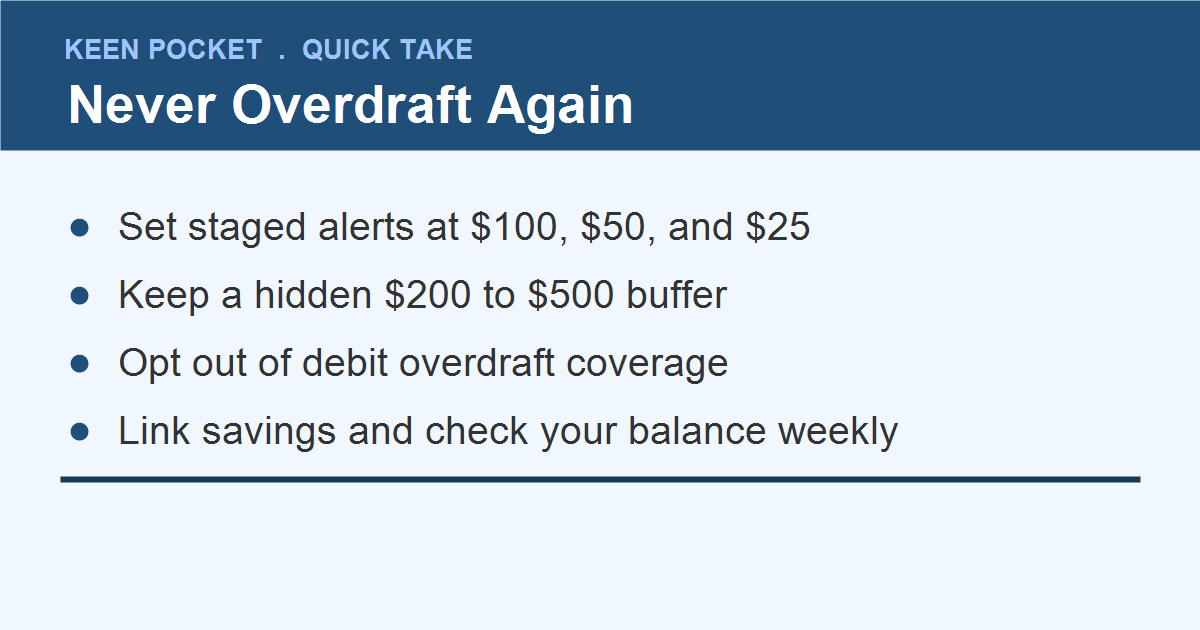
Set more than one. A staged system at $100, $50, and $25 gives you three warnings before trouble, so a low balance never sneaks up on you. The first alert is a nudge to slow down, and the last one is a hard stop before anything bounces.
Keep a cash cushion and pretend it is not there
A buffer is the quiet hero of a healthy checking account. Pick an amount, somewhere between $200 and $500 for most people, and treat it as the new zero. It sits in your account doing nothing but catching the timing mismatches that cause most overdrafts.
The trick that makes it work is hiding it from yourself. Mentally subtract the buffer from your balance so the number you spend against is lower than what the app shows. When your bank says $340 and your buffer is $300, you have $40 to spend, not $340.
Build your buffer the easy way
If you cannot spare $300 all at once, start with $50 and add to it whenever you have a good week. Even a small cushion absorbs the everyday timing gaps that trigger fees.
Link a savings account as your backup
Most banks let you connect your checking to a savings account so that if a payment would overdraw you, the bank pulls the difference from savings instead. The FDIC points to this as a low-cost alternative, since most banks charge only a small fee, if any, for the transfer. This is overdraft protection done right.
The math is lopsided in your favor. A linked-savings transfer is often free or a few dollars, while a standard overdraft runs about $27. Even on the rare day your buffer is not enough, the linked account keeps a small mistake from becoming an expensive one.
A linked-savings transfer costs little or nothing. A standard overdraft costs about $27. Link the accounts and let the cheaper option win.
Keep your buffer in that linked savings account if you like, so it does double duty as both your cushion and your backup. Just make sure the transfer is set up before you need it.
Opt out of debit card overdraft coverage
Here is a rule most people do not realize they can flip. Under federal rules, a bank cannot charge you an overdraft fee on everyday debit card purchases and ATM withdrawals unless you opted in. If you never want those fees, you can opt out, and the card simply declines a transaction you cannot cover.
A declined coffee is annoying for a second. A $27 fee on that same coffee stings for a lot longer. The Consumer Financial Protection Bureau explains that declining coverage is a legitimate choice, and for most people it is the safer one.
💡 Quick Tip
Call your bank or check your app settings and turn off debit card overdraft coverage. A declined purchase is free. An overdraft fee is not. Note that recurring bills and checks may still overdraw, which is why the buffer and alerts still matter.
Track your balance with a ten-minute weekly check
Automation handles most of your money, but a quick human glance catches what software misses. Once a week, spend ten minutes looking at your checking account with fresh eyes. It is the smallest habit here and the one that ties the others together.
Pick a consistent time, like Sunday night, so it becomes routine rather than a chore. You are not budgeting to the penny, just confirming the balance looks right and nothing surprising is about to hit.
Open your bank app and check the available balance, not pending.
Scan for any charge you do not recognize.
Note the bills due before your next paycheck.
Confirm your buffer is still intact.
If a paper check register works better for you, use it. The tool matters less than the rhythm, and a weekly look keeps small problems from becoming $27 problems.
Time your autopay to land after payday
Autopay is a lifesaver for never missing a bill, but the timing can quietly cause overdrafts. If a big autopay hits the day before your paycheck lands, you can overdraw even though the money is arriving tomorrow. The fix is to line up the dates.
Where a biller lets you choose the due date, set it for a couple of days after your income clears. Stacking your bills just after payday means the money is there when the charges arrive, not a nervous day or two before.
Set bill due dates a few days after payday.
Use direct deposit so your pay lands fast.
Keep the buffer for the odd early charge.
Letting a big autopay hit the day before payday.
Guessing when a payment will actually clear.
Stacking every bill on the same tight day.
Call your billers or change the dates in their apps once, and the timing protects you every month after that.
Watch the pending versus available balance trap
One quiet cause of surprise overdrafts is spending against the wrong number. Your bank shows two figures: the total balance and the available balance. The available balance already subtracts pending charges and holds, and it is the one you can actually spend.
People get burned when they see the bigger total, spend up to it, and forget that a pending charge is about to land. Always spend against the available balance, and remember that some deposits, like a mailed check, may not be fully available right away.
⚠️ Watch Out
The bigger number in your app is not always yours to spend. Look for the available balance, which accounts for pending charges and deposit holds, and treat that as your real limit.
If you are ever unsure whether a deposit has cleared, wait a day before spending it. A short pause beats a surprise fee.
Every habit compared at a glance
Here is how the moves stack up so you can start with whichever fits your week. None takes long, and together they close nearly every gap that causes an overdraft. Treat the effort labels as typical, since your bank’s tools vary.
| Habit | Setup effort | Cost | What it protects against |
|---|---|---|---|
| Low-balance alerts | 5 minutes | Free | Slipping toward zero unaware |
| Cash cushion | Ongoing | Set-aside cash | Timing gaps between bills |
| Linked savings | 10 minutes | Little or none | The rare shortfall |
| Opt out of coverage | 5 minutes | Free | Debit and ATM overdraft fees |
| Weekly check | 10 min a week | Free | Surprises and forgotten charges |
| Autopay timing | 15 minutes | Free | Bills hitting before payday |
You do not need all six on day one. Start with alerts and the opt-out this afternoon, add a buffer as you can, and the rest falls into place.
A realistic month with the system in place
Picture how this plays out. Say you overdrew three or four times last year, roughly the national norm, paying around $100 in fees plus the stress of surprise charges. Now you set alerts, opt out, and build a $300 cushion.
A few surprise overdrafts a year, about $100 in fees, and the nagging worry that a charge might bounce.
Alerts before you get close, a buffer that absorbs the timing gaps, and $0 in overdraft fees.
For the heaviest overdrafters, the payoff is far bigger, since a small share of accounts rack up the majority of all fees. Wherever you start, the system turns overdrafts from a recurring tax into a solved problem, and it keeps that $100 or more in your pocket every year.
Break the repeat-overdraft cycle
If you overdraft again and again, you are not careless, you are stuck in a pattern, and the numbers prove how common it is. A small group of accounts, about 7% that overdraft ten or more times a year, generate roughly 75% of all overdraft fees. The cause is almost always the same: living right at zero, where every bill is a coin flip.
The escape is to buy yourself a gap between your balance and empty. That gap is the buffer, and building it once ends the cycle for good. Until it exists, a single unexpected charge restarts the whole spiral.
- ▸Do a short buffer sprint: sell a few things or add a side gig for one month and park it as your cushion.
- ▸Ask your employer about earlier or split direct deposit to smooth the timing.
- ▸Move to a no-overdraft-fee account so a slip costs nothing while you build the gap.
Once the buffer exists, the alerts and the weekly check keep it in place, and the fees that used to feel unavoidable simply stop coming.
Where a fee-free account leaves you
These habits stop the fees, and the natural next step is to stop giving your bank easy ways to charge you at all. If your current account is stacked with fees even when you are careful, the account itself may be the problem, not your habits.
Habits keep you from overdrawing. A no-fee account keeps the bank from charging you in the first place. Use both.
Pair these habits with the right account and the money you save adds up. See our picks for bank accounts for people who hate fees, keep your buffer growing in a high-yield savings account, and let an app that rounds up your purchases build that cushion in the background.
📌 How we researched this
Fee figures come from the Consumer Financial Protection Bureau’s 2024 overdraft data spotlight and Bankrate’s 2024 checking survey, with account guidance from the FDIC. Buffer amounts and alert thresholds reflect common consumer-finance practice, not a rule for every account. This is general education, not personalized financial advice; confirm specifics with your own bank.
Frequently asked questions
How do I avoid overdraft fees the easy way?
Set low-balance alerts, opt out of debit card overdraft coverage, and keep a small cash buffer in checking. Those three take about fifteen minutes total and prevent most overdrafts. Add a linked savings account for backup and a weekly balance check to close the remaining gaps.
How much should I keep in checking as a cushion?
For most people, a buffer of $200 to $500 absorbs the timing gaps that cause overdrafts. Pick an amount you can leave untouched, mentally subtract it from your spendable balance, and refill it first if an emergency dips into it. Start smaller if you must and grow it over time.
Does linking a savings account stop overdraft fees?
It usually replaces a pricey overdraft fee with a small or free transfer. If a payment would overdraw your checking, the bank pulls the difference from your linked savings instead. It is a cheap safety net, though keeping a buffer means you rarely trigger it.
Should I opt out of overdraft coverage?
For most people, yes. Opting out of debit card overdraft coverage means those purchases are declined rather than charged a fee. A declined transaction is free and momentary, while an overdraft fee is around $27. Recurring bills and checks can still overdraw, so keep your buffer.
What is the difference between available and pending balance?
Your available balance is what you can actually spend, because it already subtracts pending charges and holds. The total balance can look higher but includes money that is spoken for. Always spend against the available balance to avoid an accidental overdraft.
Can I get an overdraft fee refunded?
Often, yes, especially for a first or occasional fee. Call your bank, explain it was a one-time slip, and ask for a courtesy reversal. Many banks will waive it for a customer in good standing, and it costs nothing to ask politely.
Do overdraft fees affect my credit score?
An overdraft fee itself is not reported to the credit bureaus, so paying one does not directly lower your score. The risk comes later: if your account goes negative and stays unpaid, the bank can close it and send the balance to collections, which can hurt your credit and land you in a banking-history database.
The bottom line
Overdraft fees feel random, but they are almost always a timing problem with a simple fix. When you learn how to avoid overdraft fees and manage your checking account balance, you replace that random $27 hit with a calm system: alerts that warn you, a buffer that catches you, linked savings as backup, and a quick weekly look.
Set your alerts and opt out this afternoon, decide on a buffer amount, and give it a couple of paychecks to settle in. After that, overdrafts stop being something that happens to you and become something you simply do not do.
Sarah is the founder and lead editor of KeenPocket, where she writes practical, plain language guides on budgeting, saving, and everyday banking habits. KeenPocket articles are educational and are not personalized financial advice; bank policies vary, so confirm the details with your own bank before acting. Last reviewed: August 2026.

Sarah Whitman is the founder and lead editor of Keen Pocket. She holds a BS in Accounting and Finance and writes plain-English guides on budgeting, saving, debt, and beginner investing.