
Ways to Lower Student Loan Payments Without Refinancing (2026 Guide)

Last fact-checked: · Editorial standards
Refinancing gets pitched as the answer to a high student loan bill, but it is the wrong move for a lot of people. Refinancing federal loans with a private lender permanently strips away income-driven plans, forgiveness, and forbearance protections, and it takes strong credit to even qualify. If you cannot or should not refinance, you still have options.
The scale of the problem is real. Americans owe about $1.77 trillion in federal student debt across roughly 43 million borrowers, and the standard 10-year payment on an average balance runs near $447 a month. That is a heavy line item, and it does not have to stay that high.
This guide covers practical ways to lower student loan payments without refinancing, using tools built into the federal system: income-driven plans, consolidation, forgiveness tracks, and a few administrative moves. Every one of them keeps your federal protections intact, which is exactly what refinancing would cost you.
Switch to an income-driven repayment (IDR) plan
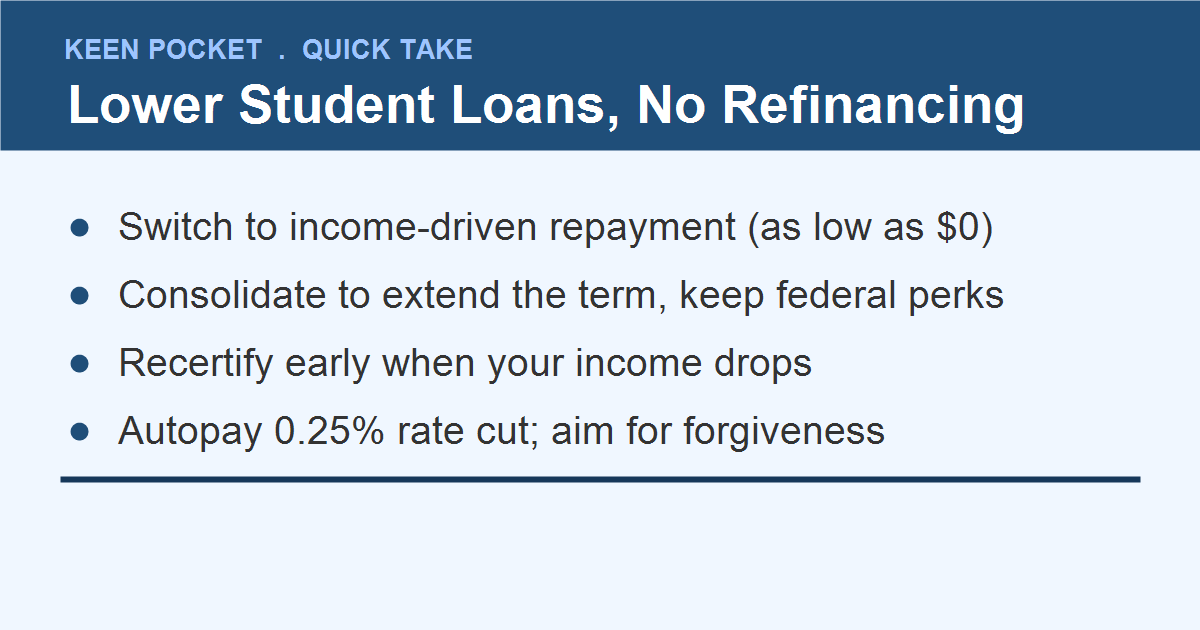
This is the single most powerful lever for most federal borrowers. An income-driven repayment plan resets your monthly payment to a slice of your discretionary income rather than a fixed loan amount, and it stretches the term to 20 to 30 years. For many people, the payment falls to a fraction of the standard amount, and for some it drops to $0.
Discretionary income is the piece of your earnings above a baseline tied to the federal poverty guideline for your family size, and your plan charges a percentage of only that slice. So a lower income, a bigger family, or both can push your required payment well below the standard bill, sometimes all the way to nothing. The official loan simulator on studentaid.gov estimates your number for each plan in a few minutes, which beats guessing.
The plan menu is changing in 2026. A court order ended the SAVE plan, so affected borrowers are being moved and asked to pick a new option, while Income-Based Repayment stays open and a newer plan called RAP is now available. Because the details are in flux, check your exact choices on Federal Student Aid and with your servicer before you switch.
Recertify your income and family size
If you are already on an income-driven plan, the number it spits out is only as current as the income you last reported. Your payment is recalculated every 12 months, and you have to recertify each year to stay enrolled. Miss it, and your payment can jump back up.
Here is the move most people overlook. If your income has dropped or your family has grown since you last certified, you do not have to wait for the annual date. You can recertify early and have your payment recalculated on the spot, which often lowers it right away.
💡 Quick Tip
Lost hours, changed jobs, or added a dependent? Recertify your income-driven plan early instead of waiting for the yearly renewal. A lower income on file usually means a lower payment starting the next cycle.
Consolidate to stretch your term (it is not refinancing)
People mix these two up constantly, and the difference matters enormously. A federal Direct Consolidation Loan combines your federal loans into one and can extend the repayment term up to 30 years, which lowers the monthly payment. Crucially, it stays inside the federal system, so you keep access to income-driven plans and forgiveness.
Refinancing is the opposite. It moves your loans to a private lender for a new rate, and in doing so it gives up every federal protection for good. Consolidation lowers your payment without that sacrifice, which is why it belongs in a no-refinance playbook and refinancing does not.
Federal consolidation keeps your federal benefits. Private refinancing throws them away. They are not the same thing.
The tradeoff with consolidation is time. A longer term means more interest paid over the life of the loan, so treat it as breathing room, not a free lunch. If refinancing is genuinely right for your situation, our guide to refinancing student loans walks through when it makes sense.
Move to a graduated or extended plan
Not everyone qualifies for or wants an income-driven plan, and that is fine. Two standard federal options can still cut your monthly bill without any income paperwork. A graduated plan starts your payments lower and steps them up every couple of years. An extended plan stretches the term to up to 25 years for a flatter, smaller payment.
These work well if your income is steady but simply stretched thin, or if you expect to earn more later and want low payments now. Like consolidation, the longer timeline means more total interest, so use them with eyes open.
A graduated or extended plan fits if you
You can compare these against the income-driven options on the official Federal Student Aid repayment plans page, which lists what each one does to your payment and term.
Chase forgiveness while you pay less
Lowering your payment and pursuing forgiveness are not separate goals; they work together. On Public Service Loan Forgiveness, 120 qualifying monthly payments while you work for a government or nonprofit employer wipe out the rest of your balance tax-free. A low income-driven payment counts just as much as a big one toward those 120.
Income-driven plans have their own forgiveness built in: whatever is left after 20 to 30 years of qualifying payments is forgiven. That means the lower your monthly payment, the more of the balance forgiveness eventually erases, which flips the usual logic on its head.
If you work in public service, keeping your payment low on an income-driven plan is the smart play, since you are aiming for forgiveness at the end anyway. Track your qualifying payments carefully and confirm your employer qualifies.
Use deferment or forbearance carefully
When money is genuinely tight, deferment and forbearance let you pause payments entirely for a set period. They are a real safety valve, and they beat missing payments and sliding toward default, which hits at 270 days past due. Used briefly and on purpose, they can carry you through a rough patch.
The catch is interest. In most cases it keeps accruing while you are paused, then gets added to your balance, so you come back owing more. Treat these as a short-term bridge, not a long-term fix, and switch to an income-driven $0 payment instead when you can, since that keeps you moving toward forgiveness.
Call your servicer before you miss a payment, not after.
Ask whether an income-driven $0 payment beats a pause for you.
If you pause, keep it short and restart as soon as you can.
An income-driven plan that lands at $0 is almost always better than forbearance, because the interest math is friendlier and those months still count toward forgiveness.
Every method compared at a glance
Here is how the options stack up side by side. Savings depend on your income, balance, and plan, so treat these as typical directions rather than guarantees. The column that matters most for anyone avoiding refinancing is the last one.
| Method | How it lowers the payment | Tradeoff | Keeps federal perks |
|---|---|---|---|
| Income-driven plan | Ties payment to income | Recertify yearly | Yes |
| Federal consolidation | Extends term to 30 yrs | More total interest | Yes |
| Graduated or extended | Lower or rising payments | More total interest | Yes |
| Deferment or forbearance | Pauses payments | Interest usually accrues | Yes |
| Autopay discount | 0.25% rate cut | Must automate | Yes |
| Private refinancing | New private rate or term | Loses federal perks | No |
Notice that every no-refinance method keeps your federal protections, while refinancing is the only row that trades them away. That single column is the whole reason this list exists.
What a lower payment can look like
A quick illustration makes it concrete. Say you owe around $35,000 and your standard 10-year payment is roughly $447 a month, which is squeezing your budget. Moving to an income-driven plan or an extended term can bring that down significantly, depending on your income.
About $447 a month on the 10-year standard plan, fixed no matter what your budget looks like.
Roughly $150 to $250 a month on an income-driven or extended plan, sized to what you actually earn.
That is a couple hundred dollars back in your monthly budget while keeping every federal benefit. The honest caveat is that a longer timeline usually means more interest overall, so run your real numbers on the official loan simulator before you commit. Your exact payment depends on your income, family size, and plan.
Small levers: autopay discount and the tax deduction
Two smaller moves round out the list, and they take minutes. Setting up automatic payments earns most federal borrowers a 0.25% interest rate reduction, which shaves the cost without touching your plan. And at tax time, you can deduct up to $2,500 of student loan interest, which is not a lower payment but is real money back.
- ▸Turn on autopay for the automatic 0.25% rate discount.
- ▸Claim up to $2,500 of student loan interest at tax time.
- ▸Keep records and stay in touch with your servicer.
None of these alone transforms your budget, but stacked on top of a plan change, they add up. Free money from the government is worth the five minutes it takes to claim.
Watch out for student loan scams
One warning applies to every option in this guide: you never have to pay a company to use them. Every federal program here is free to apply for through your servicer or the government’s own site. Businesses that charge a fee to “enroll you in forgiveness” or “get your payment lowered” are selling you something you can do yourself for nothing, and some are outright fraud.
⚠️ Watch Out
Red flags include upfront fees, pressure to act immediately, requests for your FSA ID password, and promises of instant forgiveness. The Consumer Financial Protection Bureau warns borrowers to keep their login private and work only through official channels.
If a caller or ad guarantees forgiveness for a fee, that is your signal to walk away. Your servicer and studentaid.gov will do all of it for free, and no legitimate program requires a middleman to unlock it.
Where a lower payment leaves you
Cutting your payment is not the finish line; it is the start of a stronger position. The money you free up should do a job, whether that is building a cushion so a bad month never forces a missed payment, or finally getting ahead instead of just treading water.
Lower the payment through the federal system, keep your protections, and put the freed-up money to work.
Give the breathing room a purpose. Start with a small buffer using our guide on how much emergency fund you need, and if you want to accelerate payoff, a little weekend income goes straight to the balance. Once you are steady, even investing with little money can start compounding in the background.
📌 How we researched this
Program details come from Federal Student Aid (studentaid.gov) and the Consumer Financial Protection Bureau, with debt figures from the U.S. Department of Education and EducationData. Federal repayment rules are changing in 2026, including the end of the SAVE plan, so confirm your current options with your loan servicer and studentaid.gov. This is general education, not personalized financial or legal advice.
Frequently asked questions
How can I lower student loan payments without refinancing?
Switch to an income-driven plan, consolidate to extend your term, move to a graduated or extended plan, or use deferment briefly if needed. All of these keep your federal benefits, unlike refinancing. An income-driven plan is usually the biggest and safest reduction.
Is federal consolidation the same as refinancing?
No, and the difference is critical. Federal Direct Consolidation combines your loans and can extend the term while keeping every federal protection. Refinancing moves your loans to a private lender for a new rate and permanently gives up income-driven plans, forgiveness, and forbearance.
How low can an income-driven payment go?
It depends on your income and family size, but it can go as low as $0 a month for lower earners, and those $0 payments still count toward forgiveness. Use the official loan simulator to estimate your specific number before switching plans.
Does forbearance hurt me in the long run?
It can, because interest usually keeps accruing while payments are paused and then gets added to your balance. Forbearance is a useful short-term bridge, but an income-driven plan with a low or $0 payment is generally the better long-term move.
Will lowering my payment cost me more overall?
Often yes, because stretching the term means more interest over time. That tradeoff can still be worth it for breathing room now, and if you are pursuing forgiveness, a lower payment can actually reduce what you repay in total.
Can I still get forgiveness on a lower payment?
Yes. On Public Service Loan Forgiveness and income-driven forgiveness, a smaller qualifying payment counts exactly the same as a larger one. Keeping your payment low while staying on a qualifying plan is a deliberate strategy, not a compromise.
Do these options work for private student loans?
Most are federal programs, so they apply to federal loans only. Private loans do not offer income-driven plans or federal forgiveness, but you can still call your private lender to ask about hardship programs, a temporary payment reduction, or an interest-only period. For private loans, refinancing is often the main lever.
The bottom line
Refinancing is not the only way to make a student loan bill manageable, and for federal borrowers it is often the worst way, since it hands back protections you cannot get back. The better path is to lower student loan payments without refinancing by using the tools already built into the system.
Start with an income-driven plan or a term extension, recertify whenever your income drops, layer on the autopay discount, and keep forgiveness in view. Log in to your servicer this week, run your numbers on the loan simulator, and pick the option that fits, all while keeping the federal benefits refinancing would erase.
Sarah is the founder and lead editor of KeenPocket, where she writes practical, plain language guides on budgeting, debt, and student loans. KeenPocket articles are educational and are not personalized financial or legal advice; student loan rules change often, so confirm your options with your servicer and studentaid.gov before acting. Last reviewed: August 2026.

Sarah Whitman is the founder and lead editor of Keen Pocket. She holds a BS in Accounting and Finance and writes plain-English guides on budgeting, saving, debt, and beginner investing.