
Best Bank Accounts for People Who Hate Fees (2026 Guide)

Last fact-checked: · Editorial standards
Bank fees feel like a punishment for the crime of having a checking account. A maintenance fee here, a surprise overdraft there, a few dollars every time you touch the wrong ATM, and suddenly your own money costs money. If that low-grade rage sounds familiar, this guide is for you.
The numbers back up the frustration. The average overdraft fee hit $27.08 in 2024, and it can still be charged on 94% of bank accounts, according to Bankrate’s annual survey. The average out-of-network ATM fee climbed to $4.77, the highest on record, and monthly maintenance fees run roughly $188 a year. None of that buys you anything.
Here is the good news. You can bank for a flat zero. This roundup of the best bank accounts for people who hate fees covers accounts with no monthly fee, no minimum balance, and no overdraft trap, plus the exact moves that keep every other fee off your statement for good.
What “no-fee” should actually mean
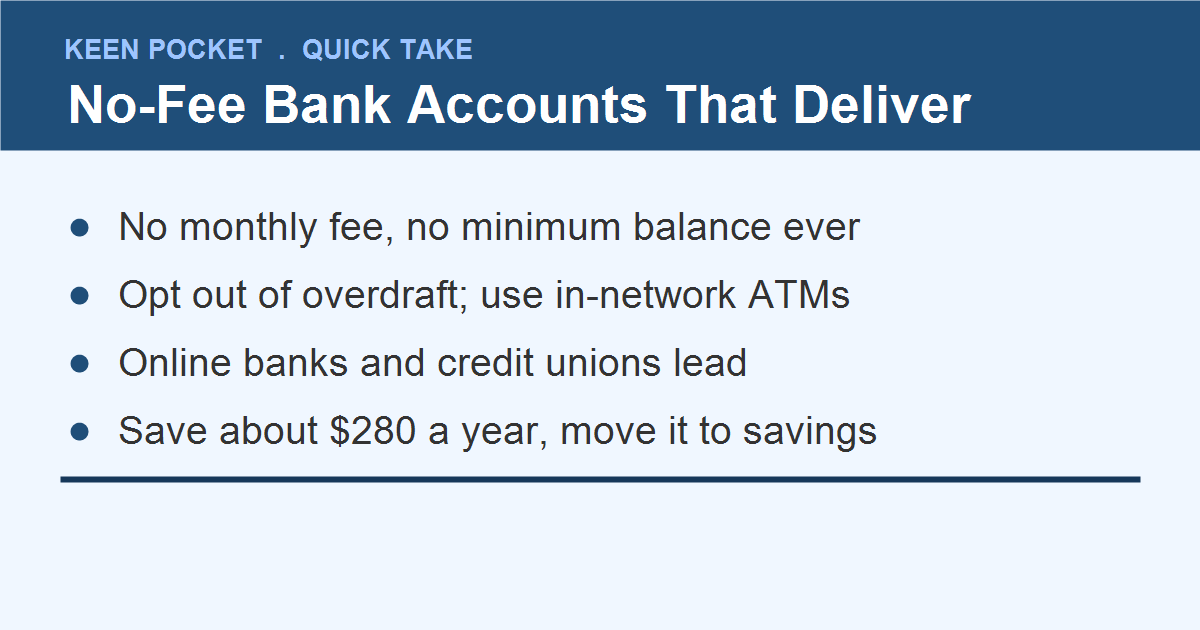
Banks love to call an account “free” while quietly leaving the door open to a dozen charges. A real no-fee account kills the four that hit people most, with no strings like a required balance or a monthly direct deposit to dodge them.
Before you trust any “free checking” label, make sure it clears all four. If an account waives the monthly fee only when you keep $500 parked or receive a certain deposit, that is a conditional fee, not a free account. The accounts worth your time simply do not charge.
Minimum-balance rules are not a small annoyance, either. In the FDIC’s 2023 national survey, not being able to meet minimum-balance requirements was the single most cited reason U.S. households went unbanked altogether. Fees do not just irritate people; they push them out of banking entirely.
The best no-fee bank accounts to consider
A handful of accounts have built their reputation on charging nothing, and they are the usual answer for people who hate fees. The table below lines up popular options by what actually matters: monthly fee, minimum balance, overdraft handling, and ATM access. Treat these as commonly recommended picks for 2026, and confirm the current terms before you open one, since banks do change them.
| Account | Monthly fee | Overdraft | ATM access |
|---|---|---|---|
| Capital One 360 | $0, no minimum | No overdraft fee | 70,000+ fee-free |
| Ally Bank | $0, no minimum | No overdraft fee | $10/cycle reimbursed |
| Chime | $0, no minimum | SpotMe up to $200 | 47,000+ fee-free |
| SoFi | $0, no minimum | Coverage up to $50 | 55,000+ fee-free |
| Alliant Credit Union | $0, no minimum | Optional coverage | $20/mo reimbursed |
| Charles Schwab | $0, no minimum | No overdraft fee | Unlimited reimbursed |
There is no single winner, only the best fit for how you bank. If you deal in cash, a network with physical ATMs matters. If you travel, Schwab’s unlimited reimbursement is hard to beat. Pick the one whose strengths match your habits.
Check what your current account is really costing you
Before you switch, it helps to see the damage in black and white. Most people have no idea what their bank quietly pulls each year, because the fees are scattered across months and buried in the transaction list. A quick audit turns that fog into a number.
Pull your last three statements and search for the word “fee.”
Add up maintenance, overdraft, ATM, and any other charges.
Multiply by four to estimate a full year, then compare to $0.
While you are at it, call your bank about the most recent fee and ask for a courtesy refund. Many banks will reverse a first overdraft or a maintenance charge for a customer who simply asks, especially one who mentions leaving. It costs nothing to try and often works.
Why online banks and credit unions win on fees
Notice a pattern in that list. Most of the truly free accounts are online banks or credit unions, and that is not a coincidence. Without thousands of branches to staff and heat, online banks have far lower overhead, so they compete by dropping fees and paying interest instead.
Credit unions play a similar game for a different reason. They are member-owned nonprofits, so profits flow back to members as lower fees and better rates. Both are as safe as any big bank when insured, which the next point covers.
The one tradeoff is in-person service. If you rarely need a teller, an online bank costs you nothing and saves you plenty. If you deposit cash often, look for one with a branch or a strong cash network before you commit.
When a traditional bank still makes sense
Going fully online is not right for everyone, and that is fine. Some people genuinely need a branch, and forcing an online-only setup on them trades fees for frustration. The goal is zero fees, not zero branches.
A local bank or credit union earns its keep if you deposit cash regularly, run a cash-based side business, or need services like a notary, a medallion signature, or a safe deposit box. In-person help also matters if you would rather sort out a problem face to face than wait on a chat window.
📌 Good to Know
You can have both. Keep a free credit union or no-fee local account for cash and in-person needs, and pair it with an online bank for interest and ATM reimbursement. Two free accounts still cost you nothing.
The trick is to make sure the local option is also genuinely free. A member-owned credit union is usually your best shot at a branch without the branch fees.
Kill the overdraft fee for good
Overdraft is the fee that makes people quit their bank, and it is also the most avoidable. The simplest fix is to turn it off. Under federal rules, banks cannot charge you for debit card overdrafts unless you opted in, so you can opt right back out and have transactions declined instead of charged.
The Consumer Financial Protection Bureau lays out the playbook: decline debit overdraft coverage, link a savings account as a free or low-cost backup, and turn on low-balance alerts so you see trouble coming.
Three moves to never overdraft again
Several accounts above go further and simply refuse to charge, or offer a small fee-free cushion like Chime’s SpotMe. Combine an opt-out with one of those, and overdraft fees leave your life entirely. For the full playbook of habits and tools, see how to avoid overdraft fees and manage your checking account balance.
Never pay an ATM fee again
ATM fees are sneaky because they can hit you twice: your bank charges an out-of-network fee, and the ATM owner adds a surcharge on top. At an average of $4.77 per withdrawal, a couple of cash runs a month becomes real money over a year.
Beating them is easy once you know the rules. Use your bank’s in-network ATMs, pick an account that reimburses out-of-network fees, and get cash back at the grocery store checkout when you can, which is free.
Stick to your bank’s fee-free ATM network.
Choose an account that reimburses ATM fees.
Grab free cash back at checkout.
Random out-of-network ATMs on a whim.
Corner-store and casino ATMs with big surcharges.
Taking out $20 at a time and paying a fee each run.
If you must use an out-of-network machine, withdraw a larger amount less often so you pay the fee once, not five times. Better yet, keep an account that hands the fee right back to you.
The sneaky fees to check before you switch
Once the big four are handled, a few smaller charges can still sneak onto a statement. They are easy to dodge once you know to look, so scan any new account’s fee schedule for these before you sign up.
⚠️ Watch Out
Look for paper-statement fees, wire-transfer fees, foreign-transaction fees, inactivity fees, and replacement-card fees. A truly no-fee account either skips these or lets you avoid them with a free setting like going paperless.
None of these should be a dealbreaker on their own, but they reveal a bank’s attitude. An account stacked with little charges is telling you how it plans to make money off you later.
How to switch banks without breaking anything
The reason most people tolerate a fee-happy bank is the hassle of leaving. It is simpler than it looks if you move in order and keep the old account open until everything clears. Do not close it on day one.
Open the new no-fee account and fund it with a small deposit.
Move your direct deposit over and confirm the first one lands.
Re-point autopays and subscriptions to the new account.
Once nothing hits the old account for a full cycle, close it in writing.
Ask the old bank for written confirmation that the account is closed at a zero balance, so a stray fee cannot quietly reopen it. Then the switch is truly done.
What zero-fee banking saves you in a year
Put a dollar figure on it and the motivation gets real. Imagine a fairly ordinary year at a fee-charging bank: the monthly maintenance fee, a couple of overdrafts, and a handful of out-of-network ATM trips. Here is roughly how that adds up against a true no-fee account.
About $188 in maintenance, two $27 overdrafts, and eight $4.77 ATM fees is roughly $280 gone in a year.
$0 in fees, and an interest-bearing account may even pay you a little instead.
That is close to $280 back in your pocket for one afternoon of switching, and it repeats every year you stay fee-free. Your exact number depends on your habits, but almost nobody who hates fees is starting from zero.
Where to put the money you save
Fees you stop paying are only worth it if the money lands somewhere useful instead of drifting back into everyday spending. A few hundred dollars a year is a real head start once you point it at a goal.
A no-fee account keeps more of your money in your hands. Move what you save somewhere it grows before it disappears.
Send it somewhere with a return. A high-yield savings account is the natural home for the money you rescue from fees, and a no-penalty CD works for cash you can leave a while. To make the saving automatic, an app that rounds up your purchases quietly builds the balance without you noticing.
📌 How we researched this
Fee figures come from Bankrate’s 2024 Checking and ATM Fee Survey, with regulatory and consumer guidance from the Consumer Financial Protection Bureau and the FDIC’s 2023 household survey. Account features reflect commonly reported terms for 2026 and can change, so confirm the current details with each bank before opening. This is general education, not personalized financial advice.
Frequently asked questions
What are the best bank accounts for people who hate fees?
Accounts that charge no monthly fee, require no minimum balance, and skip overdraft fees, such as Capital One 360, Ally, Chime, SoFi, Alliant Credit Union, and Charles Schwab. The right one depends on whether you need cash access, ATM reimbursement, or in-person service. Always confirm current terms before opening.
Are online-only banks safe?
Yes, as long as the bank is FDIC-insured or the credit union is NCUA-insured, which covers up to $250,000 per depositor. That protection is identical to what a big brick-and-mortar bank offers, so your money is just as safe with a reputable online bank.
Do free checking accounts earn interest?
Some do. Online banks like Ally and credit unions like Alliant pay interest on checking balances, while others focus on zero fees rather than yield. If earning interest matters to you, look for an interest-bearing no-fee account or keep your savings in a high-yield account.
How do I avoid overdraft fees?
Opt out of debit card overdraft coverage so purchases are declined instead of charged, link a savings account as a backup, and set low-balance alerts. Choosing an account that does not charge overdraft fees, or offers a fee-free cushion, removes the risk almost entirely.
Can I really bank with zero fees?
Yes. Between no-fee accounts, opting out of overdraft, and using in-network or reimbursing ATMs, most people can get their banking cost down to zero. The main effort is a one-time switch and a few settings changes, and after that it stays free.
Is a bank or a credit union better for avoiding fees?
Both can be excellent. Credit unions are member-owned and often charge lower fees, while online banks cut fees through low overhead. Compare the specific account’s fees and ATM access rather than the label, since a strong no-fee account exists in each category.
Will switching banks hurt my credit score?
No. Opening or closing a checking account does not affect your credit score, because everyday bank accounts are not reported to the credit bureaus the way loans and credit cards are. Just close the old account at a zero balance so no unpaid fee is sent to collections.
How much can I save by switching to a no-fee account?
It depends on your habits, but a typical fee-charging year can run around $280 between maintenance, a couple of overdrafts, and ATM charges. Moving to a true no-fee account drops that to zero, and an interest-bearing option can turn the cost into a small gain.
The bottom line
You should not have to pay for the privilege of holding your own money. The best bank accounts for people who hate fees charge nothing to maintain, demand no minimum balance, and refuse to punish you for an overdraft or an ATM run. Pair one with an overdraft opt-out and in-network ATMs, and your banking cost drops to zero.
Pick an account from the list that fits how you bank, make the switch this week, and send the fees you stop paying toward something that actually grows. That is money you were losing on autopilot, back where it belongs.
Sarah is the founder and lead editor of KeenPocket, where she writes practical, plain language guides on budgeting, saving, and banking without the fees. KeenPocket articles are educational and are not personalized financial advice; account terms change often, so confirm current details with each bank before you open one. Last reviewed: August 2026.

Sarah Whitman is the founder and lead editor of Keen Pocket. She holds a BS in Accounting and Finance and writes plain-English guides on budgeting, saving, debt, and beginner investing.