

Cheap Meal Planning on a Tight Budget for Beginners (Step-by-Step + Free Printable)

Last fact-checked: · Editorial standards
Groceries are the most flexible line in almost any budget. You cannot call the landlord and negotiate rent this week, but you can absolutely change what lands in your cart on Saturday. That makes food the first place most beginners can find real breathing room fast.
The catch is that “just spend less on food” is useless advice without a system. This guide gives you the system. Cheap meal planning on a tight budget for beginners is not about clipping a hundred coupons or eating rice and beans forever. There are plenty of ways to save money on groceries without coupons that pair with any plan. It is a repeatable five-step method, a sample week that costs about $50, and a free printable planner you can fill in tonight.
To put a floor under it: the USDA’s Thrifty Food Plan, the government’s lowest-cost nutritious grocery plan, comes to roughly $250 to $310 a month for one adult. A filling, balanced week on a small budget is not a fantasy. It is a plan, and you are about to build yours.
Why meal planning is the fastest grocery win
Most people do not overspend on groceries because they buy caviar. They overspend because they shop without a plan, buy food that rots, and end up ordering takeout when the fridge feels empty. A plan quietly fixes all three.
The waste alone is staggering. The average American family of four throws out about $1,500 of uneaten food a year, according to the U.S. Environmental Protection Agency. That is roughly a month of groceries walking into the trash. Planning what you will actually eat is the single biggest lever you have.
It matters more than ever, too. In 2023, 13.5% of U.S. households, about 18 million of them, had trouble affording enough food at some point in the year, per the USDA Economic Research Service. A tight grocery budget is not a niche problem. It is the normal starting point for millions of people.
💡 Quick Tip
Before you cut anything, track one normal grocery week exactly as it is. You cannot shrink a number you have never seen, and most beginners are shocked by how much of it was unplanned.
Know your number: set a realistic weekly grocery budget
You cannot plan cheap meals until you know what “cheap” means for your household. The USDA publishes four grocery budget levels, updated monthly for inflation, and they are the cleanest starting reference in the country.
The table shows the monthly cost per single adult across all four plans. For a tight budget, the Thrifty column is your target. Multiply roughly by household size, then divide by four to get a weekly number to plan against.
| USDA plan | Per adult, per month | Best for |
|---|---|---|
| Thrifty | ~$250 to $310 | the tight-budget target |
| Low-cost | ~$323 to $371 | a little more room |
| Moderate | ~$392 to $465 | comfortable |
| Liberal | ~$499 to $566 | generous |
For context, the average U.S. household spent $6,053 on food at home in 2023, about $504 a month, per the Bureau of Labor Statistics. If your number is well under that, you are not behind. You are just running a leaner kitchen, and a plan is how you make it work without feeling deprived.
Set the number once, then let it flex. Some weeks a great sale on chicken or a pantry already full of staples means you spend less than planned. Other weeks you restock oil, spices, and cleaning items and spend more. Watch the monthly average rather than any single trip, and adjust in small steps until the budget feels livable instead of tight.
The 5-step cheap meal planning method for beginners
Here is the whole system. It takes about twenty minutes a week once you have done it a couple of times, and it works whether you are feeding one person or five. This is the core of cheap meal planning on a tight budget, stripped down so a beginner can start today.
Shop your kitchen first. Look in the fridge, freezer, and pantry and write down what needs using up. Build the week around that before you buy a single thing.
Build around cheap staples. Pick two or three base ingredients that stretch, like rice, beans, eggs, or pasta, and let them anchor most dinners.
Plan around the sales flyer. Check your store’s weekly ad and let the discounted proteins and produce decide the rest of the menu.
Repeat a small rotation. You do not need seven new recipes. Four or five meals you can cook without thinking will carry you for months.
Write the list and stick to it. Turn the plan into one grocery list, group it by aisle, and buy only what is on it. The list is where the savings actually happen.
That is it. No app required, no spreadsheet, no color-coded binder. A scrap of paper and twenty minutes beats an empty fridge and a takeout habit every single week.
A sample $50 grocery week (worked example)
Theory is nice, but numbers make it real. Here is a genuine week of groceries for around $50, built from the staples above. Prices are typical U.S. figures and will vary by store and region, so treat them as a realistic middle, not a promise.
| Item | Typical price |
|---|---|
| Dried beans, 1 lb | $1.50 |
| Rice, 3 lb | $3.00 |
| Eggs, 1 dozen | $3.00 |
| Old-fashioned oats, 42 oz | $4.00 |
| Pasta, 2 boxes | $2.50 |
| Marinara sauce, 1 jar | $1.75 |
| Frozen mixed vegetables, 2 bags | $3.00 |
| Chicken thighs, ~2.5 lb | $6.00 |
| Canned diced tomatoes, 2 | $2.00 |
| Potatoes, 5 lb | $4.00 |
| Onions and carrots, ~4 lb | $3.75 |
| Cabbage, 1 head | $2.00 |
| Bananas and apples, ~4 lb | $4.25 |
| Peanut butter, 1 jar | $3.25 |
| Bread and store-brand cheese | $4.50 |
| Around | ~$48.75 |
That cart cooks a full week. Breakfast is oatmeal with banana and peanut butter, or eggs and toast. Lunch is leftovers or bean-and-rice bowls. Dinners rotate through chicken and rice with roasted carrots, pasta with sauce and frozen veg, a big pot of beans, potato-and-egg hash, cabbage stir-fry, and a tomato-bean soup with bread. Nobody goes hungry, and you have change left over.
Feeding more people? The math scales gently, not one-for-one, because the cheap staples are already the bulk of the cart. Add a second bag of rice, another dozen eggs, and a little more protein, and the same plan stretches to a small family for well under $100. The rotation stays identical; only the quantities move. Adding a baby to the household? Our money-saving tips for new parents cover the newborn costs beyond the grocery bill.
How the numbers work: grocery prices are typical U.S. figures that vary by store, region, and season, so treat the sample week as a realistic middle rather than a fixed total. The four budget tiers come from the USDA’s monthly Cost of Food reports.
Cheap staples that stretch the furthest
A handful of ingredients do the heavy lifting in almost every frugal kitchen. Buy these well and most meals nearly plan themselves. The cost-per-serving figures below are typical and rounded, meant to show the scale, not an exact receipt.
Frozen vegetables belong on this list too. They are picked at peak, cost less than fresh, and never wilt in the drawer before you get to them, which quietly kills the waste problem from the last section.
The mix-and-match formula so you never run out of ideas
The reason beginners quit meal planning is decision fatigue. So stop planning individual recipes and start planning a formula instead. Almost every cheap, satisfying dinner is the same four parts in a new outfit.
Pick one from each column and you have dinner. Rice, beans, frozen veg, and taco spice is one night. Pasta, egg, cabbage, and parmesan is another. Once the formula clicks, you can plan a whole week in the time it takes to boil water.
Batch cooking makes cheap meal planning on a tight budget even easier
The other quiet superpower of a tiny grocery budget is batch cooking. When a base like rice, beans, or a pot of soup is already made, dinner on a busy night stops competing with the delivery app. You are not deciding what to eat, only reheating what you planned.
You do not have to cook everything on Sunday. Even cooking double on two nights a week gives you four ready meals for lunches or leftovers. That single habit is what makes cheap meal planning on a tight budget sustainable instead of exhausting, because it front-loads the effort into the times you actually feel like cooking.
Every night starts with “what is there to eat,” an empty-feeling fridge, and a takeout order by 7 p.m.
A cooked base is waiting, dinner is ten minutes of assembly, and the delivery app stays closed.
How to use the free printable meal planner
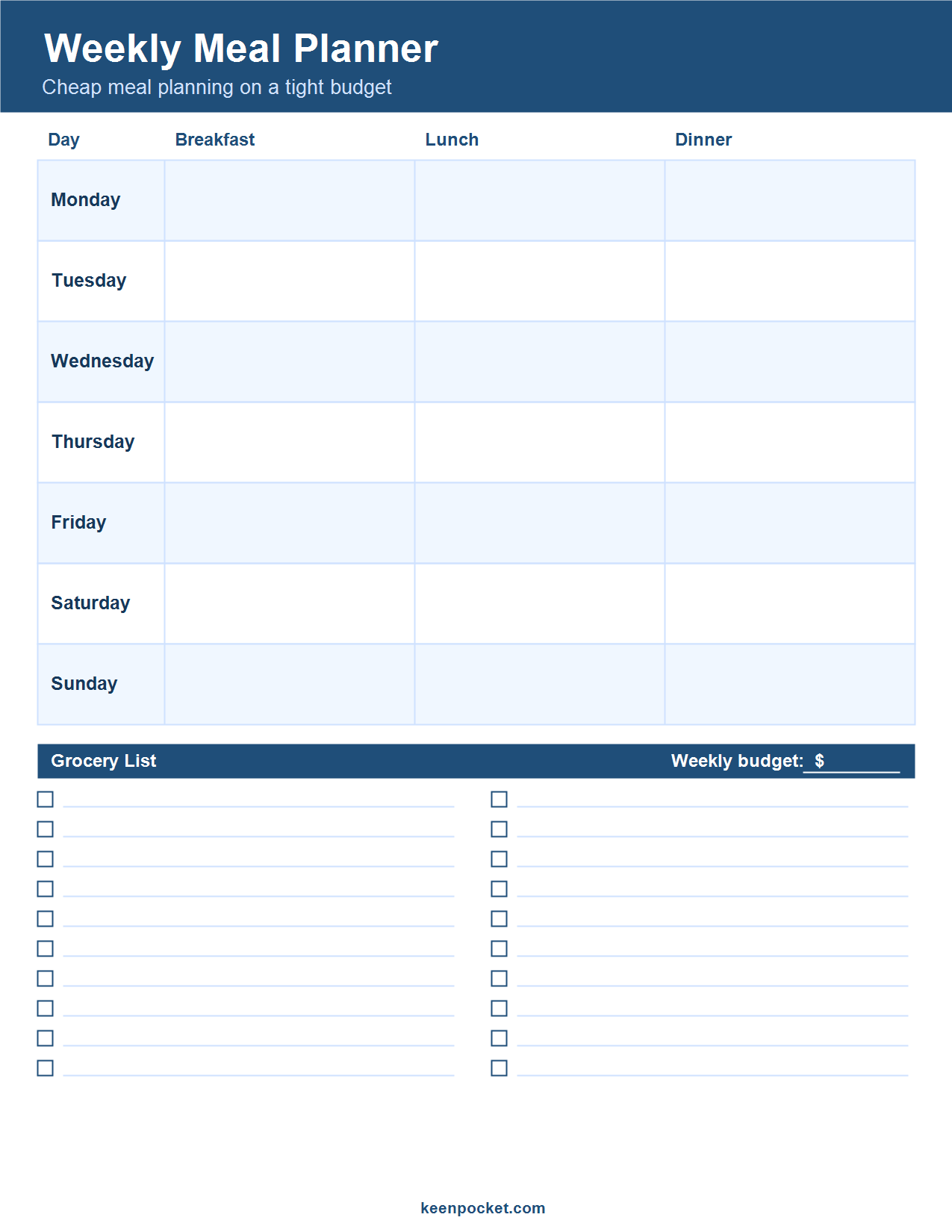
A plan in your head is a wish. A plan on paper, stuck to the fridge, is a system. The printable planner above gives you a spot for all seven days plus a running grocery list, so the whole week lives on one page.
Fill it in the same order as the five steps: pantry first, then staples, then the sale flyer, then the meals, then the list. Print a fresh copy each week, or slip one into a page protector and reuse it with a dry-erase marker.
Keep your first few plans boring on purpose. The goal of cheap meal planning on a tight budget is not an Instagram spread, it is a week that gets cooked and a bill that stays small. Once the routine is automatic, you can add variety without adding cost.
What to write in each part
Common beginner mistakes that blow the budget
Cheap meal planning fails in a few predictable ways, and every one of them is easy to sidestep once you know it is coming.
Plan meals that share ingredients.
Cook once and plan the leftovers on purpose.
Eat before you shop.
Buying a special ingredient for one recipe only.
Planning seven meals you have never cooked.
Shopping hungry and without a list.
If a week goes sideways, do not scrap the habit. A single takeout night is not failure. Just wipe the board, plan the next week, and keep the streak of trying alive.
Where your grocery savings should go
Here is the part most food articles skip. Cutting your grocery bill only matters if the money goes somewhere better than the next impulse buy. Give it a job the moment it is freed up.
If you trim $150 a month from food, that is $1,800 a year. Sent to a starter emergency fund, it is most of a real cushion. Applied to a card balance, it is a genuine dent in the interest. Dropped into a savings challenge, it is momentum you can feel.
A grocery plan is not about eating less. It is about wasting less and redirecting the difference toward something that actually changes your month.
Point the savings at a specific goal and the whole effort compounds. Our guides on an emergency fund on a small income and an easy savings challenge are the natural next step once the food money is under control.
Frequently asked questions
How do I start cheap meal planning on a tight budget?
Start with the five steps: shop your kitchen first, build around cheap staples, plan around the sale flyer, repeat a small rotation, and write one list. Do it for a single week before you judge it. The first plan is the slowest; every one after gets faster.
Can I do cheap meal planning on a tight budget for one person?
Absolutely, and it is often easier solo. Cook full-size batches and eat the leftovers across the week so nothing spoils, freeze single portions for later, and keep breakfast and lunch on repeat. One person can eat well for well under the Thrifty Food Plan’s per-adult figure with a little planning.
How much should a beginner budget for groceries per week?
Use the USDA Thrifty Food Plan as your floor: roughly $60 to $75 a week for one adult, scaled up by household size. If your budget is tighter than that, plan more meatless meals and lean harder on beans, eggs, and frozen vegetables.
What are the cheapest foods to buy on a tight budget?
Dried beans, rice, oats, eggs, potatoes, cabbage, carrots, bananas, and frozen vegetables give you the most nutrition per dollar. Built into a rotation, they cover breakfast, lunch, and dinner for a fraction of the cost of convenience food.
How do I meal plan if I only have $50 a week?
Anchor every dinner to a cheap base and protein, keep breakfast and lunch nearly identical all week, and plan leftovers as their own meal. The sample cart above shows a full week for under $50 without anyone going hungry.
Does meal planning really save money?
Yes, mostly by killing waste and takeout. The average family throws out around $1,500 of food a year, and a plan is what stops most of that. It also removes the “there is nothing to eat” moment that leads to a delivery order.
How do I stick to a grocery budget once I have a plan?
Bring a written list, shop the perimeter and the staple aisles only, and check your running total as you go. Paying with cash or a dedicated card makes overspending obvious. The plan sets the target; the list is what keeps you on it.
The bottom line
You do not need a bigger paycheck to eat well this week. You need a plan, a short list of staples, and a page to write it all on. That is the entire promise of cheap meal planning on a tight budget for beginners, and you can start with the very next shop.
Print the planner, pick four meals you already know how to cook, and build your first list around what is cheap and on sale. Do that once, send the savings somewhere that matters, and a tight grocery budget stops feeling like a punishment and starts feeling like a skill.
Sarah is the founder and lead editor of KeenPocket, where she writes practical, jargon-free money guides for real, everyday budgets. Every figure in this article is tied to a named, current primary source such as the Federal Reserve, CFPB, IRS, or BLS, and the math is shown so you can check it. KeenPocket articles are educational and are not personalized financial advice; for choices about your own situation, consider speaking with a licensed professional.

Sarah Whitman is the founder and lead editor of Keen Pocket. She holds a BS in Accounting and Finance and writes plain-English guides on budgeting, saving, debt, and beginner investing.