

Retirement Planning on a Low Income in Your 30s: A Realistic Guide

Last fact-checked: · Editorial standards
If you are in your 30s earning a modest paycheck, retirement can feel like a problem for people with more money than you have. The bills are real now, and setting aside cash for a decade you cannot picture yet feels almost silly. Here is the part nobody tells you: your age is worth more than a higher salary would be. Time, not income, is the thing that does the heavy lifting.
You are also not as far behind as you think. The median retirement savings for U.S. households under 35 is just $18,880, according to the Federal Reserve’s 2022 Survey of Consumer Finances. Most people your age have barely started. That means retirement planning on a low income in your 30s is less about catching up and more about starting a small, steady habit while the clock is still on your side.
This guide keeps it realistic. We will cover how little you can start with, how to grab free money from an employer match and the IRS, which account to pick when every dollar counts, and what modest monthly contributions actually grow into. No lectures about cutting your coffee. Just a plan that fits a tight budget.
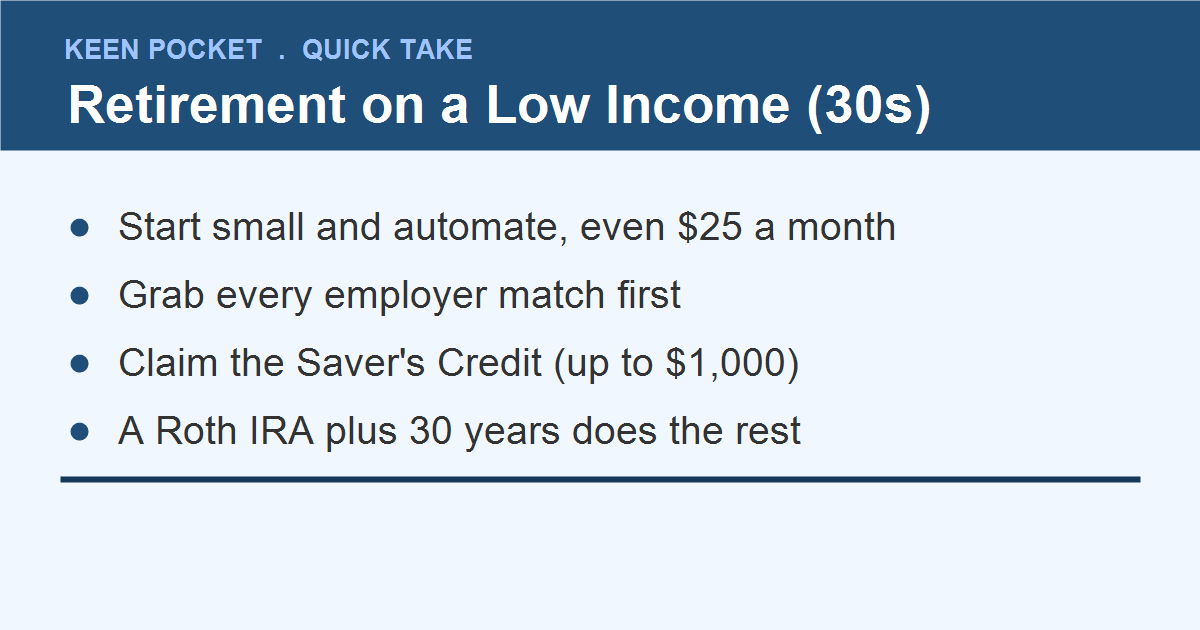
Why your 30s beat a bigger income later
Compounding rewards time more than size. A small amount invested at 32 has over three decades to grow, and the growth itself starts earning growth. Someone who waits until their late 40s to get serious, even on a much bigger salary, has to shovel in far more cash to catch up to where you could quietly coast.
That is the quiet superpower of starting now. You do not need to be impressive, you just need to be early and consistent. A few decades of small, automatic deposits can outrun a late start with a fat paycheck.
Start with any amount, even $25 a month
The biggest myth on a tight budget is that a small contribution is not worth making. It is. Starting the habit matters more than the size of the first deposit, because you can raise it later as your pay grows. What you cannot get back is the years you skipped.
Treat the contribution like a bill with a due date, not a leftover you fund if anything remains. Automate it so it moves the day you get paid, before you can spend it. Then bump it up by 1% of your pay each year, or whenever you get a raise, and you will barely feel the climb.
Make the habit stick
If even $25 feels tight right now, start at $10 and prove to yourself the transfer works. The number is not the point yet. The rhythm is.
Where to find the money to invest
On a tight budget, the contribution money rarely appears on its own. You redirect it. The most painless dollars are the ones you never built your life around: a raise, a tax refund, a bonus, or the month a loan finally gets paid off and that payment frees up for good.
Smaller sources add up too. One forgotten subscription can fund a $15 monthly contribution. A few hours of side income can cover a whole month at once. The trick is to route new or freed-up money straight into the IRA before it blends into everyday spending and quietly disappears.
Redirect a raise or refund before your spending adjusts.
Cancel one unused subscription and reroute it.
Send part of any side-gig cash straight to the IRA.
Waiting for a big windfall that may never come.
Inflating your lifestyle the moment income rises.
Stopping the transfer in a tight month. Shrink it instead.
None of this asks you to live on less than you already do. It asks you to catch money in motion and point a little of it at your future self before it slips away.
Grab every dollar of employer match first
If your job offers a 401(k) or 403(b) with a match, that is the first place your money should go, before anything else. A match is not a bonus, it is an instant, guaranteed return on your own contribution. Put in 3% and get a 3% match, and you just doubled that money the moment it landed.
Contribute at least enough to capture the full match, whatever percentage your employer sets. Skipping it is the one mistake with no upside. You are leaving pay on the table that was offered to you.
A full employer match is a 100% return on day one. No investment on earth reliably beats free money, so claim all of it before anything else.
No match at your job, or no workplace plan at all? That is common for hourly, gig, and part-time work, and the next section is built for exactly that situation.
Retirement planning on a low income: pick the right account
When you do not have a 401(k) match to chase, an Individual Retirement Account is your workhorse. Anyone with earned income can open one, and a Roth IRA is usually the winner on a low income. You contribute money you have already paid tax on, and every dollar comes out completely tax-free in retirement. When your tax rate is low today, paying that tax now is a bargain.
A Traditional IRA flips the timing, giving you a deduction now and taxing withdrawals later. On a modest income, the upfront deduction is worth less because you are in a low bracket already. The table lays out the trade-offs. Treat the limits as the 2026 IRS figures, and confirm current numbers before you contribute.
| Account | Best for | 2026 limit | Tax timing |
|---|---|---|---|
| Roth IRA | Low earners now, tax-free later | $7,500 | Pay tax now, none later |
| Traditional IRA | A deduction you need today | $7,500 | Deduct now, tax later |
| 401(k) / 403(b) | Anyone with an employer match | $24,500 | Grab the match first |
You will not come close to these limits on a low income, and that is fine. The caps are ceilings, not targets. Open a Roth IRA at a low-cost brokerage, pick a simple target-date or total-market fund, and set an automatic monthly transfer you can live with.
How to open your retirement account this week
If you do not have an account yet, opening one is a same-week task, not a life event. You do not need a financial advisor, a big balance, or any special knowledge to begin. Set aside twenty minutes and work through the list below.
Open a Roth IRA in four moves
A target-date fund is the closest thing to autopilot. You choose the one with the year nearest your retirement, and it handles the mix of stocks and bonds and shifts it as you age. One fund, and you are invested. Do not let picking investments become the excuse that stalls you for another year.
Claim the Saver’s Credit, the IRS pays you to save
This is the piece most retirement guides skip, and it is built for you. The Saver’s Credit is a tax credit that hands low and moderate earners back a chunk of what they put into a retirement account. It is worth 50%, 20%, or 10% of up to $2,000 you contribute, depending on your income, for a maximum credit of $1,000, or $2,000 for a married couple.
For 2026, you can qualify with an adjusted gross income up to $40,250 as a single filer, $60,375 as a head of household, or $80,500 filing jointly, per the IRS. The lower your income, the higher your percentage, so the people who most need help get the biggest break. Contribute to your IRA or 401(k), then claim it with Form 8880 at tax time.
Think about what that does. If you are in the 50% tier and you contribute $2,000, the government effectively refunds $1,000 of it. Your retirement account keeps the full $2,000, and you get $1,000 back. Few money moves on a low income pay you that fast.
Your step-by-step low-income retirement plan
Order matters more than amount here. Doing these in sequence keeps a surprise expense from wrecking your progress and puts free money ahead of everything else. Here is the whole plan on one page.
Park a small starter emergency fund so you are not forced to raid retirement later.
Knock down high-interest debt, since a 24% credit card beats any market return.
Contribute enough to grab the full employer match if you have one.
Open a Roth IRA and automate a monthly amount you can actually keep up.
Raise the amount 1% a year and claim the Saver’s Credit each tax season.
If money is tight this month, it is fine to sit on step one for a while. The sequence is the map, not a race. Just keep moving down it as your situation allows.
What small, steady contributions become by 65
Numbers make this real, so here is a hypothetical grounded in a 30-year runway from age 35 to 65. These use an assumed 7% average annual return, which is a common long-run stock market estimate, not a guarantee. Markets rise and fall, and your real result will differ.
$50 a month looks pointless. It is only $600 a year, barely a rounding error next to a retirement number.
At a hypothetical 7% over 30 years, that $50 a month grows to roughly $60,000. The growth did most of the work.
Scale it up and the picture gets brighter. Around $100 a month lands near $120,000 over the same 30 years, and $200 a month climbs toward $245,000, all at that same hypothetical 7%. You contributed a fraction of those totals. Compounding added the rest. That is why starting in your 30s, even small, is such a strong move for retirement planning on a low income.
Mistakes that quietly cost low-income savers
A tight budget leaves no room for expensive slip-ups, and a few common ones can erase years of effort. The most damaging is cashing out a 401(k) when you change jobs. It feels like found money, but you lose the growth, and you usually pay taxes plus a 10% penalty on top.
⚠️ Watch Out
Waiting until you earn “enough” to start is the costliest move of all, because you forfeit your best asset, which is time. And never skip the employer match or the Saver’s Credit. Both are free money you qualify for right now.
The other trap is thinking you must choose between debt and retirement and freezing. You do not. Grab the match, chip at high-interest debt, and let a tiny automatic IRA run in the background. Progress on all three beats perfection on none.
Where retirement fits with your other money goals
Retirement is one shelf in a bigger cabinet, and it works best when the shelves below it are steady. A small emergency fund keeps a car repair from becoming a retirement withdrawal, and clearing high-interest debt frees up cash you can redirect into that automatic contribution. Build the base, then let the long-term money compound untouched.
Automate a small amount, capture every match and credit, and let 30 years do what a big salary cannot.
Tie it to what you are already building. If you are still setting up a cushion, start with saving your first $1,000 and figure out how much emergency fund you need. When you are ready to invest the retirement money, our guides to investing $50 a month and starting to invest with little money walk you through the how.
📌 How we researched this
Contribution limits and Saver’s Credit income thresholds come from the IRS 2026 figures (IR-2025-111). The median savings figure is from the Federal Reserve’s 2022 Survey of Consumer Finances. The 30-year projections are hypothetical illustrations at an assumed 7% average annual return, not a forecast or a promise. Confirm current tax numbers with the IRS or a tax professional before acting.
Frequently asked questions
How much should I save for retirement on a low income?
Save what you can automate and keep, even if that is $25 a month to begin. A common goal is working toward 10% to 15% of your pay over time, but starting small and raising it 1% a year is what matters most in your 30s. The habit beats the amount.
Roth IRA or Traditional IRA if I earn a low income?
A Roth IRA usually wins on a low income. You pay tax on contributions now while your rate is low, then withdraw everything tax-free in retirement. A Traditional IRA gives a deduction today, which is worth less when you are already in a low bracket.
What if my job does not offer a 401(k)?
You can still save on your own. Anyone with earned income can open an IRA at a brokerage and set up automatic monthly contributions. Many hourly and gig workers rely on a Roth IRA as their main retirement account, and it still qualifies you for the Saver’s Credit.
Do I qualify for the Saver’s Credit?
For 2026 you may qualify with an adjusted gross income up to $40,250 as a single filer, $60,375 as head of household, or $80,500 married filing jointly. You claim it with Form 8880 after contributing to a retirement account. It is worth 10%, 20%, or 50% of up to $2,000, depending on income.
Is it too late to start retirement planning in my 30s?
Not at all. With roughly 30 years until a traditional retirement age, compounding still has plenty of time to work. The median saver under 35 has only $18,880 set aside, so starting now on a low income puts you ahead of the curve, not behind it.
Will Social Security be enough for a low-income retiree?
Social Security is designed to replace only part of your income, and it usually is not enough to live on comfortably by itself. Your own savings, even modest ones, fill the gap. Treat any future benefit as a base, not the whole plan.
Should I pay off debt or save for retirement first?
Do both in the right order. Grab any employer match first, since that is a guaranteed return. Then attack high-interest debt like credit cards, which usually costs more than investments earn. Keep a small automatic contribution running the whole time so the habit never stops.
What should I invest my retirement money in?
For most beginners, one broad fund is plenty. A target-date fund matched to your retirement year, or a low-cost total-market index fund, gives you instant diversification without picking stocks. Keep fees low and avoid trading in and out. This is not personalized advice, so match choices to your own comfort with risk.
The bottom line
Retirement planning on a low income in your 30s is not about heroic saving. It is about starting a small automatic habit, grabbing the free money from a match and the Saver’s Credit, choosing a Roth IRA that fits your tax picture, and letting three decades of compounding carry the load.
Pick one number you can commit to today, automate it, and set a yearly reminder to nudge it up. That single decision, made in your 30s, is worth more than any raise you could chase to make up for it later.
Sarah is the founder and lead editor of KeenPocket, where she writes practical, plain language guides on budgeting, saving, and investing for people building financial stability on a modest income. KeenPocket articles are educational and are not personalized financial, tax, or investment advice; for decisions about your own situation, consider speaking with a licensed professional. Last reviewed: August 2026.

Sarah Whitman is the founder and lead editor of Keen Pocket. She holds a BS in Accounting and Finance and writes plain-English guides on budgeting, saving, debt, and beginner investing.