

How to Save Money on Car Insurance Without Reducing Coverage (9 Ways)

Last fact-checked: · Editorial standards
Car insurance keeps getting more expensive, and it is not your imagination. Premiums climbed about 30% between 2023 and 2025, according to a Consumer Reports survey of more than 40,000 drivers. When the bill jumps, the tempting fix is to strip off coverage and hope nothing happens. That is the one move that can bankrupt you after a bad crash.
The better path is to attack the price, not the protection. You can save money on car insurance without reducing coverage by shopping your rate, adjusting your deductible on your own terms, bundling, opting into a usage program, and claiming discounts you already qualify for. Same policy limits, smaller bill.
This guide walks through nine levers that lower your premium while keeping every bit of your coverage intact. We will put real numbers on each one, show how they stack on an average policy, and flag the traps that quietly weaken your protection so you can avoid them.
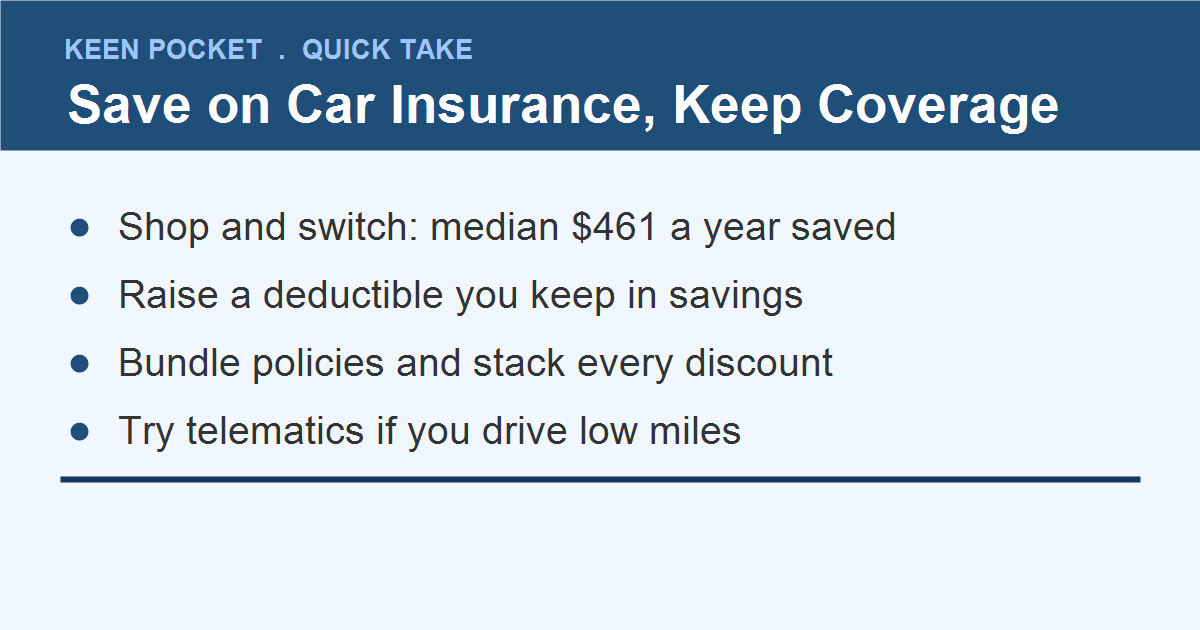
Shop around and compare quotes every year
This is the single biggest lever, and most people never pull it. Insurers price the same driver very differently, and your current company counts on your inertia. In the Consumer Reports survey, drivers who switched saved a median of $461 a year, yet only about 30% had shopped their policy in the past five years.
Get quotes from at least three insurers for the exact same coverage limits and deductibles you have now. The National Association of Insurance Commissioners stresses giving each company identical information so the quotes are truly comparable. If a competitor beats your rate, you either switch or ask your current insurer to match it.
Raise your deductible the smart way
Your deductible is what you pay out of pocket before insurance kicks in on a claim. Raising it lowers your premium, and it does not touch your coverage limits at all. According to the Insurance Information Institute, moving from a $200 to a $500 deductible can cut collision and comprehensive costs by 15 to 30 percent, and going to $1,000 can save 40 percent or more.
There is one rule that makes this safe. Only raise your deductible to an amount you can actually pay tomorrow if you crash today. If you bump it to $1,000, keep that $1,000 sitting in savings so a fender bender is an annoyance, not a crisis.
💡 Quick Tip
A higher deductible changes what you pay after a claim, not how much your policy will cover. Park the deductible amount in a savings account first, then raise it and pocket the lower premium.
Bundle your policies with one insurer
If you rent or own, you almost certainly need another policy, and putting it with your car insurance usually earns a real discount. Bundling home and auto, or auto and renters, can save up to around 30% with some carriers, and it makes your bills simpler too.
Ask your insurer what the bundled price looks like before you assume it is cheaper, since a rare few come out ahead unbundled. Most of the time, one company handling both lines rewards you for the loyalty with a multi-policy discount, and your coverage on each policy stays exactly the same.
Bundling home or renters with auto can shave up to 30% off, with zero change to what either policy protects.
If you do not have a second policy yet, renters insurance is cheap on its own and often pays for itself through the auto discount it triggers.
Use a telematics or low-mileage program
Telematics, also called usage-based insurance, lets your insurer see how you actually drive through an app or a small plug-in device. Safe, low-mileage drivers tend to win here. Consumer Reports found people in these programs saved a median of $120 a year, and some insurers advertise discounts of 10 to 30 percent.
This is an opt-in discount, not a coverage cut. Your limits stay put; you are simply proving you are a low-risk driver. If you drive few miles or mostly calm suburban routes, it is close to free money.
Telematics tends to pay off if you
Check whether your insurer’s program can raise your rate for risky driving or only lower it. Many are discount-only, which makes trying one an easy call.
Stack every discount you qualify for
Insurers offer a long menu of discounts, and they rarely apply them automatically. This is where a five-minute phone call pays off. Ask your agent to read you the full list and check which ones you are missing, because the small ones add up fast.
Paperless billing and autopay often trim 4 to 10 percent. Anti-theft devices can cut 5 to 20 percent. A defensive driving course saved drivers about $233 a year in the Consumer Reports data. None of these touch your coverage; they just lower the price of keeping it.
Good student, low mileage, military, occupation, and loyalty discounts may also apply. You will not qualify for all of them, but you almost certainly qualify for more than you are getting.
All nine methods compared at a glance
Here is how the levers stack up side by side. Treat the savings as typical ranges from 2024-2025 sources, not guarantees, since your rate depends on your state, car, and history. The key column is the last one: every method leaves your coverage untouched.
| Method | Typical savings | Effort | Coverage impact |
|---|---|---|---|
| Shop and switch | ~$461/yr median | Medium | None |
| Raise deductible | 15 to 40%+ | Low | None |
| Bundle policies | Up to ~30% | Low | None |
| Telematics program | ~$120/yr, up to 30% | Low | None |
| Stack discounts | 4 to 20% each | Low | None |
| Improve credit | Varies by state | Slow | None |
| Pay annually, go paperless | 4 to 10% | Low | None |
Notice that the highest-effort move, shopping around, also tends to pay the most. If you only do one thing this week, do that one.
Fix the two things insurers watch most
Beyond discounts, two background factors quietly set your base rate: your credit history and your driving record. In most states, insurers use a credit-based insurance score, so the same habits that build good credit also lower your premium over time. A clean record of no claims and no tickets does the same.
These are slow levers, not overnight fixes, but they compound. Check your credit report for errors, since a mistake there can inflate your rate for no reason. And guard your record: one avoidable lapse or ticket can undo a year of the savings above.
Check your credit report and dispute any errors.
Keep continuous coverage with no gaps.
Ask if a defensive driving course removes points.
Letting your policy lapse between insurers.
Ignoring credit errors that raise your score.
Filing tiny claims you could pay yourself.
When you switch insurers, line up the new policy to start the same day the old one ends. A single day of no coverage can bump your future rates.
Small levers: pay annually, go paperless, review yearly
A few low-effort habits round out the savings. Paying your premium in one annual lump instead of monthly installments often removes installment fees. Going paperless usually adds a small discount on top. And a yearly policy review keeps you from paying the loyalty penalty, where long-time customers slowly drift to higher rates.
Pay in full for the term if you can, to skip installment fees.
Switch to paperless billing and autopay for the extra discount.
Re-shop your policy every year at renewal, even if you stay.
Set a yearly calendar reminder near your renewal date. Fifteen minutes once a year is a strong return for the money it keeps in your pocket.
A realistic savings stack on a $2,500 premium
Numbers make it concrete. Say you start at the rough national average of $2,500 a year for full coverage, and you qualify for a handful of these moves. This is a hypothetical stack, not a promise, and not everyone will qualify for every discount, but it shows how the levers combine.
$2,500 a year, full coverage, never re-shopped, no extra discounts applied.
Roughly $1,600 to $1,800 a year, same coverage, after switching, bundling, telematics, and paperless.
That is $700 to $900 back in your budget for identical protection. Switching alone might save around $460, a telematics discount adds roughly $120, bundling and small discounts trim the rest, and a higher deductible you can afford squeezes out even more on the collision side. Nobody hits every number, but stacking two or three is realistic.
The coverage worth keeping while you cut costs
Since the whole point is to lower the price without weakening your protection, it helps to know which coverages are worth defending. These are the parts of a policy that turn a catastrophe into a manageable event, and they are exactly what a too-cheap quote tends to quietly shrink.
Liability limits protect your savings and future income if you injure someone or damage property. Uninsured and underinsured motorist coverage steps in when the other driver has little or no insurance, which is more common than you would hope. Comprehensive covers theft, weather, and animal strikes. Keep these strong and cut the price elsewhere.
Dropping collision or comprehensive can make sense on a car worth very little, which the Insurance Information Institute notes when the vehicle is worth less than about ten times what you pay to insure it. That is a math decision on an old beater, not a way to save on a car you still rely on.
Mistakes that quietly cost you or cut coverage by accident
Chasing a lower price can backfire if you are not careful about what you are actually buying. The most common trap is picking the cheapest quote without checking that it carries the same liability limits and coverage types as your old policy. A rock-bottom price often hides a thinner policy.
⚠️ Watch Out
Dropping your liability limits or cutting uninsured-motorist coverage to save a few dollars is not saving, it is shifting risk onto yourself. Lower the price with the levers above, never by thinning the protection that matters after a serious crash.
Also resist filing small claims you could pay out of pocket, since a claim history can raise your rate more than the payout was worth. Save your insurance for the losses that would actually hurt.
Where to put the money you save
The point of trimming a bill is to redirect that money somewhere it works for you, not to let it dissolve back into spending. A few hundred dollars a year is a real head start on a goal you already have.
Cut the premium with these levers, then send the savings straight to a goal before it disappears.
Send it somewhere useful on autopilot. A great first home is the deductible cushion this guide keeps mentioning, and our guide on emergency funds for renters and homeowners helps you size it. For more painless wins, see our lists of tiny habits that save $500 a month and cashback strategies for everyday bills.
📌 How we researched this
Savings figures come from the Insurance Information Institute, the National Association of Insurance Commissioners, and Consumer Reports’ 2024 survey of more than 40,000 policyholders. Ranges are typical, not guarantees, since your rate depends on your state, vehicle, and driving record. Confirm any discount with your own insurer before counting on it.
Frequently asked questions
What is the cheapest way to save money on car insurance without losing coverage?
Shopping around and switching insurers tends to save the most, a median of $461 a year in Consumer Reports data, with no change to your coverage. Pair it with a deductible you can afford and every discount you qualify for to stack the savings.
Does raising my deductible reduce my coverage?
No. A deductible is only what you pay before insurance covers the rest, so raising it changes your out-of-pocket cost on a claim, not your coverage limits. Just keep the deductible amount in savings so you can pay it if you need to.
How much can I save by switching car insurance?
Drivers who switched saved a median of $461 a year in the Consumer Reports 2024 survey, though your result depends on your state, car, and record. Always compare identical coverage limits so you are truly comparing price, not protection.
Is usage-based or telematics insurance worth it?
For safe, low-mileage drivers, usually yes. Consumer Reports found a median savings of $120 a year, and many programs only lower your rate rather than raise it. Confirm whether your insurer’s program can penalize risky driving before enrolling.
How often should I shop for car insurance?
About once a year, ideally near your renewal date, and any time your life changes, such as moving, buying a car, or adding a driver. Loyalty rarely pays in insurance, so a quick annual comparison keeps your rate honest.
Will lowering my premium automatically drop my coverage?
Not if you use the right levers. Shopping, deductibles, bundling, telematics, and discounts all lower the price while keeping your limits intact. Coverage only drops if you actively remove a coverage type or reduce a limit, which this guide advises against.
Does bundling always save money?
Usually, but not always, so ask for the bundled and unbundled prices before you decide. Multi-policy discounts are common and can reach around 30%, yet a few carriers price a standalone auto policy lower. Compare the real numbers rather than assuming.
Can I lower my rate without switching companies?
Yes. Ask your current insurer to review your discounts, raise your deductible, add a telematics program, bundle another policy, or match a competitor’s quote. Many will adjust your rate to keep you, especially if you bring a lower quote to the conversation.
The bottom line
Rising rates do not have to mean choosing between a painful bill and being underinsured. You can save money on car insurance without reducing coverage by treating your premium as negotiable: shop it every year, set a deductible you can back with savings, bundle, opt into a usage program, and claim every discount on the list.
Do two or three of these and a few hundred dollars a year is well within reach, all while keeping the exact protection you have now. Start with a fresh set of quotes this week, then send whatever you save toward a goal that matters.
Sarah is the founder and lead editor of KeenPocket, where she writes practical, plain language guides on budgeting, saving, and everyday bills like insurance. KeenPocket articles are educational and are not personalized financial or insurance advice; for decisions about your own coverage, consider speaking with a licensed agent or your state insurance department. Last reviewed: August 2026.

Sarah Whitman is the founder and lead editor of Keen Pocket. She holds a BS in Accounting and Finance and writes plain-English guides on budgeting, saving, debt, and beginner investing.