High-Yield vs Regular Savings Account: Is Switching Worth It on a Small Balance?

Last fact-checked: · Editorial standards
Short answer: yes — if the money is going to sit there for a while, and the switch costs you nothing, which it does.
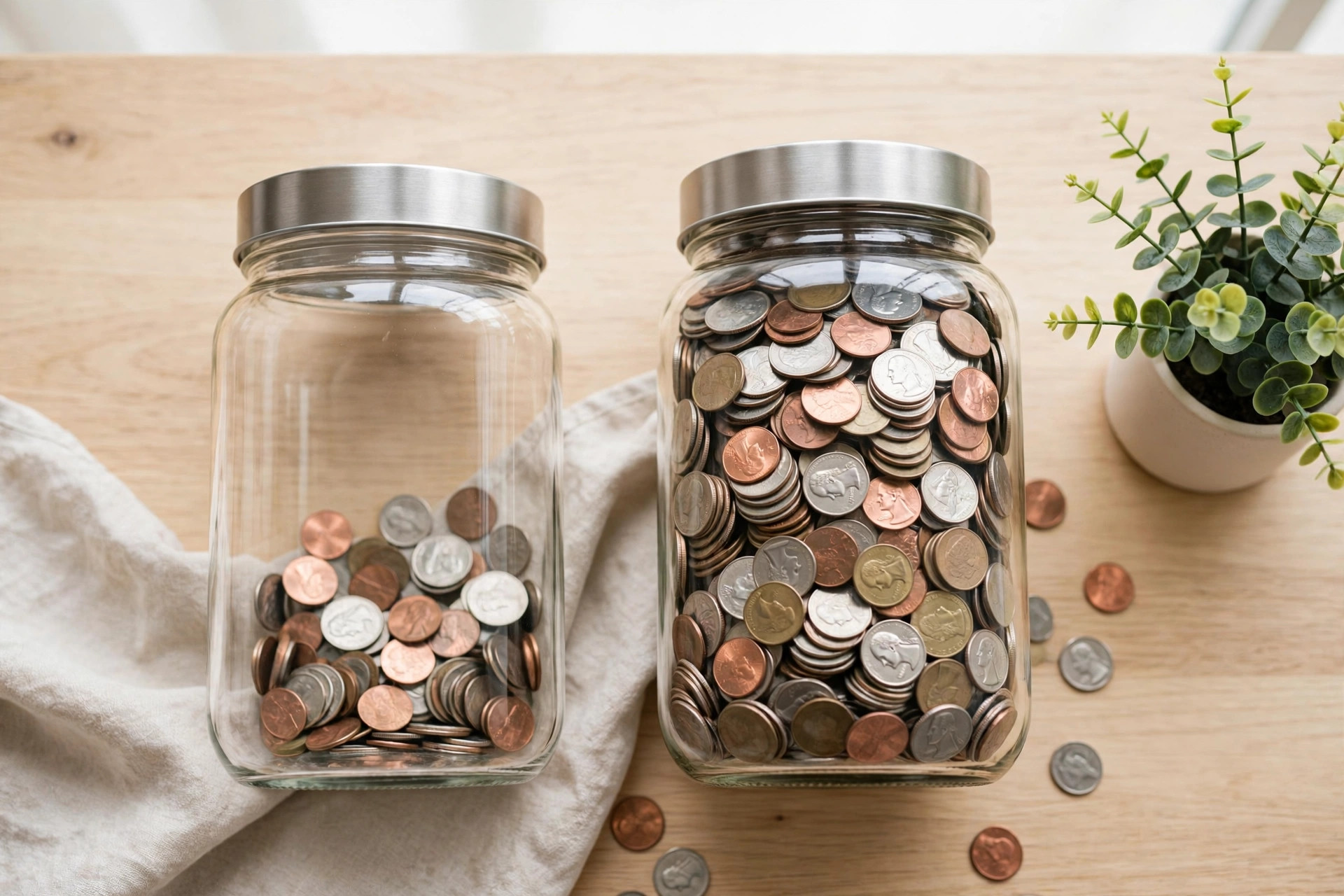
A regular savings account and a high-yield savings account are the same thing with one number changed. Same FDIC insurance, same kind of deposit account, same safety. The only difference is the interest rate — and right now that difference is about ten times.
The question is not whether the high-yield account pays more. It does. The question is whether the extra money is enough to matter on a small balance, and whether there is a catch hiding behind the rate. This post does the maths on $100, $500, $1,000 and $10,000, explains why the two accounts pay such different rates, and says honestly when the regular account is still the right choice.
What each one actually is
A regular savings account is the one most people already have: the savings account that came with their checking account at a branch bank — Chase, Bank of America, Wells Fargo. It holds money outside checking, earns a little interest, and is there when you need it.
A high-yield savings account (HYSA) is the same product, usually at an online bank — Ally, Capital One 360, Marcus, SoFi, Pibank. It holds money outside checking, earns interest, and is there when you need it. The difference is the rate.
That is the whole distinction. “High-yield” is a marketing label, not a legal category. There is no separate law, no separate licence, no separate kind of account. A bank calls its savings account “high-yield” when it pays a competitive rate; another bank calls the same kind of account “savings” and pays almost nothing.
High yield savings vs regular savings account: side by side
| Regular savings account | High-yield savings account | |
|---|---|---|
| Typical APY (Nov 2026) | 0.01% at Chase/Wells Fargo; 0.04% at Bank of America; national average 0.39% | 3.20% at Ally and Capital One 360; up to 4.40% at Pibank and SoFi; up to 5.00% promo at Axos ONE |
| FDIC/NCUA insured | Yes, up to $250,000 per depositor, per bank, per ownership category | Yes — exactly the same cover |
| Monthly fee | Often $5–$8 unless waived by a minimum balance or auto-transfer | Usually $0, no minimum |
| Minimum to open | Usually $0 | Usually $0 |
| Branch access | Yes — walk in, deposit cash, talk to someone | Usually none — online and phone only |
| ATM/debit card | Sometimes, at branch banks | Usually not on the savings account itself |
| How fast you get the money | Same day — same bank, instant transfer to checking | 1–3 business days by ACH transfer to your checking |
| Rate type | Variable — can change any time | Variable — can change any time |
| Best for | Money you need this week; cash deposits | Emergency fund and savings goals you will not touch for months |
Read the table once and the rest of this post is detail. Everything that matters is in the first two rows: the rate, and the insurance — which is identical.
The dollar maths: what switching actually pays
APY already includes compounding, so the one-year maths is simple: balance × APY = interest earned in a year. Here it is at the FDIC national average of 0.39%, at a big bank’s 0.01%, and at a round 4.00% — a rate several top high-yield accounts pay around, with no conditions.
| Balance | At 0.01% (Chase standard) | At 0.39% (national average) | At 4.00% (HYSA example) | Extra per year vs the average |
|---|---|---|---|---|
| $100 | $0.01 | $0.39 | $4.00 | $3.61 |
| $500 | $0.05 | $1.95 | $20.00 | $18.05 |
| $1,000 | $0.10 | $3.90 | $40.00 | $36.10 |
| $5,000 | $0.50 | $19.50 | $200.00 | $180.50 |
| $10,000 | $1.00 | $39.00 | $400.00 | $361.00 |
Look at the $500 row, because that is the balance this post is about. At the national average you earn $1.95 in a year — less than a coffee. At 4.00% you earn $20.00. The difference is $18.05 a year. At Chase’s 0.01% the difference is $19.95, because $500 at 0.01% earns five cents in a whole year.
Eighteen dollars is not life-changing money, and nobody should pretend it is. But it is free: switching costs $0, the account costs $0 a month, and the money is insured the same way. It is $18 a year for about twenty minutes of work, every year, for as long as the money sits there. On $1,000 it is $36.10 a year. On a $5,000 emergency fund it is $180.50 — real money, the size of a grocery trip, for doing nothing after the switch.
Monthly, it is smaller and easier to feel: $1,000 at 4.00% earns about $3.33 a month; at 0.39% it earns about $0.33. Ten times the monthly interest, every month, on the same thousand dollars.
And the gap grows, because interest compounds. Leave $1,000 untouched for five years: at 4.00% it becomes about $1,217 — $217 of interest. At 0.39% it becomes about $1,020 — $20 of interest. Same thousand dollars, same five years, $197 apart. The longer the money sits, the more the rate matters.
One caveat on the 4.00% figure: it is a round example rate, not one bank’s rate. Several top accounts pay around it — Pibank at 4.40%, SoFi up to 4.40%, Peak Bank at 4.27% — and the plain no-conditions accounts most people actually open, Ally and Capital One 360, pay 3.20%. At 3.20%, $1,000 earns $32.00 a year instead of $40.00. The conclusion does not change; only the size of the win does. Check the rate on the bank’s own page on the day you open the account, because every one of these rates is variable and moves when the Fed moves.
Why online banks pay ten times more
If the accounts are the same, why does one pay 0.01% and the other 4.00%? Branches.
A branch bank runs thousands of buildings, staffs them, heats them, and pays rent on them. That costs money, and the money comes out of what the bank pays savers. An online bank has no branches. Its overhead is a website, an app and a call centre, so it can afford to pay savers more and still make its margin.
There is a second reason, less flattering to the big banks: they do not need to compete on rate. Most people open savings where they already bank, and most never check the rate afterwards. Chase pays 0.01% because deposits arrive anyway. The online banks have to pay 3–4% because nobody would move their money to a bank with no branches for 0.01%.
That is also why the gap survives the Fed’s moves. The Federal Reserve held its target range at 3.75–4.00% on 28 October 2026, and the best savings rates sit roughly in that range. The big branch banks pay 0.01% in the same economy. The Fed sets the weather; each bank decides how much of it reaches your account.
Is it worth it on $100 to $500?
Yes — with one condition: the money is going to sit there for a while.
On $100, the difference is $3.61 a year. That sounds trivial, and it is, until you notice what it costs you: nothing. No fee to open, no monthly fee, no minimum balance at the accounts named above, and about twenty minutes to open the account online. A $3.61 return on zero cost and twenty minutes is a good trade. The money also grows with you — the $100 becomes $500, then $1,000, and the same account keeps paying the same rate on all of it.
The only version where switching is not worth it is if the money will be gone within days. If $500 is rent money that leaves on the 1st, the interest is a few cents either way and the transfer delay matters more than the rate.
The honest downsides
A high-yield account is not better in every way. Four real drawbacks, stated plainly:
The rate is variable. Your 4.00% can fall. Every HYSA rate moves with the Fed — the next decision is 9 December 2026, and if the Fed cuts, savings rates follow within weeks. A regular savings rate can fall too, but it has almost nowhere to fall from. This is not a reason to avoid switching; it is a reason to check your rate once in a while instead of assuming it stays put.
Getting the money takes 1–3 days. A HYSA at a different bank from your checking moves money by ACH transfer, which takes one to three business days. If your car breaks down on a Friday, the money may not reach your checking until Monday or Tuesday. Keep a small buffer in checking for that. Some banks are faster — Capital One’s linked checking moves same-day in many cases — but do not count on same-day until you have tested it once.
No branch, no debit card, no cash deposits. There is nowhere to walk in with an envelope of cash, and usually no ATM card on the savings account itself. If your income arrives in cash, or you need a human being to sort out a problem face to face, an online-only bank will frustrate you.
Some banks still limit withdrawals. The federal rule that capped savings withdrawals at six a month was removed in April 2020, but banks can set their own limits. Ally, for example, limits certain withdrawals and transfers to a combined 10 per statement cycle. For an emergency fund you touch twice a year, that never matters. For an account you dip into weekly, it does.
None of these is a hidden fee or a trap. They are the price of the rate, and for money you are saving rather than spending, the price is low.
When regular savings still makes sense
Keep the regular account — or keep some money in it — when:
- You need the money within 30 days. Rent, a bill due next week, a purchase you have already committed to. The transfer delay costs more than the interest earns.
- You deposit cash. Tips, cash jobs, money from selling something. An online bank has no drawer to put it in; your branch bank does.
- You want a branch. Some people bank better with a person across a desk, especially for joint accounts, estates, or sorting out a problem. That is a real preference, not a failure.
- The balance is tiny and moving constantly. A $50 buffer that empties every payday earns pennies anywhere. Put the effort into the account where the balance actually grows.
The sensible setup for most people is both: checking and a small regular savings at the branch bank for this week’s money, and a high-yield account at an online bank for the emergency fund and the goals. You do not have to close anything to switch.
Will switching hurt my credit? Do I close the old account?
No, switching does not hurt your credit. Opening a savings account is not borrowing money. Banks usually check ChexSystems — a record of bank accounts, not a credit report — and most do not run a hard credit inquiry at all. There is no loan, no balance to carry, nothing to report to the credit bureaus. Your credit score does not move.
No, do not close the old account straight away. Open the high-yield account, link it to your existing checking, move a small test amount first — $25 or $50 — and confirm it arrives. Then move the savings balance over. Leave the old savings account open for a month with a small balance in it, in case a transfer or an automatic payment still points at it. Close it later, if you want to, once nothing is still using it. Closing a savings account has no effect on your credit either.
One more practical note: the interest you earn is taxable income. Your bank will send a 1099-INT if you earn $10 or more in a year, and the interest goes on your tax return. That is true at 0.01% and at 4.00% alike — the only difference is that at 4.00% there is actually something to report.
Bottom line
A high-yield savings account is not a different kind of account. It is the same account, with the same $250,000 of FDIC insurance, paying a rate about ten times higher because the bank behind it has no branches to pay for.
On $500, switching is worth about $18 a year. On $1,000, about $36. On a $5,000 emergency fund, about $180. It costs $0 to switch, $0 a month to keep, and about twenty minutes once. The only real costs are a 1–3 day transfer delay and no branch — and for money you are saving, not spending, those cost you nothing.
So if your savings are sitting at 0.01% or at the 0.39% national average, and the money is not needed this week, move it. The rate is the only difference. Take the better one.
Next in this series: how to switch to a high-yield savings account in 20 minutes without missing a payment — the step-by-step version of this post — each linking back to Best High-Yield Savings Accounts, How to Save Your First $1,000 and How to Save Money on a Low Income.
Rates verified 17 Nov 2026 from the FDIC, the Federal Reserve, NerdWallet and the banks’ own pages. APYs are variable and change without notice — check the rate on the bank’s own page before you open an account. This is not financial advice.

Sarah Whitman is the founder and lead editor of Keen Pocket. She holds a BS in Accounting and Finance and writes plain-English guides on budgeting, saving, debt, and beginner investing.