
Easy Savings Challenge for Low Income Families (5 That Work)

Last fact-checked: · Editorial standards
Most savings challenges are designed for people who already have money left over. The famous 52-week version has you set aside $52 in a single week by the end, adding up to $1,378. That is a fine plan if your budget has that kind of room. When it does not, the challenge quietly sets you up to feel like you failed by February.
Saving when money is tight is a different skill, and it deserves a different plan. The goal is not a big number on a chart. It is a small, steady habit that survives a rough week without falling apart.
This is an easy savings challenge for low income families, built around amounts you can actually spare. Every version here works on a few dollars a week, bends when your income is uneven, and still adds up to real money by the end of the year. And this matters more for tight budgets than almost anyone admits. In the Federal Reserve’s 2024 survey, only 24% of households earning under $25,000 had three months of expenses saved, compared with 75% of households earning $100,000 or more.
Why Most Savings Challenges Fail Low-Income Families
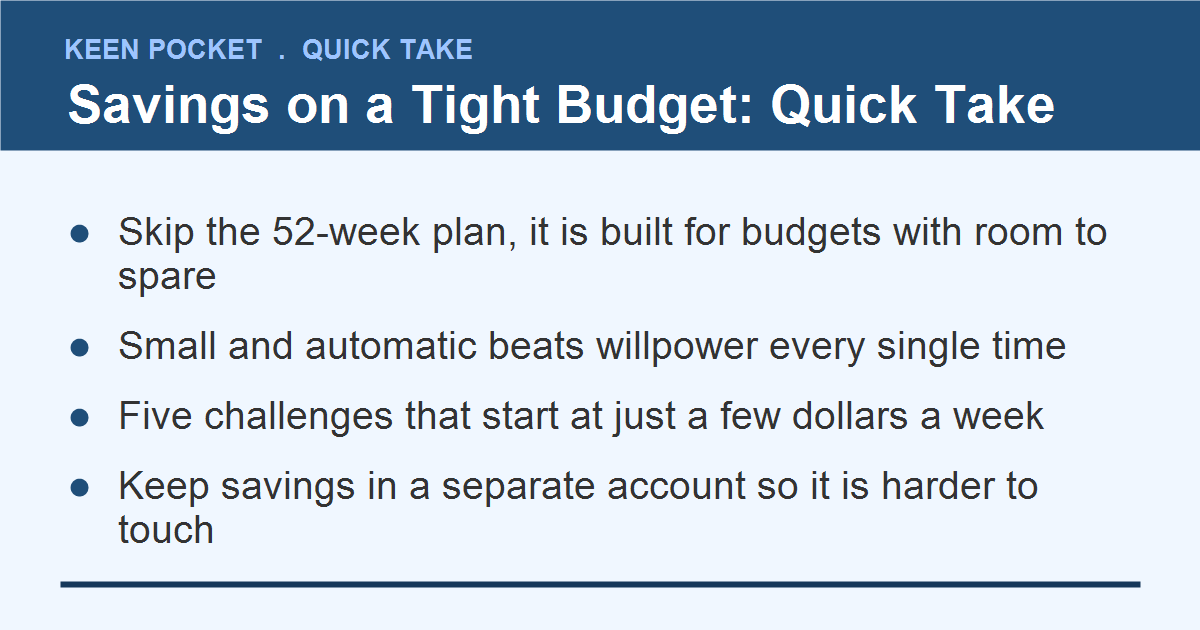
The problem is not effort. It is math. A challenge that ramps up to $52 a week assumes your budget grows a bigger pile of spare cash every month, and most tight budgets never do.
So a hard week hits, you cannot make that week’s payment, and the whole thing feels broken. You quit. A challenge sized to your real budget does the opposite. It keeps going even on your worst week, which is the only version that ever reaches December.
A savings challenge you can keep on a bad week beats a bigger one you quit in a month. Pick the smallest amount you will not miss, and protect the streak above the total.
Why Small and Automatic Beats Willpower
There is real research behind this. Economists who study saving have run field experiments for years, and the same pattern keeps showing up. People save far more when the decision is made once and then runs on its own, rather than being chosen fresh every week.
Part of the reason is what researchers call present bias, the very human pull to value money today over money later. Willpower fights that pull every single week and eventually loses. Automatic and commitment-style saving wins by removing the weekly decision entirely.
Deciding to save from scratch every week.
A rising target that demands more each time.
Money that sits in your everyday account.
One flat amount, set and forgotten.
An automatic transfer or round-up.
Money moved somewhere slightly harder to reach.
Keep that in mind as you read the challenges below. The best one for you is not the one with the biggest total. It is the one that needs the least willpower to keep going.
Challenge 1: The Flat Weekly Challenge
This is the simplest one, and the best place to start. You pick one small amount and save that same number every single week. No ramping up, no schedule to track, no surprises.
Because the amount never changes, you always know what is coming, so it survives a tight week. Even a couple of dollars adds up to real money over a year.
| Save each week | Per month | In one year |
|---|---|---|
| $2 | about $9 | $104 |
| $5 | about $22 | $260 |
| $10 | about $43 | $520 |
| $20 | about $87 | about $1,040 |
Start on the low end. You can always raise it later, but starting too high is the fastest way to give up. If you want more structure while the habit forms, a simple cash envelope system pairs well with a flat weekly amount.
Challenge 2: The Penny Challenge (Modified for Low Income)
The penny challenge turns saving into a slow-building game. You save one cent on day one, two cents on day two, and add a penny each day for a year. It ends up at $667.65, and the biggest single day is only $3.65.
The early days cost mere pennies, so there is no reason to skip. If even the later months feel steep, run the modified version: start at 50 cents and increase by 50 cents each week instead of each day.
A printable chart helps a lot here, since crossing off each day is what keeps the game going. This challenge also works well for kids learning that small amounts add up.
Challenge 3: The No-Spend Week
A full no-spend month can feel impossible with a family, so shrink it. Pick one week and spend only on true needs, like groceries, gas, and bills, with nothing extra.
Whatever you would have spent on takeout, coffee, or impulse buys goes into savings at the end of the week. One focused week is far easier to finish than thirty days.
Easy swaps for your no-spend week
Ready for a longer version once you have the hang of it? The site’s guide to a full no-spend month walks through the meal plans and rules step by step.
Challenge 4: The Round-Up Challenge
If deciding to save is the hard part, this is the challenge for you, because it removes the decision. Round-up tools take each purchase up to the next dollar and move the spare change into savings on their own.
This is the automatic saving the research points to. You set it once, then it works quietly in the background without asking for willpower.
The catch is that some round-up apps charge a monthly fee that eats your savings. Many banks now offer a free round-up feature on their own accounts, so check there first before paying for one.
Challenge 5: The Save What You Skip Challenge
This one connects saving to a choice you already make. Every time you skip something you would normally buy, you move that exact amount into savings the same day.
💡 Quick Tip
Skip a $4 snack and move $4 to savings right then, before the money drifts. Seeing the reward land immediately makes the skip feel worth it instead of like going without.
It turns every small no into a small yes for your future. Some weeks that is a few dollars, some weeks more, and either way it counts.
The 5 Challenges Side by Side
Before you pick, it helps to see all five together. There is no best one, only the best one for how your money comes in and how much willpower you want to spend.
| Challenge | Best for | Weekly cost | One-year total | Effort |
|---|---|---|---|---|
| Flat Weekly | steady income | $2 to $20 | $104 to $1,040 | very low |
| Penny (Modified) | slow builders | up to $3.65/day | $667.65 | low, needs a chart |
| No-Spend Week | a one-time reset | $0 extra | what you skip | medium, one week |
| Round-Up | irregular income | pennies, auto | varies | none, automatic |
| Save What You Skip | impulse control | what you skip | varies | low, in the moment |
If you only glance at one column, make it the last one. The lowest-effort challenge you will actually keep beats the one with the biggest total on paper.
Pick the Right Challenge for Your Situation
The best challenge is the one you will actually keep, which depends on how your money comes in.
A ramping plan that demands more each week until one bad paycheck breaks the whole streak.
A flat or automatic plan sized to your tightest week, so it keeps going no matter what the month throws at you.
If your income is steady, the flat weekly challenge is a clean fit. If it swings from week to week, lean on the round-up or the save-what-you-skip version, since neither one demands a fixed payment.
How to Make a Savings Challenge Stick
The challenge is easy. Staying with it for a year is the real work, and a few small setups make that far more likely.
Keep the money in a separate account, so it is a little harder to dip into. That small friction is doing real work.
Track it where you can see it, on a printable chart or a note on the fridge.
If you miss a week, skip it and keep going. One miss is not a failure.
Getting the kids involved helps too. When children color in a savings chart, the whole family stays motivated, and they pick up a money habit early. For outside accountability, nonprofits like America Saves run free savings pledges built on this same small-and-steady idea.
What Your First Year Looks Like
A flat $5 a week does not feel like much on a Tuesday. The magic is only visible when you zoom out and watch it stack, week after quiet week.
Bump it to $10 a week and that year-end number doubles to $520. The penny challenge, never asking more than $3.65 in a day, quietly lands at $667.65. None of it feels dramatic in the moment, and that is exactly why it works.
What to Do When You Have to Skip a Week
Every saver on a tight budget hits a week where there is simply nothing left to set aside. That is not failing the challenge. It is the whole reason this plan is built to bend instead of break. The rule is simple: skip the deposit, but do not skip the habit.
On a skipped week, still open the app or the envelope at your usual time and mark it. Keeping the ritual alive is what carries the streak across the gap, because the habit was never really about the dollar. When money comes back, pick up exactly where you left off rather than trying to make up the missed amount. Doubling up to catch up is the fastest way to burn out and quit for good.
If you skip three or four weeks in a row, drop your target lower rather than stopping. A dollar a week that lasts a year beats ten dollars a week that lasts a month.
Common Mistakes That Break the Streak
Most challenges do not end because the amount was wrong. They end over a couple of avoidable slips.
Start smaller than feels exciting.
Keep the money out of your everyday account.
Restart the day after any missed week.
Copying a big-number challenge from social media.
Raiding the savings for non-emergencies.
Quitting the whole thing after one missed week.
Where to Keep Your Savings So It Grows
Where you park the money matters almost as much as saving it, for two reasons. A separate account adds the friction that keeps you from dipping in, and the right account pays you a little extra for doing nothing.
Most everyday savings accounts pay close to the national average of about 0.39%. A no-fee, no-minimum high-yield savings account can pay many times that, which is free money layered on top of your own effort.
What to look for in a savings account
The site’s roundup of the best high-yield savings accounts shows which ones have no fees or minimums, and the guide to saving your first $1,000 maps where this habit leads once the challenge is rolling.
Frequently Asked Questions
What is the easiest savings challenge for low income families?
The flat weekly challenge is the easiest, since you save the same small amount every week with no ramping up. Even $2 or $5 a week builds a real cushion over a year, and it survives a tight paycheck.
How much can I realistically save on a tight budget?
Saving $5 a week adds up to $260 in a year, and $20 a week reaches about $1,040. Even the penny challenge, which never asks for more than $3.65 in a day, ends at $667.65. Start with whatever amount you will not miss.
What is the best savings challenge if my income is irregular?
Automatic options fit uneven income best. A round-up feature or the save-what-you-skip method never demands a fixed weekly payment, so a slow week does not break your streak.
Where should I keep the money during a savings challenge?
Keep it in a separate account from your everyday spending. That small bit of friction makes it less tempting to dip in, which the research on saving shows is one of the biggest factors in success.
How do I get my kids involved in a savings challenge?
Give them a chart to color in as the savings grows. Making progress visible keeps the whole family motivated and teaches children a money habit early.
Bottom Line
The right easy savings challenge for low income families is the one sized to your tightest week, not the flashiest number online. Pick a small flat amount, or let an app round up your change, and protect the streak above all else.
Quick recap
Every small amount you set aside moves you off that one-emergency-from-trouble line, the place where only 24% of the lowest earners have a real cushion. When you are ready for the next goal, the site’s guides on saving on a low income and saving your first $1,000 show you where this habit leads.

Sarah Whitman is the founder and lead editor of Keen Pocket. She holds a BS in Accounting and Finance and writes plain-English guides on budgeting, saving, debt, and beginner investing.