
How to Start Sinking Funds With Biweekly Paychecks (Beginner’s Guide)

Last fact-checked: · Editorial standards
You already know the bills are coming. The car registration renewal, the holiday gifts, the insurance premium that lands as one fat charge, the vet visit that somehow always arrives in the same week as everything else. None of it is a true surprise. It just never seems to have money waiting for it.
That gap is exactly what a sinking fund closes, and if you get paid every two weeks, you are holding the easiest version of the tool. Learning how to start sinking funds with biweekly paychecks comes down to one clean division and a little timing. No spreadsheet wizardry, no perfect budget, just a small amount pulled from each check before it can disappear.
This guide is about the biweekly part specifically: the per-paycheck math, the timing around your pay cycle, and where to park the cash. If you want the full menu of what to save for, our sinking fund categories guide and free tracker covers that in depth. Here, we make sinking funds with biweekly paychecks click into your actual pay schedule. Paid monthly instead? See how to manage money on a monthly paycheck.
What a sinking fund actually is (and why biweekly pay fits it)
A sinking fund is money you set aside a little at a time for a specific expense you know is coming but that does not bill every month. Holiday spending. New tires. The annual insurance renewal. You name the goal, pick a target, and feed it in small amounts until the bill shows up and the money is already there.
People mix this up with an emergency fund, and the difference matters. An emergency fund is for the unknown, the job loss or the ER visit you cannot predict. A sinking fund is for the known, the expense with a name and a rough price tag. You need both, and keeping them separate is what stops you from raiding your safety net every December.
Here is why biweekly pay suits this so well. Getting paid every two weeks means 26 paychecks a year, a steady drumbeat you can attach a savings habit to. Biweekly is also the most common way Americans get paid: about 43% of private businesses run a biweekly schedule, more than any other frequency, according to the U.S. Bureau of Labor Statistics. If that is you, this system was practically built for your pay stub.
This approach works best for anyone who feels caught off guard by the same expenses every year. If holidays, car repairs, or an insurance renewal keep landing on a credit card, you are the exact person sinking funds with biweekly paychecks are meant to help. You do not need a high income to start, just a small, steady slice of each check.
| Sinking fund | Emergency fund |
|---|---|
| For known, planned expenses | For unknown, unplanned shocks |
| Has a name and a target date | Has no date, just a cushion size |
| Gets spent on purpose, then refills | Stays put until a real emergency |
| Often several small funds | Usually one larger pool |
The one calculation: divide any bill by 26
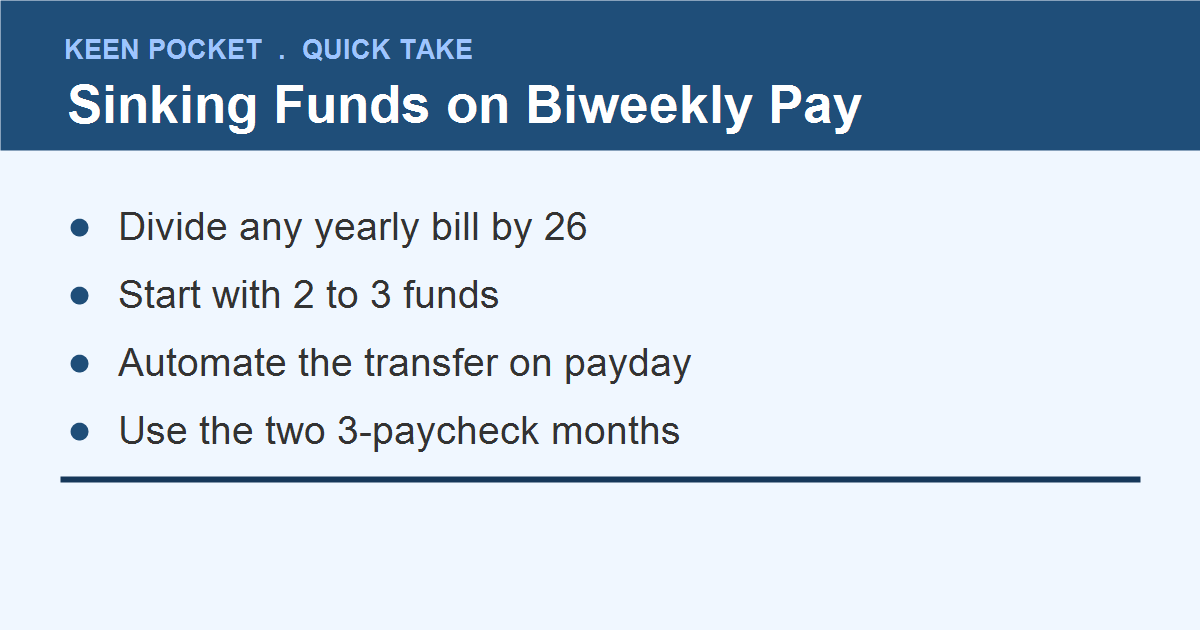
This is the whole trick, and it is why a biweekly schedule makes sinking funds so painless. Take the yearly cost of something, divide it by 26, and you have the amount to pull from each paycheck. That is it. One division per goal.
The numbers get real fast when you anchor them to what things actually cost. Americans planned to spend an average of $902 per person on the winter holidays in 2024, per the National Retail Federation. Car upkeep runs about $792 a year for maintenance, repairs, and tires, according to AAA. Divide each by 26 and the scary annual number turns into pocket change per check.
Notice how manageable that looks. Three real, recurring expenses that used to blindside you become $35, $31, and $14 a paycheck. You are not finding an extra $900 in December anymore. You are setting aside the price of a couple of coffees every two weeks and letting the calendar do the heavy lifting.
One small tweak makes it even easier: round each number up to the nearest $5. Saving $35 instead of $34.69 barely changes your paycheck, but the rounding quietly builds a buffer, so a slightly pricier holiday or a surprise part does not empty the fund. Rounded numbers are also simpler to set as a recurring transfer.
Sinking funds with biweekly paychecks: a starter set of categories
You do not need fifteen funds on day one. Start with two or three that hit the expenses most likely to wreck a month, then add more once the habit sticks. For the full menu of ideas, the categories guide lists them all, but here is a beginner starter set with the biweekly cost worked out.
The table below turns each category into a per-paycheck number so you can see the real commitment before you start. Treat the annual figures as typical ranges, not promises, and swap in your own quotes where you have them.
| Category | Typical yearly cost | Per paycheck (÷26) | Horizon |
|---|---|---|---|
| Holiday and gifts | ~$900 | $35 | once a year |
| Car maintenance and tires | ~$790 | $31 | rolling |
| Registration and taxes | ~$360 | $14 | once a year |
| Insurance premium | varies | your premium ÷ 26 | every 6 to 12 months |
| Annual subscriptions | ~$150 | $6 | once a year |
Pick the two that scare you most and start there. For most people that is the holiday fund and the car fund, because those are the expenses that reliably turn a normal month into a credit card month.
Timing it to your pay cycle: the two three-paycheck months
Here is the quiet bonus of a biweekly schedule. Twelve months times two checks is only 24, but you actually get 26 checks a year. That means two months each year land a third paycheck, and if your budget already runs on two checks a month, that third one is not spoken for.
To find yours, pull up a calendar and mark every payday for the year. Two months will have three marks. Those are your front-loading months. Instead of treating the extra check as a splurge, aim it straight at a sinking fund that has a deadline, like the holiday fund before December or the insurance premium before renewal.
This is the move that separates people who talk about sinking funds with biweekly paychecks from people who actually stay ahead. One well-placed third check can fund an entire holiday season on its own.
December arrives, the gift list is $900, and the card takes the hit you spend until spring paying off.
A third paycheck in the fall tops off the holiday fund, so December is already paid for in cash.
Where to keep sinking fund money so it grows
Cash you can see is cash you will spend. So the goal is to keep sinking fund money close enough to grab when the bill hits, but far enough from checking that you are not tempted mid-month.
The simplest setup for sinking funds with biweekly paychecks is one high-yield savings account with named buckets, one per goal. Many online banks now let you split a single account into labeled sub-savings, so you can watch the holiday bucket and the car bucket fill separately without opening five accounts. If your bank does not offer buckets, a spreadsheet or the free tracker does the same job on top of one account. See our breakdown of high-yield savings versus a CD for picking the right home.
Prefer physical cash? The cash envelope system works for short-horizon funds, though you lose the interest. For a fund you will not touch for a year or more, a no-penalty CD can pay a little extra while staying reachable.
Automate it: set it and forget it on payday
Willpower is a bad savings plan. The people who keep their funds full are almost never more disciplined than you. They just took themselves out of the decision by automating the transfer.
Schedule the money to move on payday or the morning after, before it can blend into your checking balance. When you are paid every two weeks, that is 26 tiny transfers a year you never have to think about again. Pairing this with a zero-based budget makes it airtight, because every dollar already has a job before it arrives.
Add up your per-paycheck amounts from the table (say $35 + $31 + $14 = $80).
Open a recurring transfer from checking to savings, set to repeat every two weeks on payday.
Label each bucket so you can see which goal every dollar belongs to.
Check it once a month, not once a day. The system runs itself.
A realistic first year on biweekly paychecks
Numbers make it stick, so let us walk a plain example. Say you start three funds at $80 a paycheck total: $35 for holidays, $31 for car upkeep, and $14 for registration. Across 26 paychecks that is $2,080 in a year, saved without a single frantic month.
The table shows the running total by quarter. Keep in mind that two of those quarters carry a third paycheck, so the real number often runs a bit ahead of the flat pace below.
| By the end of | Paychecks saved | Running total at $80 |
|---|---|---|
| Quarter 1 | ~6 | $480 |
| Quarter 2 | ~13 | $1,040 |
| Quarter 3 | ~19 | $1,560 |
| Quarter 4 | 26 | $2,080 |
By the time the holiday season and the registration renewal roll around, the money is sitting there with its name on it. That is the entire promise of sinking funds with biweekly paychecks: the bill stops being an event and turns into a withdrawal.
Common mistakes that quietly break a sinking fund
Most sinking funds do not fail because the math was wrong. They fail because of a few habits that are easy to fix once you spot them.
Keep sinking funds separate from your emergency fund.
Start with two or three goals, not ten.
Automate the transfer on payday.
Leaving the money in checking where it blends in.
Raiding the car fund to cover the holiday fund.
Setting amounts so high you quit in month two.
If a fund does run dry before its bill, do not scrap the whole system. Lower the amount, extend the deadline, and keep the transfer alive. A smaller fund that survives beats a perfect one you abandon.
What to do once a fund is full
This is the part that makes the habit worth it. When the bill finally arrives, you spend the fund on exactly what it was for, with zero guilt and zero interest. The holiday fund buys the holidays. The car fund pays the mechanic. No scramble, no card, no regret.
Then you reset. A one-time fund like registration goes back to zero and rebuilds for next year. A rolling fund like car repairs keeps a floor so the next surprise is covered. If a goal finishes early or comes in under budget, roll the surplus into your next fund or your emergency savings instead of letting it drift back into spending.
A sinking fund turns a $900 December into $35 a paycheck you never notice. The bill was always coming; now the money beats it there.
Frequently asked questions
How much should I put in sinking funds each paycheck?
Add up the yearly cost of each goal, divide by 26, and that is your per-paycheck amount. Three modest funds often total $60 to $100 a check. Start on the low end if that feels safer and raise it once the transfer stops stinging.
What is the difference between a sinking fund and an emergency fund?
A sinking fund is for known expenses with a name and a date, like holidays or new tires. An emergency fund is for the unpredictable, like a job loss or an ER bill. With 37% of adults unable to cover a $400 surprise in cash, per the Federal Reserve, you want both, kept separate.
Where should I keep my sinking fund money?
A high-yield savings account with labeled buckets is the sweet spot: close enough to reach when the bill lands, far enough from checking that you will not spend it, and earning interest while it waits. Cash envelopes work for short-term goals.
How many sinking funds should a beginner start with?
Two or three. Pick the expenses most likely to blow up a month, usually holidays and car costs, and add more only after the habit is automatic. Too many funds at once is the fastest way to give up.
What should I do with the third paycheck in a biweekly month?
Aim it at a sinking fund with a deadline. Two months a year hand you a third check that your two-check budget did not plan for. Front-loading the holiday or insurance fund with it can knock out a whole goal in one shot.
Can I use sinking funds if my income varies?
Yes. Set a small baseline transfer you can always afford, then add extra on stronger paychecks. The system flexes with you, and even $10 a check builds a real cushion over 26 pay periods.
Should I fund sinking funds or pay off debt first?
If you carry high-interest credit card debt, put most of your extra money there while keeping one small sinking fund for the bill most likely to derail you, usually car repairs. That tiny fund is what stops a surprise from sending you back to the card. Once the high-interest debt is gone, shift those payments into your funds.
The bottom line
Sinking funds are not a personality trait or a math degree. They are one division and one automatic transfer, repeated on a schedule you already have. Knowing how to start sinking funds with biweekly paychecks means you stop bracing for the known bills and start meeting them with cash that was waiting the whole time.
Pick two goals this week. Divide each by 26. Set the transfer for your next payday. By this time next year, the expenses that used to wreck a month will just be another line item you already paid for.

Sarah Whitman is the founder and lead editor of Keen Pocket. She holds a BS in Accounting and Finance and writes plain-English guides on budgeting, saving, debt, and beginner investing.