

How to Pay Off 5000 Credit Card Debt Fast on Low Income (A Real Plan)

Last fact-checked: · Editorial standards
Five thousand dollars on a credit card can feel like a wall, especially when your paycheck is already stretched thin. You make a payment, the interest eats half of it, and the balance barely moves. It is easy to feel like you will be stuck forever.
You will not be. Learning how to pay off 5000 credit card debt fast on low income is less about earning more and more about a clear plan, a lower interest rate, and finding a little extra to throw at the balance every month. Thousands of people on modest incomes do it every year, and you can too.
This is a realistic guide, not a fantasy one. We will show honest payoff timelines, a real case study on a $2,400 monthly income, and exactly where to find the extra money. The goal is to pay off 5000 credit card debt on low income without shame, gimmicks, or advice that assumes you have money you do not.
The real reason $5,000 feels stuck
The problem usually is not you. It is the interest rate. The average credit card charged over 23% for accounts carrying a balance in late 2024, according to the Federal Reserve. At that rate, a big chunk of every minimum payment just covers interest.
You are far from alone in this. Americans owed a record $1.21 trillion on credit cards at the end of 2024, per the Federal Reserve Bank of New York, and the average cardholder carries around $6,500. A $5,000 balance is normal, and so is wanting out of it.
⚠️ Watch Out
Paying only the minimum on $5,000 at 23% can take more than 15 years and cost thousands in interest. The minimum is designed to keep you paying, not to get you free. Beating it, even by a little, is the whole game.
Snowball or avalanche: pick one and commit
There are two proven ways to attack debt, and for a single $5,000 card the choice barely matters. What matters is picking one and sending every spare dollar to it instead of spreading payments thin.
The debt avalanche targets your highest interest rate first, which saves the most money. The debt snowball targets your smallest balance first for a quick win and momentum. If $5,000 is your only card, just throw everything at it. If you have several debts, our full debt snowball guide walks through the method step by step.
Pick one method and automate the extra payment.
Send every windfall straight to the balance.
Keep making at least the minimum on time.
Splitting extra cash randomly across cards.
Waiting for a “perfect” month to start.
Adding new charges to the card you are clearing.
Realistic payoff timelines on a low income
Here is the honest math, and it is the most important part of this guide. How fast you clear $5,000 depends almost entirely on how much extra you can pay each month. The table below assumes about a 23% rate, with figures rounded.
| Monthly payment | Time to pay off | Interest paid |
|---|---|---|
| $150 | about 4.5 years | around $3,000 |
| $250 | about 2 years | around $1,400 |
| $400 | about 14 months | around $760 |
| $430 on a 0% transfer | 12 months | about $150 fee, no interest |
How we calculated this: the payoff figures use a standard amortization formula at about a 23% APR (near the late-2024 average for cards carrying a balance) with a fixed monthly payment, rounded. Your real timeline depends on your exact APR, minimum payment, and whether you add new charges.
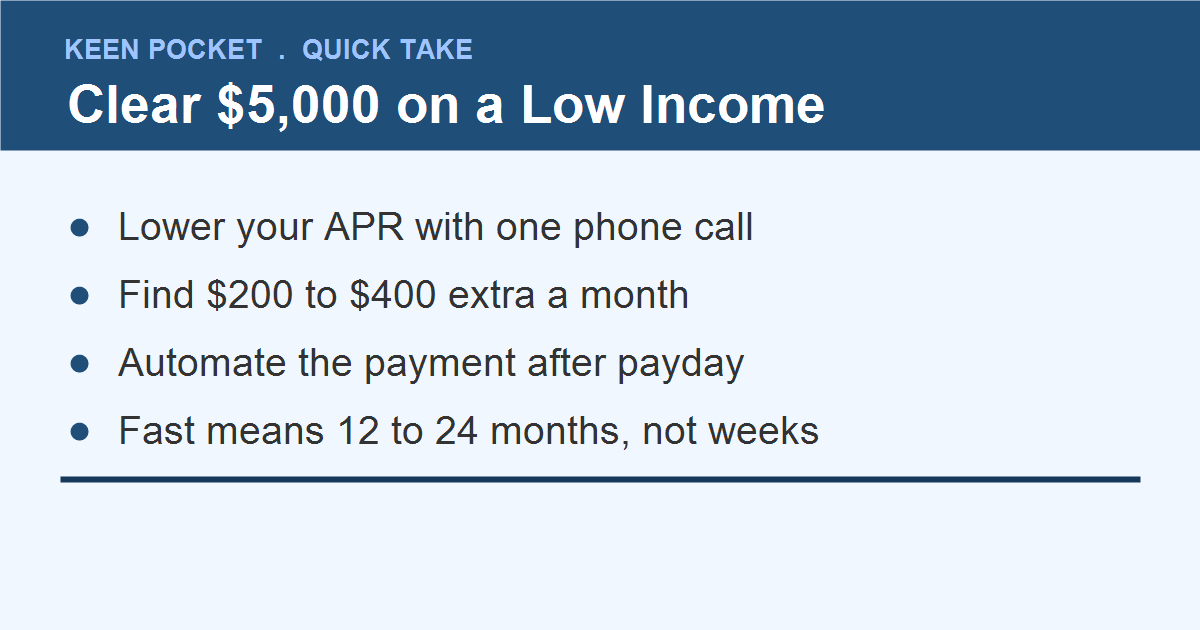
See the pattern? On a low income, “fast” realistically means 12 to 24 months, not a few weeks, and that is a genuine win. Every extra $100 a month you find cuts both the time and the interest dramatically. That is why the next section matters most.
It also reframes the whole goal. To pay off 5000 credit card debt on low income, you are not chasing a heroic one-time effort, you are locking in a payment you can actually sustain. A steady $250 that you never miss beats a $500 you can only manage twice before life gets in the way.
Find the extra $200 to $400 a month
This is the hard part on a low income, and the honest one. The payoff speed lives or dies on the extra payment, so the real work is freeing up cash. You rarely find it in one place. You stack it from several.
Say you trim $120 from groceries with smarter shopping, cancel $40 of subscriptions, and pick up $140 from a weekend gig. That is $300 a month you did not have before, and it turns a five-year slog into a payoff in under two years. Our guides on cutting the grocery bill and saving on a low income are built for exactly this.
Do not underestimate one-time cash either. A tax refund, a bonus, birthday money, or the proceeds from selling things you no longer use can all take a big bite out of the balance in a single payment. When your income is tight, the fastest way to pay off 5000 credit card debt on low income is to combine a steady monthly extra with every windfall you can send its way.
Lower your APR before you pay a dime more
Before you scrape together extra payments, try to shrink the interest rate working against you. A lower APR sends more of every dollar to the balance instead of the bank, and some of these cost nothing but a phone call.
Calls and moves to make first
Be honest with yourself here. Balance transfer and consolidation offers usually need good credit, so if your score is low, they may not be options yet. That is fine. A nonprofit credit counseling agency can often negotiate a lower rate for you, and the CFPB explains how legitimate ones work. The phone call to your own issuer is free and works more often than people expect.
Your first 30 days: where to start
Momentum matters more than perfection, so do not wait until you have read every article on the internet. The first month is about setting up the system that will pay off 5000 credit card debt on low income while you barely think about it.
Write down the real numbers. Your exact balance, your APR, and your minimum payment. You cannot plan around numbers you are avoiding.
Make the free calls. Ask your issuer for a lower rate and ask about a hardship plan. Ten minutes can save you hundreds.
Find your first extra payment. Even $50 above the minimum this month proves the plan is real and starts the momentum.
Automate it. Schedule the extra payment for the day after payday so it leaves before it can be spent.
That is the entire setup. Once those four things are in place, the plan mostly runs itself, and your only job each month is to protect that extra payment and resist adding new charges.
A real case study: $5,000 on $2,400 a month
Meet Maria. She brings home about $2,400 a month and owes $5,000 at 23%. She could only ever pay the minimum, so the balance never moved. Here is how she got unstuck, and it is a blueprint you can copy.
Maria found $300 a month by cutting her grocery bill, pausing two subscriptions, and picking up a few weekend hours. She automated a $300 payment the day after payday so it left before she could spend it. This is what her payoff looked like.
| Milestone | Balance left |
|---|---|
| Month 1 (first real dent) | about $4,800 |
| Month 6 | about $3,700 |
| Month 12 (over halfway) | about $2,300 |
| Month 20 (nearly done) | about $80 |
Maria was debt-free in about 20 months and paid roughly $1,090 in interest along the way. Not overnight, but real, and on an income most people would call tight. That is what it actually looks like to pay off 5000 credit card debt on low income.
What if $5,000 is not your only debt?
Plenty of readers who want to pay off 5000 credit card debt on low income also carry a second card, a car loan, or medical bills. The plan still works; you just decide the order of attack first, then point your extra payment at one target at a time.
If the total feels unmanageable no matter how you slice it, that is not a personal failure, it is a signal to get free help. A nonprofit credit counseling agency, such as a member of the National Foundation for Credit Counseling, can roll several debts into one lower-rate plan, and it costs little or nothing.
Avoid the traps that keep low-income borrowers stuck
The path is simple, but there are potholes that specifically target people who are struggling. Steering around them protects the progress you are working so hard for.
Keep the paid-down card open to protect your credit.
Build a tiny $500 buffer so surprises do not go back on the card.
Use free nonprofit help, not paid settlement firms.
Payday loans, which cost far more than the card.
Debt settlement companies that charge big fees.
Charging new purchases while you pay it down.
Debt settlement in particular can wreck your credit and leave you owing more, and the Federal Trade Commission warns that many of these firms overpromise and underdeliver. When in doubt, a nonprofit counselor is the safe door to knock on.
The reason these traps are worth naming is that they target the exact people trying hardest to get free. When you are working to pay off 5000 credit card debt on low income, a slick ad promising to erase it overnight is tempting. Real progress is quieter: a lower rate, a steady payment, and a little patience beat every shortcut.
Where to put the money once you are free
The day that balance hits zero, do not let the payment you were making vanish into everyday spending. That $300 a month is now a powerful, freed-up tool. Redirect it on purpose.
Send it first to a starter emergency fund so the next surprise never lands on a card again. A small cushion is the single best defense against sliding back into debt. After that, the same habit can build real savings for the first time.
The payment that cleared your debt becomes the payment that builds your safety net. Keep it going, just point it somewhere new.
Our guides to building an emergency fund on a low income and breaking the paycheck-to-paycheck cycle are the natural next step. The muscle you built paying off the card is exactly the one that keeps you out of it.
Frequently asked questions
How can I pay off 5000 credit card debt on low income if money is tight?
Free up an extra $150 to $400 a month by cutting the big expenses, canceling unused subscriptions, and adding a few gig hours, then automate that as an extra payment. Lower your APR with a phone call or a credit counselor first. On a tight income, expect 12 to 24 months, and treat that as a win.
Will paying off $5,000 raise my credit score?
Usually yes, and often noticeably. Lowering your balance drops your credit utilization, one of the biggest factors in your score, so paying down a maxed card can lift it within a couple of months. Keeping the card open after payoff helps even more by preserving your available credit. And if your file is still thin, learning how to build credit with a secured credit card gives you a positive account that keeps growing after the debt is gone.
How fast can you realistically pay off $5,000 in credit card debt?
At around 23% interest, paying $400 a month clears it in roughly 14 months, $250 a month in about two years, and $150 a month in about four and a half years. A 0% balance transfer, if you qualify, can wipe it out in 12 months for just the transfer fee.
Should I use the snowball or avalanche method for $5,000?
For a single $5,000 card the two methods are nearly identical, so just pay as much as you can. If you carry several debts, the avalanche saves the most interest while the snowball gives faster emotional wins. Pick whichever keeps you going.
Can I get a balance transfer with a low income or bad credit?
Sometimes, but 0% transfer cards usually require good credit, not high income, so a thin or damaged credit file can be the barrier. If you do not qualify, a nonprofit credit counseling agency can often negotiate a lower rate on your existing card instead.
Should I pay off the card or save first on a low income?
Do a little of both. Build a small $500 buffer so emergencies do not go back on the card, then throw everything else at the balance. Once the card is gone, redirect the whole payment into real savings.
Is a debt consolidation loan a good idea on a low income?
Only if the new loan’s rate is genuinely lower than your card and the payment fits your budget. A loan at 10% beats a card at 23%, but a high-fee or high-rate loan just moves the problem. Compare the true numbers before signing anything.
The bottom line
A $5,000 balance is not a life sentence, even on a modest paycheck. The formula is the same for everyone: lower the interest rate, find a steady extra payment, and send it automatically every month until the balance is gone. That is how to pay off 5000 credit card debt fast on low income, and it works because it is boring and repeatable.
Start this week. Call your issuer, find your first extra $100, and automate the payment. Do that, keep going, and in a year or two you will be looking at a zero balance and a freed-up payment ready to build the safety net you deserve.
Sarah is the founder and lead editor of KeenPocket, where she writes practical, jargon-free money guides for real, everyday budgets. Every figure in this article is tied to a named, current primary source such as the Federal Reserve, CFPB, IRS, or BLS, and the math is shown so you can check it. KeenPocket articles are educational and are not personalized financial advice; for choices about your own situation, consider speaking with a licensed professional.

Sarah Whitman is the founder and lead editor of Keen Pocket. She holds a BS in Accounting and Finance and writes plain-English guides on budgeting, saving, debt, and beginner investing.