
No Spend Weekend Ideas That Still Feel Fun (25 Free Things to Do)

Last fact-checked: · Editorial standards
The phrase “no-spend weekend” can land like a punishment, two days of sitting on your hands while everyone else brunches. It does not have to feel that way at all. Done right, it feels less like going without and more like giving yourself permission to slow down.
Here is the fun secret: most of what makes a weekend good was never the money. It was the people, the rest, the little rituals. These no spend weekend ideas lean into exactly that, so you keep the joy and quietly pocket the cash. The best no spend weekend ideas that still feel fun are the ones you will actually want to repeat.
Below you will find 25 genuinely enjoyable things to do, a simple Friday-to-Sunday plan, and a look at what a typical going-out weekend really costs. If you want the bigger picture, our no-spend challenge guide zooms out; this one is all about the weekend.
The mindset shift that makes it work
The whole thing rises or falls on how you frame it. If a no-spend weekend feels like deprivation, you will white-knuckle through it and order takeout by Saturday night. If it feels like a chosen reset, it can be one of the best weekends you have in a while.
It helps to know how much of our fun is just habit. Entertainment makes up about 4.7% of household spending, and Americans average roughly $4,485 per person a year on food away from home, per the USDA. A lot of that is autopilot, not joy.
A no-spend weekend is not about having less fun. It is about discovering how much of your fun never needed a receipt.
Set the stage on Friday
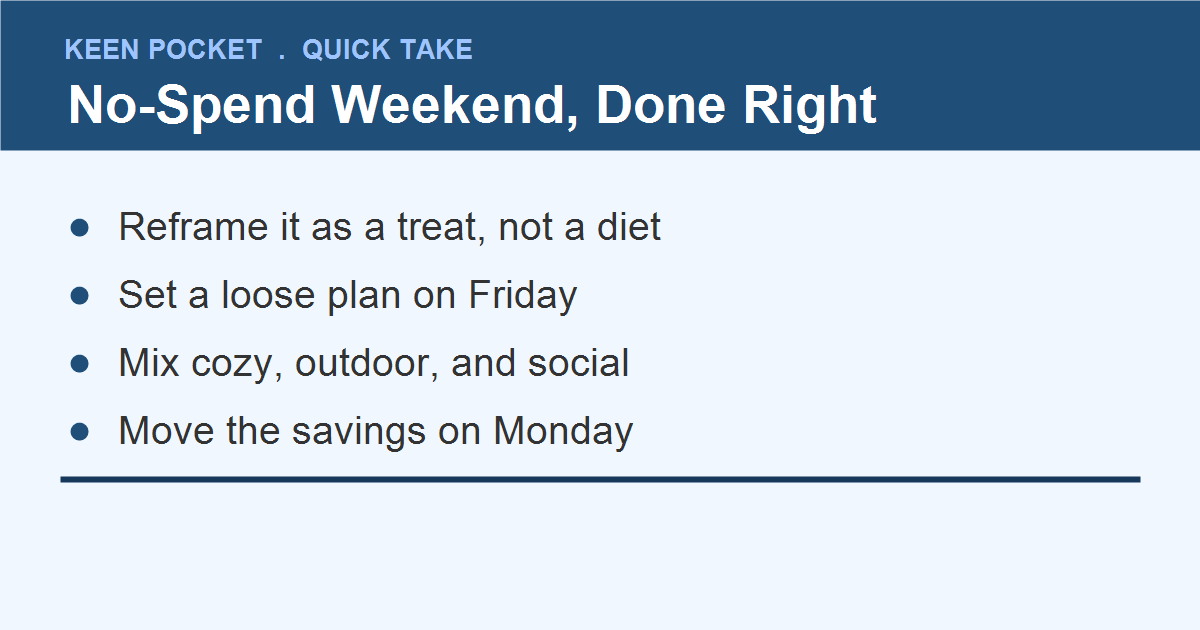
A great no-spend weekend is mostly decided on Friday. Twenty minutes of setup keeps Saturday from drifting into “there is nothing to do, let us just go grab something.” Give yourself a plan and a cozy runway.
Pick a loose plan. Choose two or three ideas from this list so Saturday is not a blank, boring page.
Shop your kitchen. Plan meals around what you already have so you are not tempted by delivery.
Tell your people. Invite a friend to a free hangout so you are not fighting FOMO alone.
Set one rule. Essentials like gas and medicine are fine; new discretionary spending is off the table.
That is the entire prep. With a plan in place, the weekend has somewhere to go, and the urge to spend loses most of its power.
One more small move helps: leave your cards at home for any outing. When paying takes real effort, an impulse coffee or a “quick” store stop just does not happen. A little friction is a quiet superpower, and it turns good intentions into a weekend that actually stays free.
Cozy ideas for a night in
Start where it is easiest: your own couch. A night in only feels cheap when it is an afterthought, so make it deliberate and it turns into a genuine treat.
Round it out with a book from the library app, a big pot of tea, and your phone in another room. Add a “restaurant at home” night where you plate a pantry meal nicely, and the couch beats a crowded booth most weeks.
The trick that makes a night in feel special is a little ceremony. Dim the lights, put on real clothes or your comfiest ones on purpose, and give the evening a theme, a decade, a country’s cuisine from whatever is in the cupboard, a favorite director. The same living room feels like an event when you treat it like one, and that reframing is the entire point.
Get outside without spending a cent
Fresh air is the cheapest mood-lifter there is, and it makes a no-spend weekend feel active instead of stuck indoors. Nature does not check your bank balance at the door.
Free ways to get outside
Many museums, zoos, and gardens also run free-admission days, so a quick search of your city plus “free days” can turn up an outing that would normally cost $40. The weekend starts to feel spacious rather than restricted.
Turn a plain walk into an actual activity and it stops feeling like filler. Try a photo walk where you capture ten interesting things, a “new streets” walk down blocks you have never explored, or a self-guided architecture tour of your own neighborhood. Bring a thermos of coffee from home and the whole outing costs nothing while feeling like a small trip.
Connect with people for free
The going-out reflex is really about seeing people, and you can get all of that connection without a tab. Swap the venue, keep the company, and nobody misses the bill.
Host a movie or theme night, start a walking meetup, or plan a shared cooking session where you split a big batch to freeze. The point of a no-spend weekend was never to hide from people, just to gather somewhere that does not charge cover.
If hosting feels like pressure, keep it low-key on purpose. A “bring your own mug” coffee morning, a puzzle table anyone can drift by, or a backyard fire with whatever snacks people have all count. Nobody remembers the venue a month later; they remember laughing with you, and that part was always free.
Creative and self-care ideas to reset
Some of the best no spend weekend ideas are the quiet ones that leave you feeling like a person again. When the week has wrung you out, a weekend spent making or resting beats one spent scrolling and half-shopping.
Two days of doom-scrolling, impulse carts, and vague guilt that leaves you more tired than Friday.
Journaling, a long bath, decluttering one closet, and a new skill from a free video. You feel reset.
Try sketching, a home yoga session, or finally organizing the photos on your phone. Declutter a drawer and set aside anything you can sell later, so the weekend even seeds a little income. Restful and productive are not opposites here; a good reset is both.
The idea categories at a glance
Not every weekend calls for the same energy. Some you need to collapse and recharge; others you want to feel busy and social. Here is how the main types stack up so you can match the plan to your mood.
| Category | Effort | Best for | The vibe |
|---|---|---|---|
| Cozy night in | low | a tiring week | restful |
| Outdoors | low to medium | restless energy | energizing |
| Social | medium | feeling isolated | lively |
| Creative and self-care | low | needing a reset | restorative |
Mix and match across the two days. A restful Friday, an active Saturday, and a social Sunday give a no-spend weekend real shape, so it feels full rather than empty. Creative ideas fill the gaps: journaling, sketching, decluttering a closet, or finally learning that thing from a free video.
A sample no-spend weekend that saves about $160
Theory is nice, but the dollars make it click. Here is one realistic weekend, the kind of going-out routine that quietly costs a small fortune, turned into a no-spend version that costs nothing. Figures are typical, not exact.
Add it up and that is about $160 you did not spend, for a weekend most people would say they enjoyed just as much or more. Do that twice a month and you are looking at real money, over $300, redirected toward something that actually matters to you.
How we got $160: the figures are typical U.S. costs for a going-out weekend, a takeout dinner, brunch and an outing, and a couple of coffee runs, in line with the USDA and BLS spending data above. Your own savings depend on what your usual weekend looks like.
No-spend ideas for any season or weather
A rainy Saturday or a freezing January can sink a plan built only around walks and picnics. The fix is to keep a few no spend weekend ideas ready for whatever the sky is doing, so bad weather never becomes an excuse to spend.
| When it is | Free ideas that fit |
|---|---|
| Cold or winter | baking, board games, a movie marathon, a soup night |
| Warm or summer | stargazing, a sunset picnic, a swim, free outdoor concerts |
| Spring or fall | a nature walk, gardening, a leaf hunt with kids |
| Rainy day | a jigsaw, a home spa, decluttering, a library run |
Keep this little menu in mind and the weekend adapts to you, not the forecast. There is a free, genuinely nice option for almost any day of the year. Save a shortlist of your favorites in your notes app, and next time a spendy weekend threatens, you already have the fun, free answer ready to go.
Keep it fun, not miserable
A no-spend weekend goes wrong in a few predictable ways, and every one of them is about mindset, not money. Sidestep these and the weekend stays a treat instead of a test.
Plan a couple of things you are actually excited for.
Make the food at home feel special.
Invite a friend into the plan.
Framing it as punishment or a diet.
Leaving Saturday totally unplanned.
Doom-scrolling shopping apps all day.
If friends want to go out, suggest the free version instead of bailing, a walk instead of a bar, a home hang instead of a restaurant. Most people are relieved to save money too; they were just waiting for someone to offer the option.
Where the money you didn’t spend should go
Here is the step that turns a nice weekend into real progress. The $160 you did not spend is only a win if it lands somewhere better than next weekend’s takeout. Move it on purpose before it drifts away.
💡 Good to Know
Transfer the amount you would have spent into savings on Monday morning. Seeing the number move is what makes the next no-spend weekend feel worth it, not just virtuous.
Send it to an emergency fund, an extra debt payment, or a specific goal you are excited about. With 37% of adults unable to cover a $400 surprise in cash, per the Federal Reserve, even one saved weekend is a real head start on a cushion.
Our guides to an easy savings challenge and a full no-spend month are the natural next step once a single weekend feels easy. A weekend is a great place to start; a habit is where the money is.
Frequently asked questions
What are the best no spend weekend ideas?
A themed movie night, a home spa evening, a hike or park visit, a pantry potluck with friends, and a baking or creative project cover most moods. The best no spend weekend ideas are the ones you would happily do even if money were no object, because those never feel like sacrifice.
How much money can a no-spend weekend actually save?
For many people, around $100 to $200. A typical weekend of eating out, coffee runs, and an outing adds up fast, so swapping it for free plans commonly saves about $160. Do it a couple of times a month and it becomes real money toward a goal.
How do you have fun without spending money?
Lean into connection, novelty, and rest rather than purchases. Invite people over, try a new free activity, and make ordinary things feel special, like plating a home meal nicely. Fun comes from attention and company far more than from a price tag.
What are the rules of a no-spend weekend?
Keep it simple: cover true essentials like gas and medicine, but pause all discretionary spending, no takeout, shopping, or paid outings. Decide the rule on Friday so there is no negotiating with yourself on Saturday. Flexibility on essentials keeps it realistic.
How do I do a no-spend weekend with kids?
Kids often prefer free stuff anyway: a backyard campout, a blanket fort movie night, a nature scavenger hunt, baking together, or a trip to the library or a free museum day. Build the weekend around one “big” free activity and the rest falls into place.
How do I stay motivated for a no-spend weekend?
Make the payoff visible and the plan enjoyable. Decide in advance where the saved money goes, then actually move it Monday so you see the number grow. Pairing that with two or three no spend weekend ideas you genuinely look forward to keeps it feeling like a choice, not a chore.
What if my friends want to go out and spend?
Offer the free version rather than declining outright. Suggest a potluck, a game night, or a walk, and be honest that you are saving toward something. More often than not they will happily join, since plenty of people are quietly trying to spend less too.
The bottom line
A no-spend weekend is not a test of willpower; it is a chance to notice how much good stuff was free the whole time. The most fun no spend weekend ideas that still feel fun are simply the ones you plan on purpose, with a little coziness, some fresh air, and people you like.
Pick two or three ideas, set them up on Friday, and move your savings on Monday. Do that once and you will see it was never really about the money, which is exactly what makes you want to do it again.
And if a weekend goes sideways and you cave for a coffee, shrug it off. This is not a purity test; one small slip does not undo a whole weekend of good choices. The goal is a lighter, richer weekend and a little more in the bank, not a perfect scorecard. Aim for that and you will keep coming back to it.
Sarah is the founder and lead editor of KeenPocket, where she writes practical, jargon-free money guides for real, everyday budgets. Every figure in this article is tied to a named, current primary source such as the Federal Reserve, USDA, or BLS, and the math is shown so you can check it. KeenPocket articles are educational and are not personalized financial advice; for choices about your own situation, consider speaking with a licensed professional.
Last reviewed: August 2026

Sarah Whitman is the founder and lead editor of Keen Pocket. She holds a BS in Accounting and Finance and writes plain-English guides on budgeting, saving, debt, and beginner investing.