

Money-Saving Tips for New Parents on a Tight Budget (15 Ways)

Last fact-checked: · Editorial standards
Bringing home a baby is joyful and, if you are honest about the receipts, a little terrifying. The first year commonly runs $15,000 to $20,000 or more once you add up diapers, feeding, gear, healthcare, and childcare. On a tight budget, that number can feel impossible.
Here is the reassuring truth: a huge share of that spending is optional, and babies do not know or care what anything cost. With a few deliberate choices, you can shave thousands off the first year without shortchanging your child on a single thing that matters.
These money-saving tips for new parents focus on the newborn and infant phase, where the costs hit hardest and fastest. We will cover diapers, feeding, gear, and childcare, plus the tax breaks and free programs most guides skip, so you keep more of your money for the moments that count.
Start with hand-me-downs and secondhand gear
Babies outgrow clothes and gear at a dizzying pace, often before an outfit is worn twice. That makes buying new for the newborn phase one of the easiest places to overspend, and secondhand one of the biggest wins. A onesie is a onesie whether it cost $2 at a consignment sale or $20 at the mall.
Tap buy-nothing groups, consignment shops, and hand-me-downs from friends for clothes, toys, books, and most furniture. A short list of items is worth buying new for safety: a car seat, since you cannot verify a used one’s crash history, and a crib that meets current standards. Everything else is fair game used.
Slash the diaper bill
Diapers are the relentless expense of year one. Families spend close to $936 on disposables in the first year, roughly $18 a week, across thousands of changes. It is a big number, and it is very shrinkable.
Store-brand diapers cost far less than name brands and perform about the same, so try a small pack before you commit. Buy in bulk when the per-diaper price is lowest, use subscribe-and-save discounts, and do not stockpile the newborn size, since babies grow out of it fast. If it fits your life, part-time cloth diapering cuts the bill even further.
Cut the diaper cost fast
If diapers ever become a true hardship, a local diaper bank can help bridge a rough stretch, no shame attached.
Cut feeding costs without cutting corners
Feeding is the other daily cost, and the savings depend on how you feed. If you breastfeed, most of the direct cost disappears, and many insurance plans cover a breast pump and lactation support at no charge, so ask.
If you use formula, the brand choice is where the money is. Store-brand formula runs roughly $840 to $1,200 a year, while name brands can hit $1,440 to $2,400. All infant formula sold in the U.S. must meet the same federal nutrition standards, so the cheaper tub is not a lesser product. When your baby starts solids, blending your own from fresh produce costs a fraction of the little jars.
Always follow your pediatrician’s guidance on feeding, especially with formula choice. The goal is to spend less on the label, not to compromise on nutrition.
Don’t overbuy newborn gear
Registries and stores are designed to make you feel like you need one of everything. You do not. Newborns need a safe place to sleep, a car seat, diapers, feeding supplies, and a few clothes. Most of the rest can wait until you know whether your baby actually likes it.
When you do buy, choose items that grow with your child. A convertible car seat, a crib that becomes a toddler bed, and a stroller that adapts all cost less over time than replacing single-stage gear. Borrow the bulky, short-use items like bassinets and baby swings from friends whose kids have outgrown them.
💡 Quick Tip
Wait on the wish-list extras. Set up a shared registry so relatives cover the big-ticket needs, and hold off on gadgets until you know your baby’s preferences. Half of them go barely used.
Grab every free sample and rewards program
Baby brands want your loyalty early, and they pay for it in free stuff. Signing up for manufacturer programs from the major diaper and formula makers gets you samples, coupons, and rewards points that add up to real diapers and wipes over a year.
Do the free ones and ignore the paid upsells. Hospital gift bags, brand email lists, and store baby-registry welcome boxes are genuinely worth grabbing. A monthly “baby box” subscription you pay for usually is not.
Join free brand reward and sample programs.
Grab the store registry welcome box.
Keep the hospital freebies; they are yours.
Paying for a monthly baby-box subscription.
Buying trendy gear off social media impulse.
Bulk-buying a brand before baby has tried it.
Set up a separate email address for these sign-ups so the coupons do not bury your real inbox.
Negotiate your hospital and medical bills
Delivery and the first round of pediatric visits can produce eye-watering bills, and those numbers are more negotiable than they look. Hospitals expect questions, and a surprising share of charges can be reduced, corrected, or spread out if you simply ask.
Start by requesting an itemized bill and checking it against your insurance explanation of benefits, since billing errors are common. Then ask about financial assistance, sometimes called charity care, which many hospitals offer to families under certain income levels. If you still owe, request an interest-free payment plan rather than putting it on a credit card.
Before you pay a hospital bill
A single phone call to the billing office can turn a scary lump sum into a manageable monthly amount, or shrink it outright. It is worth the fifteen minutes.
Use the money tools built for parents
This is where most tight-budget guides go quiet, and it is where the biggest dollars hide. The tax system has real breaks for parents that put money straight back in your pocket, and skipping them is like leaving cash on the table.
Claim the Child Tax Credit, worth up to $2,200 per qualifying child according to the IRS. If your employer offers a dependent care FSA, it lets you set aside up to $5,000 a year pre-tax for childcare, which lowers your taxable income. And if money is tight, direct your tax refund toward the baby fund instead of letting it evaporate.
File for the Child Tax Credit when you do your taxes.
Enroll in a dependent care FSA at work if childcare is coming.
Send your tax refund to the baby fund before it disappears.
A quick chat with a tax professional or your HR benefits page can confirm what you qualify for. These are not loopholes, they are programs built for exactly your situation.
Tap the free help you qualify for
Needing help does not mean you failed, and plenty of free support exists precisely for new families. The biggest is WIC, a federal program that provides formula, baby food, and healthy groceries at no cost to eligible pregnant women, new mothers, and children under five.
Beyond WIC, your community is full of free resources. Libraries run story times and lend more than books, parks and community centers host free baby classes, and buy-nothing groups keep gear circulating for nothing. Use them without hesitation.
Programs like WIC exist for families on a tight budget. If you qualify, using them is smart, not shameful.
Check your eligibility for WIC through the USDA, and ask your pediatrician’s office what local supports they recommend. They see new parents every day and know what is out there.
Bring down the childcare bill
If both parents work, childcare is usually the single largest baby expense, and it dwarfs the rest. The national average price of child care reached $13,128 in 2024, according to Child Care Aware of America, and for a single parent that can eat about a third of median income.
Because the number is so big, small structural choices save the most. A nanny share splits a caregiver’s cost between two families. Family, a home daycare, or staggered work schedules can each cost far less than a full-price center. And that dependent care FSA quietly lowers the real cost by using pre-tax dollars.
A full-price daycare center, paid with after-tax dollars, at the top of your local range.
A nanny share or home daycare, paid partly through a pre-tax FSA, at a lower local rate.
Run the numbers on a couple of options before you commit, since the difference over a year can rival a used car.
Every money-saving tip compared at a glance
Here is the whole playbook in one place, sorted so you can start with the biggest wins. Savings ranges are typical and depend on your baby, your area, and your choices, so treat them as directions rather than guarantees.
| Tip | Typical yearly savings | Effort |
|---|---|---|
| Secondhand clothes and gear | $500 to $1,500 | Low |
| Store-brand diapers and bulk buying | $200 to $400 | Low |
| Store-brand formula (if formula feeding) | $600 to $1,200 | Low |
| DIY baby food | $100 to $300 | Medium |
| Child Tax Credit | Up to $2,200 | Low |
| Dependent care FSA | Hundreds in taxes | Low |
| Childcare structure (nanny share, home care) | $2,000+ | Medium |
You will not use every line, but stacking even four or five of these turns an overwhelming first-year bill into something you can actually plan for.
What baby’s first year can cost with these tips
Numbers make it real. Picture a first year that would have run about $18,000 done the default way, all new gear, name-brand everything, no tax breaks claimed. Now stack a handful of these moves.
About $18,000 for the first year buying everything new and skipping the tax breaks.
Several thousand less after secondhand gear, store brands, samples, WIC if eligible, and the Child Tax Credit.
Secondhand gear might save $1,000, store-brand formula and diapers another $1,000, and the Child Tax Credit returns up to $2,200. None of it changes your baby’s world, but together it can keep $5,000 or more in your pocket over that first year. Your exact numbers depend on your choices and your area.
Build a small baby buffer and put the savings to work
The point of spending less is not to hoard, it is to build a little breathing room so the surprises of parenthood do not become emergencies. A modest baby buffer, even a few hundred dollars, absorbs the unexpected doctor visit or the week you run short.
Spend less on the baby, then move what you save into a small buffer before it slips back into everyday life.
Automate it and tie it to your bigger plan. Save toward the one-time costs with sinking funds from your biweekly paychecks, build a cushion using our guide on an emergency fund on a tight income, and if you need more coming in, these side hustles for busy parents fit around a newborn.
📌 How we researched this
Cost figures come from Child Care Aware of America’s 2024 price report, the IRS, and 2024 baby-cost data; program details are from the IRS (Child Tax Credit) and USDA (WIC). Savings ranges are typical and depend on your area, income, and choices. This is general education, not personalized financial or medical advice; follow your pediatrician’s guidance on feeding and confirm benefits with your own provider.
Frequently asked questions
What are the best money-saving tips for new parents?
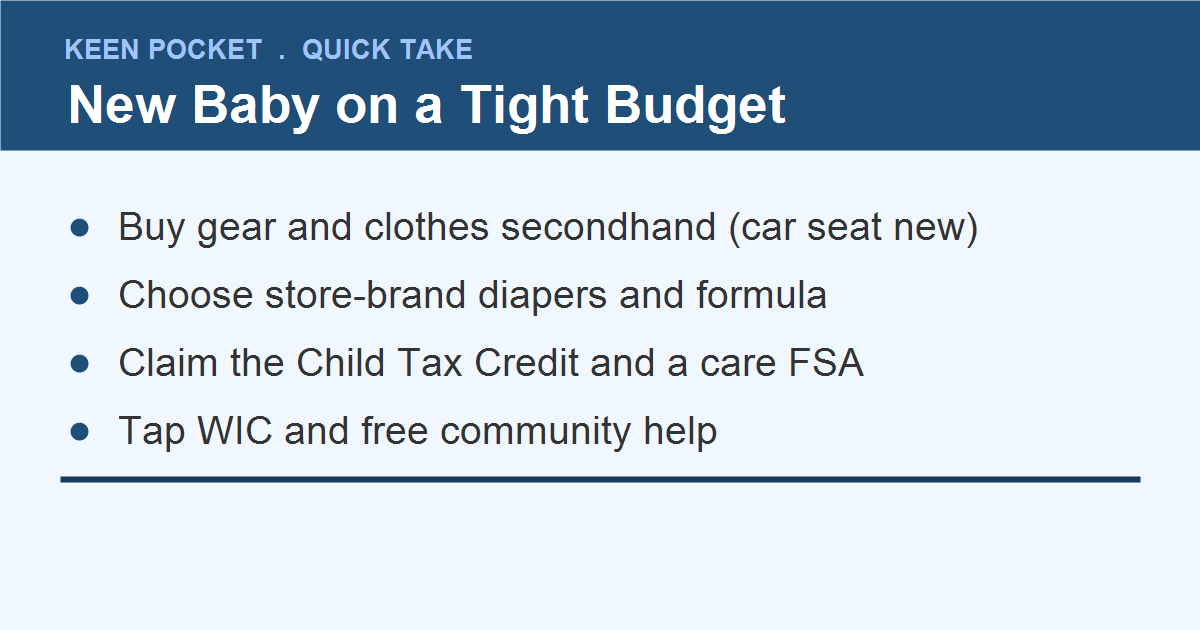
Buy gear and clothes secondhand, choose store-brand diapers and formula, sign up for free samples, and claim the tax breaks built for parents like the Child Tax Credit and a dependent care FSA. Tap WIC and community programs if you qualify. Stacking a few of these saves the most.
How much does a baby cost in the first year?
Estimates commonly land around $15,000 to $20,000 or more, and can climb higher with childcare. Diapers alone run close to $936, and average U.S. childcare was $13,128 in 2024. The good news is that a large share of the total is flexible and can be trimmed.
What baby items should I buy used versus new?
Buy clothes, toys, books, and most furniture secondhand, since babies outgrow them fast. Buy a car seat and crib new for safety, because you cannot verify a used car seat’s crash history and older cribs may not meet current standards. When in doubt, prioritize safety over savings.
How can I save the most on diapers and formula?
Switch to store brands for both, since U.S. formula meets the same federal standards and store diapers perform similarly. Buy in bulk at the lowest per-unit price, use subscribe-and-save, and do not overstock the newborn size. Breastfeeding, if it works for you, removes most feeding costs.
Do I qualify for WIC or the Child Tax Credit?
WIC serves eligible pregnant women, new mothers, and children under five based on income and need, and you can check eligibility through the USDA. The Child Tax Credit is available to most families with a qualifying child, worth up to $2,200, and you claim it on your tax return.
Is a dependent care FSA worth it?
If your employer offers one and you will pay for childcare, usually yes. It lets you set aside up to $5,000 a year pre-tax, which lowers your taxable income and the real cost of care. Confirm the details with your HR benefits page, since you elect it during enrollment.
Should I start a college fund before anything else?
Usually not first. On a tight budget, build a small baby buffer and an emergency fund before college savings, because a surprise expense today is a bigger risk than tuition years away. Once your cushion is steady, even small automatic contributions to a 529 plan can grow over eighteen years.
The bottom line
A new baby will stretch your budget, but the sticker shock hides how much of that spending is actually optional. The best money-saving tips for new parents come down to buying used, choosing store brands, grabbing the free help and tax breaks made for your situation, and being honest about what a newborn truly needs.
Pick a few of these to start today, from switching diaper brands to signing up for WIC or claiming the Child Tax Credit. Then move what you save into a small buffer, and give yourself the one thing every new parent needs most: a little financial breathing room.
Sarah is the founder and lead editor of KeenPocket, where she writes practical, plain language guides on budgeting, saving, and family money for people on a tight income. KeenPocket articles are educational and are not personalized financial or medical advice; follow your pediatrician on feeding and confirm benefits and eligibility with your own providers. Last reviewed: August 2026.

Sarah Whitman is the founder and lead editor of Keen Pocket. She holds a BS in Accounting and Finance and writes plain-English guides on budgeting, saving, debt, and beginner investing.