
Free Bill Payment Tracker Printable (Instant Download)

Last fact-checked: · Editorial standards
Missing a bill is rarely about not having the money. It is about losing track. A due date slips past on a busy week, and suddenly a $32 late fee is stapled onto a bill you could easily have paid. A simple tracker fixes that, and you do not need an app or a subscription to start. You need one page.
The cost of forgetting is real. According to doxo’s 2024 Hidden Costs of Bill Pay report, Americans paid about $23 billion in late fees in 2024, roughly $173 per household, and about a third of households got hit with at least one. Almost none of that was necessary. It was mostly a tracking problem.
This is a free bill payment tracker printable you can download, print, and start using in the next five minutes. Below you will find the download, exactly what is on it, how to use it, and how it fits into the rest of your budget so bills stop sneaking up on you.
- Most late fees are a memory problem, not a money problem, and one page fixes it.
- U.S. households paid about $23 billion in late fees in 2024, roughly $173 each (doxo).
- Tick a bill “paid” only when the money clears, so you catch failed autopays.
- List every recurring charge, including the small subscriptions that hide.
- The tracker is free: download and print it above, or rebuild it in two minutes.
Reviewed and updated for 2026. Late-fee figures come from doxo’s Hidden Costs of Bill Pay report, the CFPB, and LendingTree.
Why a Bill Tracker Beats Relying on Memory
Your brain is a terrible filing cabinet for due dates. It juggles rent, utilities, insurance, subscriptions, and a credit card minimum, each on its own schedule, and it only takes one distracted week for one of them to slip. A tracker moves all of that out of your head and onto a single page you can glance at.
Autopay helps, but it is not a complete answer. Autopay can overdraw a thin checking account, quietly renew a subscription you meant to cancel, or fail when a card expires. A bill payment tracker gives you the one thing autopay does not: a simple place to confirm that each charge actually cleared, and to catch the one that did not before it becomes a fee.
What Is on the Free Printable Bill Payment Tracker
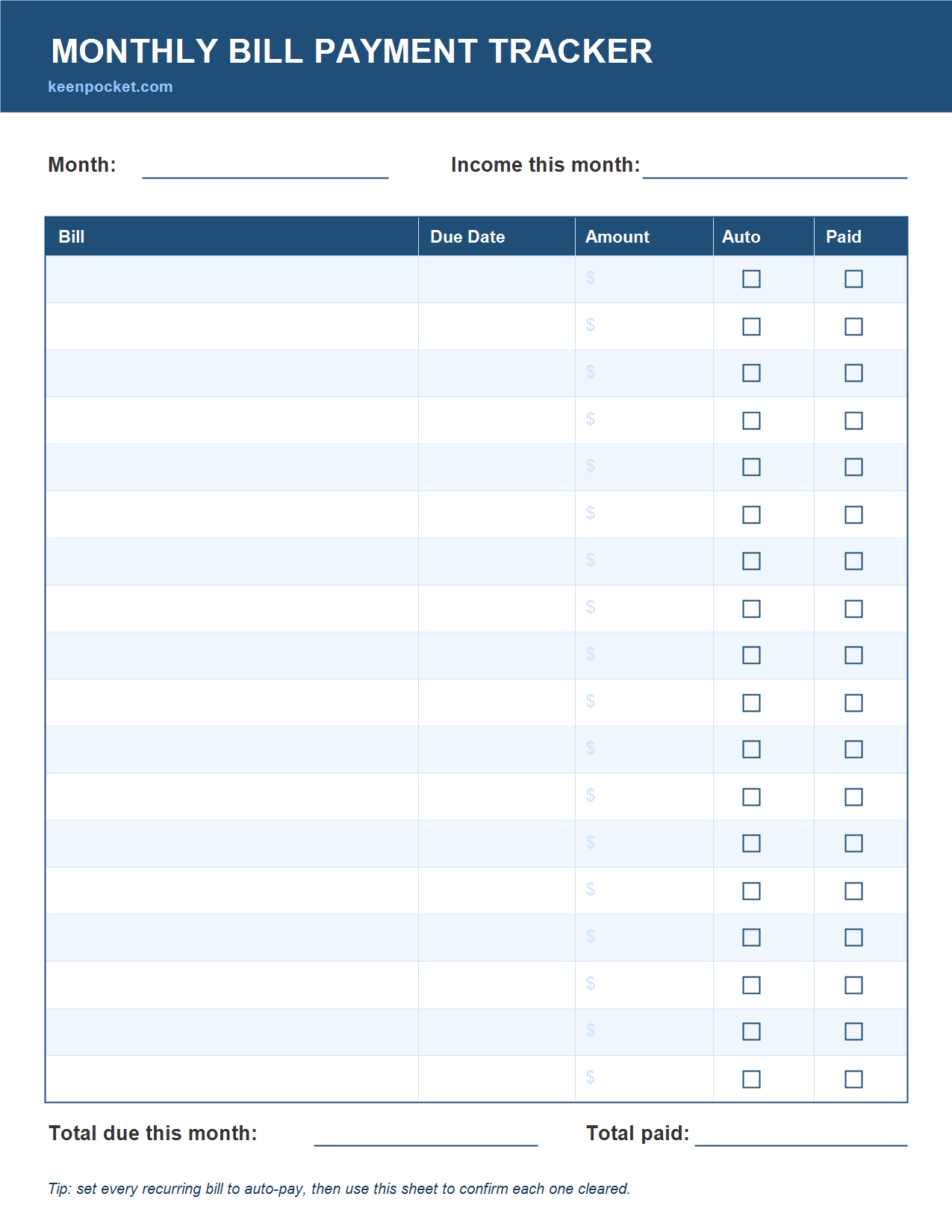
The layout is deliberately simple, because a tracker you have to think about is a tracker you will abandon. Every column earns its place.
- Bill. The name of each recurring payment, from rent to streaming.
- Due date. The day it is owed, so you can sort your month at a glance.
- Amount. What you owe, so the total is never a surprise.
- Auto. A checkbox for whether it is on autopay, so you know what still needs a manual push.
- Paid. A checkbox you tick only when the money has actually left your account.
- Totals. A line for total due and total paid, so you can see the whole month in two numbers.
How to Use the Tracker in 5 Minutes
Setup is a one-time job. After that, the tracker takes about two minutes a week.
- List every recurring bill. Go through last month’s bank and card statements and write down each repeating charge. Most people find one or two they forgot they were paying.
- Fill in due dates and amounts. Sort them in your head by early-month and late-month so you can see where the pressure lands.
- Mark what is already on autopay. Tick the Auto box for each one. The blanks are your manual to-do list.
- Check off each bill as it clears. Not when it is due, when the money actually leaves. That distinction is what catches failed autopays.
- Total it once. Add the amounts so you know exactly what the month costs before it starts.
Which Bills to Pay First When Money Is Short
Some months the total is bigger than the paycheck, and that is when the tracker earns its keep: it lets you triage instead of panic. Not every bill carries the same consequences for being late, so pay them in order of what hurts most to miss.
Start with the roof and the lights. Rent or mortgage and utilities come first, because falling behind there risks your housing and your power, and those are the hardest holes to climb out of. Next come anything tied to getting to work, like your car payment and insurance, since losing either can cost you the income that pays for everything else.
After that, protect your credit by covering at least the minimum on any credit cards and loans, because a payment reported 30 days late can dent your score for years. Lower on the list sit the flexible bills, streaming, the gym, and other subscriptions, which you can pause or cancel in a genuinely tight month with no lasting damage.
Writing your bills on the tracker in this rough priority order, not just by date, turns a scary shortfall into a clear plan. You always know exactly which payment protects the most.
How to Set Up Autopay Without the Overdraft Risk
Autopay and a tracker make a powerful pair, but autopay done carelessly can cause the exact problem you are trying to avoid. The fix is to be deliberate about what you automate and when.
Automate the stable, fixed bills first, the ones that are the same amount every month, like rent, insurance, and loan payments. Those are safe to put on autopilot because there are no surprises. Be more cautious with variable bills like utilities or credit cards, where a higher-than-usual month could drain your account without warning.
Time your autopay dates to land a day or two after your paycheck, never before. That small buffer keeps a well-timed bill from overdrawing an account that will be full again within 48 hours. Keep a little cushion in checking as backup too, so a slightly early charge does not trigger a $35 overdraft fee, which is even worse than the late fee you were dodging.
On the tracker, tick the Auto box for everything you automate. The unticked bills become your short manual to-do list each month, and the Paid column is where you confirm the automatic ones actually went through.
Printable vs App vs Autopay Alone
There is no single right way to track bills. Here is an honest comparison so you can pick what fits how your brain works.
| Method | Cost | Best for | Weak spot |
|---|---|---|---|
| Paper printable | Free | Visual, fridge-door people | You must update it by hand |
| Budgeting app | Free to ~$100/yr | Automatic reminders | Easy to ignore a notification |
| Autopay only | Free | Fixed, predictable bills | Overdrafts and silent failures |
A Realistic Month With the Tracker
Say your household has ten recurring bills. Before the tracker, you paid two of them a few days late last quarter, costing roughly $60 in fees plus a small interest bump. Here is what a tracked month looks like instead.
- Day 1: You fill in all ten bills, due dates, and amounts. Total due lands at $2,240. No surprises.
- Week 1: Rent and two utilities clear. You tick them off and confirm the amounts matched.
- Week 2: An autopay you thought was on had actually lapsed when your card renewed. The blank Paid box catches it, and you pay it the same day, dodging a $32 fee.
- Month end: Every box is checked, total paid equals total due, and you saved the roughly $60 in fees you used to lose without noticing.
Digital Alternatives if You Prefer an App
Paper is not the only way, and some people simply will not keep a sheet updated. If that is you, a good budgeting app can send automatic due-date reminders and track bills for you. Our roundup of the best budgeting apps covers the strongest options, and several also flag recurring charges and subscriptions you may want to cut.
The honest truth is that the best system is the one you will actually use. Some people need the physical act of ticking a box on the fridge. Others need a phone buzzing at them. Try the printable first, since it is free and instant, and move to an app only if the paper version keeps drifting.
How Missed Bills Hurt Your Credit Score
A late fee stings once. A missed payment reported to the credit bureaus can follow you for years, which is why a simple tracker quietly protects far more than your wallet.
Most lenders do not report a payment as late to the bureaus until it is a full 30 days past due, so a bill you catch a few days late usually costs only the fee, not your score. But once a payment crosses that 30-day line, it can sit on your credit report for up to seven years and drag your score down, making future loans and even apartment applications harder and more expensive.
The Consumer Financial Protection Bureau points out that payment history is the single biggest factor in most credit scores, which means on-time bills are the cheapest credit-building move you have. A tracker that makes you confirm each payment cleared is, in effect, a free credit-protection tool.
If you do slip past 30 days, pay it immediately, then for a first-time miss call the lender and politely ask for a goodwill adjustment. It does not always work, but it costs nothing to ask and can spare your score real damage.
How to Handle Annual and Irregular Bills
The bills that ambush people are rarely the monthly ones. They are the annual and irregular charges, the insurance premium, the car registration, the yearly subscription that renews at full price, that never show up on a monthly tracker at all.
Give these a home so they cannot surprise you. List each annual bill, divide its cost by twelve, and set that amount aside every month in a separate savings pot, so the money is waiting when the bill lands. A $600 insurance premium becomes a painless $50 a month instead of a brutal single hit.
That is exactly what a sinking fund does, and pairing your monthly bill tracker with a sinking fund plan covers both halves of your obligations. The tracker handles the predictable monthly rhythm, and the sinking fund absorbs the big, occasional shocks before they can wreck your budget.
Review Your Bills Twice a Year for Creep
Bills do not stay still. Subscriptions raise prices, promotional rates expire, and small fees appear with little announcement. A tracker makes this drift visible, because last month’s amounts are sitting right there for comparison.
Twice a year, run a quick audit. Go down your list and ask three questions of each bill: is the amount higher than it was, am I still using this, and can I get it cheaper. Streaming services, insurance, and phone plans are the usual offenders, and a single afternoon of calls or cancellations often trims $30 to $60 a month with no real change to your life.
Cancel what you no longer use, renegotiate what crept up, and update the tracker with the new numbers. Bills are one of the few places where a couple of hours of attention pays you back every month for the rest of the year.
What Most Bill-Tracking Advice Misses
The standard advice is simple: put everything on autopay and forget it. That is half right, and the missing half is where the fees come from. Autopay is a payment method, not a confirmation, and it fails silently more often than people expect.
A card expires and the autopay lapses. A balance dips too low and the charge bounces. A “free trial” converts and the payment goes through when you meant to cancel. In every case, autopay did exactly what it was told and still cost you money, because nobody was checking that each charge actually landed the way it should. The gap is not payment, it is verification.
That is the real job of a bill tracker, and it is why a sheet of paper beats blind automation. Autopay handles the doing; the tracker’s Paid column handles the checking. Spend two minutes a week confirming each charge cleared for the right amount, and you catch the one failure that would have become a $32 fee, a late mark, or a subscription you never wanted. Automate the payment, but never automate the trust.
Common Bill-Tracking Mistakes
- Marking a bill paid on the due date. Tick the box only when the money clears, or you will miss failed payments.
- Forgetting the small subscriptions. The $9.99 charges are exactly the ones that slip. List every single one.
- Trusting autopay blindly. Autopay is a helper, not a guarantee. The tracker is your backstop.
- Not totaling the month. If you never add it up, a heavy month can catch you short. Two minutes of math prevents it.
Where a Bill Tracker Fits in Your Budget
Tracking bills is the defensive half of a budget. It stops money from leaking out in fees. The offensive half is directing what is left, and the two work best together.
Pair this free bill payment tracker printable with a full monthly plan using our free printable budget planners, and add a sinking fund tracker for the irregular bills that are not monthly. If late payments have already dinged your credit or piled on interest, the debt snowball method helps you claw it back. New to all of this? Start with our budgeting tips for beginners.
Frequently Asked Questions
Is the bill payment tracker printable really free?
Yes. The download above is a free, print-ready file with no email required. Print it at letter size, and reprint a fresh copy each month or slip it into a sheet protector and reuse it with a dry-erase marker.
How often should I update a bill tracker?
Fill it out once at the start of the month, then spend about two minutes a week ticking off what has cleared. A quick weekly glance is enough to catch a failed payment before it turns into a late fee.
Should I still use a tracker if all my bills are on autopay?
Yes. Autopay can fail quietly when a card expires or a balance runs low, and it can renew subscriptions you meant to cancel. The tracker is your two-minute confirmation that every charge actually went through as expected.
What is the best way to organize the bills on the sheet?
Sort them by due date, grouping early-month and late-month bills, so you can see where the pressure lands. That makes it obvious when you need to hold a little cash back for the second half of the month.
Can I reuse the same printable every month?
Yes. Slip it into a clear sheet protector and fill it in with a dry-erase marker, then wipe it clean for the next month. Or just print a fresh copy each time, since the file is free and takes seconds to reprint.
Do late fees still hurt if I pay the bill in full a day later?
You will usually still owe the flat late fee, which averages around $32 on a credit card, even if you pay the full balance the next day. The upside is that a payment only a day or two late is almost never reported to the credit bureaus, so your score stays safe. The tracker helps you catch it inside that safe window. According to LendingTree, most people who recently paid a bill late said they simply could not afford it that week, which is exactly why a small buffer plus a tracker matters so much.
The Bottom Line
Most late fees are not a money problem, they are a memory problem, and a single sheet of paper solves it. Download the free bill payment tracker printable above, list every recurring charge, and tick each one off only when it clears. Two minutes a week is all it takes to stop giving banks and billers an extra $173 a year for nothing. Print it, stick it on the fridge, and let the page do the remembering.

Sarah Whitman is the founder and lead editor of Keen Pocket. She holds a BS in Accounting and Finance and writes plain-English guides on budgeting, saving, debt, and beginner investing.