
Emergency Fund Rules for Renters vs Homeowners (2026 Comparison)

Last fact-checked: · Editorial standards
Almost every emergency fund guide gives the same answer: save three to six months of expenses. It is decent advice, but it treats a renter and a homeowner as the same person, and they are not. What can go wrong, how much it costs, and how fast you can react are all shaped by whether you rent or own.
That gap matters, because most people are not ready for a shock either way. About 37% of U.S. adults could not cover a surprise $400 expense with cash in 2024, according to the Federal Reserve. A one-size-fits-all target is part of why.
This guide fixes that with clear emergency fund rules for renters vs homeowners: how much each group really needs, the risks that differ, where to keep the cash, and simple ways to build it faster. By the end you will know your number, not a generic one.
Why your housing situation changes the math
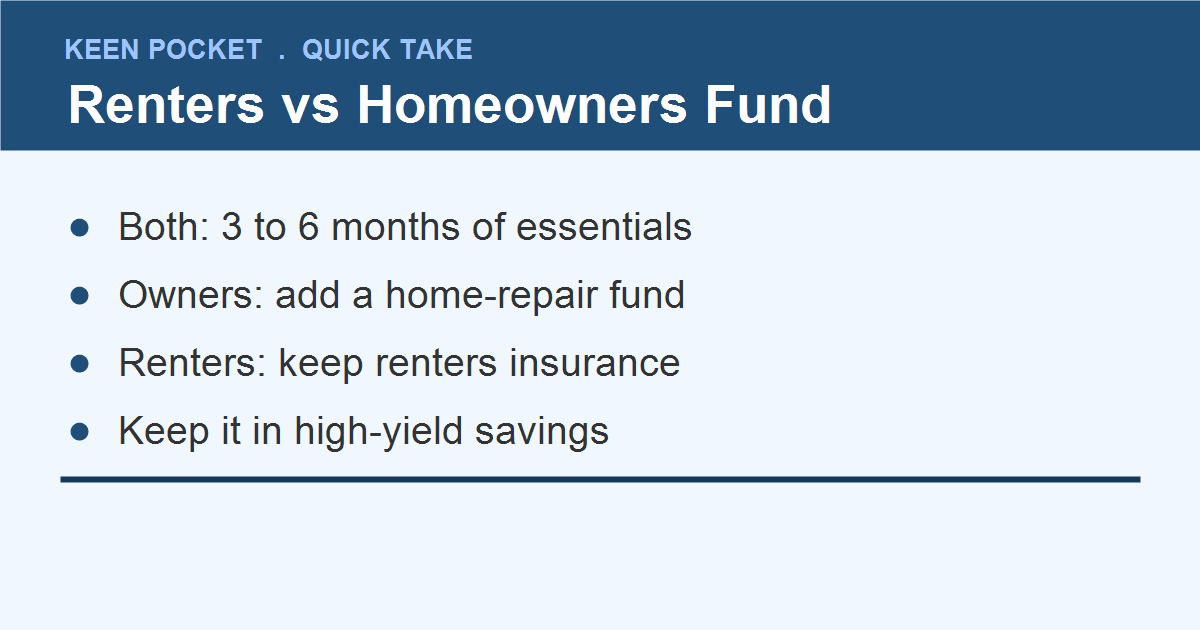
The classic three-to-six-month rule was never wrong, just incomplete. The right amount depends on your risks, and renting versus owning creates very different ones. The biggest split is who pays when something breaks.
When a renter’s water heater dies, the landlord replaces it. When a homeowner’s does, that is a $1,500 bill landing on them with no warning. Owners also have money locked in home equity, which is not something you can tap in a hurry. That single difference reshapes the whole emergency fund for renters vs homeowners.
💡 Quick Tip
Build your fund around your actual monthly essentials, not your income. Add up rent or mortgage, utilities, food, transport, and insurance, then multiply by the months you want covered. That number is your real target.
How much renters need (and why)
Renters should still aim for three to six months of essential expenses, with rent as the anchor. The good news is your list is simpler: you are covering living costs during an income gap, not surprise repairs to a building you do not own.
Your risks are more about disruption than destruction. A job loss, a sudden move, a new security deposit, or a rent hike at renewal are the events that drain a renter’s savings, and with half of U.S. renters cost-burdened, spending 30% or more of income on housing per Harvard’s Joint Center for Housing Studies, there is rarely much slack to absorb them. Because you can downsize or relocate faster than an owner, a well-stocked fund plus flexibility is a genuine safety net.
One cheap move makes a renter’s fund go further: renters insurance. For roughly the price of a couple of coffees a month, it covers your belongings after theft, fire, or water damage, so your emergency savings never has to. If high rent is squeezing your ability to save, our guide on saving money when rent is high is built for you.
How much homeowners need (and why)
Homeowners need everything a renter does, plus a cushion for the house itself. The base is still three to six months of essentials, but now that includes the mortgage, property taxes, and homeowners insurance, which push the number higher.
Then there is the part renters never see: upkeep. Hidden homeownership costs average about $18,118 a year, with maintenance alone around $8,808, according to Bankrate. Roofs, HVAC systems, and water heaters fail on their own schedule, not yours.
Because of that, homeowners are wise to run two buckets: a true emergency fund for income shocks, and a separate home-repair fund that you feed monthly. A common guide is to save around 1% of your home’s value a year for maintenance, so a $300,000 home means roughly $3,000 set aside annually. Keeping repairs in their own bucket stops a broken furnace from wiping out your safety net.
This two-bucket approach is the single biggest way the emergency fund for renters vs homeowners diverges. A renter with a full fund is genuinely covered; an owner with the same fund and no repair bucket is one bad roof away from a crisis. The extra bucket is not optional caution, it is the price of the keys.
Renters vs homeowners at a glance
Here is the whole comparison in one place. The core target is similar, but the buffers, risks, and flexibility diverge, which is exactly why generic advice falls short. Treat the amounts as sensible ranges, not hard rules.
| Factor | Renters | Homeowners |
|---|---|---|
| Core target | 3 to 6 months of essentials | 3 to 6 months of essentials |
| Extra buffer | usually none needed | separate home-repair fund |
| Biggest risks | income gaps, moving, rent hikes | big repairs, tax and insurance spikes |
| Who fixes the roof | the landlord | you do |
| Cutting costs fast | can downsize quickly | slower, equity is locked |
Notice the pattern. Renters carry less to insure against but less stability, while homeowners have more to protect and less liquidity. Good emergency fund rules for renters vs homeowners simply match the cushion to those realities.
Where to keep it, plus the homeowner two-bucket trick
Both groups want the same qualities in an emergency fund: safe, separate, and easy to reach within a day or two. A high-yield savings account is the standard home, since it earns real interest while staying liquid. The CFPB has a solid free primer on setting one up.
Where each bucket belongs
Homeowners get the most from splitting the money in two. Keep your income-shock fund untouched, and let a home-repair fund fill up on its own so the next big bill is boring instead of scary. A sinking fund is the perfect structure for that repair bucket, and a high-yield savings account versus a CD comparison helps you pick the right home for each.
Renters can keep it even simpler with a single account, since there is no repair bucket to separate. Either way, the storage rule inside the emergency fund for renters vs homeowners is identical: keep it somewhere safe and instantly reachable, and never chase a slightly higher yield at the cost of being able to withdraw the moment life goes sideways.
A real example: Maya the renter vs Dave the homeowner
Numbers make this click. Meet two people with similar incomes but different housing, and watch how their targets diverge. These are illustrations built from typical figures, not promises.
Maya’s higher rent is lower than Dave’s full housing cost, so her monthly essentials run about $2,600 and her three-month goal is roughly $7,800. Dave’s essentials are near $3,200, putting his three-month goal around $9,600, and he also feeds a repair fund of about $3,000 a year. Same starting habit, two different finish lines, both totally reachable.
If they each wanted a full six months instead of three, Maya’s target rises to about $15,600 and Dave’s to roughly $19,200. Whether three or six months is right depends on how stable your income is: a two-earner household or a very secure job can lean toward three, while a single income or variable pay argues for six. Pick the end of the range that matches your risk.
How we built these examples: Maya and Dave are illustrative profiles using typical U.S. costs, not real individuals. Monthly essentials are multiplied by three or six months, and the homeowner repair figure uses the common guideline of about 1% of home value a year. Your own target depends on your actual bills and how stable your income is.
What if you rent now but plan to buy soon?
Plenty of readers are in between: renting today, saving for a home tomorrow. If that is you, your emergency fund for renters vs homeowners needs to bridge both worlds, because the risks change the moment you get the keys.
The smart move is to keep your renter-sized emergency fund fully stocked, then build the future home-repair buffer as a separate savings goal alongside your down payment. That way, on move-in day, you already have a cushion for the surprises that come with owning.
Three to six months of essentials covers you, and the landlord handles the building.
Same core fund, now covering the mortgage, plus a repair bucket you already started.
Do not raid your emergency fund for the down payment. They are two different jobs: one keeps you afloat during a shock, the other buys the house. Blurring them is how new owners end up house-rich and cash-poor in the same month they move in.
Savings strategies that fit each group
Building the fund is the same core habit for everyone, automate a transfer and treat it like a bill, but a few moves are tailored to your situation. Start where the leverage is highest for you.
Everyone: automate it. Set a recurring transfer the day after payday so the fund grows without willpower.
Renters: attack the rent-to-income ratio. Negotiate at renewal, add a roommate, or move to a cheaper unit to free up cash fast.
Homeowners: prevent the big bills. Routine maintenance is far cheaper than emergency repairs, so servicing the HVAC beats replacing it.
Both: bank every windfall. Tax refunds, bonuses, and raises are the fastest way to hit your target without touching your budget.
Whichever group you are in, the muscle is the same. If you are rebuilding from a tight spot, our guide to building an emergency fund on a low income shows how to start with very little.
Pace matters more than perfection. Saving $200 a month builds a $7,800 renter fund in roughly three years, or faster once you add windfalls, while $300 a month gets a homeowner to a $9,600 base in under three. The emergency fund for renters vs homeowners is not a sprint; it is a steady transfer you protect month after month until the target is met.
Common mistakes each group makes
A few predictable errors trip up both renters and homeowners. Spotting them early keeps your fund doing its job when you actually need it.
Renters: keep renters insurance so belongings are covered.
Homeowners: keep repairs in their own bucket.
Both: refill the fund right after you use it.
Homeowners: counting home equity as your emergency fund.
Renters: assuming the landlord covers your stuff.
Both: parking the fund somewhere you cannot reach fast.
The equity mistake is the costly one. Your home’s value is real wealth, but you cannot pay a plumber with it on a Sunday. Emergency money has to be cash you can move today, no matter which group you are in.
Get the emergency fund for renters vs homeowners right and most of these mistakes solve themselves. The whole point of segmenting the advice is to build a fund sized to what can actually go wrong in your situation, so you are neither under-saving and exposed nor over-saving and starving your other goals.
Where your fully-funded money goes next
Once your emergency fund is complete, and your repair bucket too if you own, do not let the momentum fade. The monthly transfer that built your safety net is a powerful habit, so point it at the next goal instead of letting it drift back into spending.
Match the cushion to your risks, not to a generic rule. A renter and a homeowner protecting the same income still need different-sized funds.
With the safety net secure, that same transfer can start building wealth. Redirecting it into investing small amounts each month is the natural next step, turning a defensive habit into an offensive one.
Frequently asked questions
What is the difference in an emergency fund for renters vs homeowners?
Both aim for three to six months of essential expenses, but homeowners also need a separate home-repair fund because they pay for their own maintenance, which averages around $8,808 a year. Renters skip that buffer since the landlord handles repairs, but they should carry renters insurance for their belongings.
Do I need a bigger emergency fund if I own a home?
Generally yes. The emergency fund for renters vs homeowners differs mainly because owners carry higher fixed housing costs and their own repair bills. Plan on a similar three-to-six-month base calculated on your full housing cost, plus a dedicated repair fund that renters do not need.
Do renters really need an emergency fund?
Yes, arguably more than they think. Renters face income gaps, sudden moves, new deposits, and rent hikes, and they often have less financial stability than owners. Three to six months of essentials, with rent as the anchor, is the target.
How much emergency fund should a homeowner have?
Three to six months of full housing costs and essentials, plus a home-repair fund. A common guide is saving about 1% of your home’s value each year for maintenance, so a $300,000 home means roughly $3,000 set aside annually on top of the core fund.
Should my emergency fund cover rent or my mortgage?
Absolutely. Your housing payment is usually your largest essential, so it belongs at the center of the calculation. Multiply your full monthly essentials, housing included, by the number of months you want covered to get your target.
Is a home-repair fund the same as an emergency fund?
No, and keeping them separate is smart. An emergency fund covers income shocks like job loss; a repair fund covers predictable-but-irregular home costs like a new roof. Mixing them means one broken furnace can wipe out your entire safety net.
Where should renters and homeowners keep an emergency fund?
A high-yield savings account is ideal for both: safe, separate, and reachable within a day or two while earning interest. Avoid tying emergency cash up in stocks or a CD, where a downturn or penalty could hit exactly when you need the money.
The bottom line
Generic savings advice is a fine starting point, but your fund should fit your life. The real emergency fund rules for renters vs homeowners come down to matching your cushion to your risks: renters guard against disruption, homeowners guard against disruption plus repairs.
Add up your true monthly essentials, pick your months of coverage, and automate the transfer today. If you own, start the repair bucket alongside it. Get that right, and the next surprise becomes a line item you already planned for instead of a crisis.
Sarah is the founder and lead editor of KeenPocket, where she writes practical, jargon-free money guides for real, everyday budgets. Every figure in this article is tied to a named, current primary source such as the Federal Reserve, CFPB, IRS, or BLS, and the math is shown so you can check it. KeenPocket articles are educational and are not personalized financial advice; for choices about your own situation, consider speaking with a licensed professional.

Sarah Whitman is the founder and lead editor of Keen Pocket. She holds a BS in Accounting and Finance and writes plain-English guides on budgeting, saving, debt, and beginner investing.