Cashback Credit Cards for Groceries Only (7 Best 2026)

Last fact-checked: · Editorial standards
Groceries are one of the few big expenses you cannot skip, which makes them the perfect thing to earn cashback on. The average U.S. household spends around $5,750 a year on food at home, according to Bureau of Labor Statistics data, so even a few percent back adds up to real money over a year. The trick is using a card that actually rewards the supermarket, and knowing the fine print that trips people up.
Not every card treats groceries the same. Some pay a rich rate but cap it, some exclude the very stores you shop at, and some charge an annual fee you have to earn back first. This guide walks through the best cashback credit cards for groceries only, how the grocery category really works, and whether a grocery-focused card is worth it for how you actually shop.
One note before we start: this is general educational information, not personalized financial advice. Card terms change often, so confirm the current rate, cap, and fee with the issuer, and choose based on your own spending and credit situation.
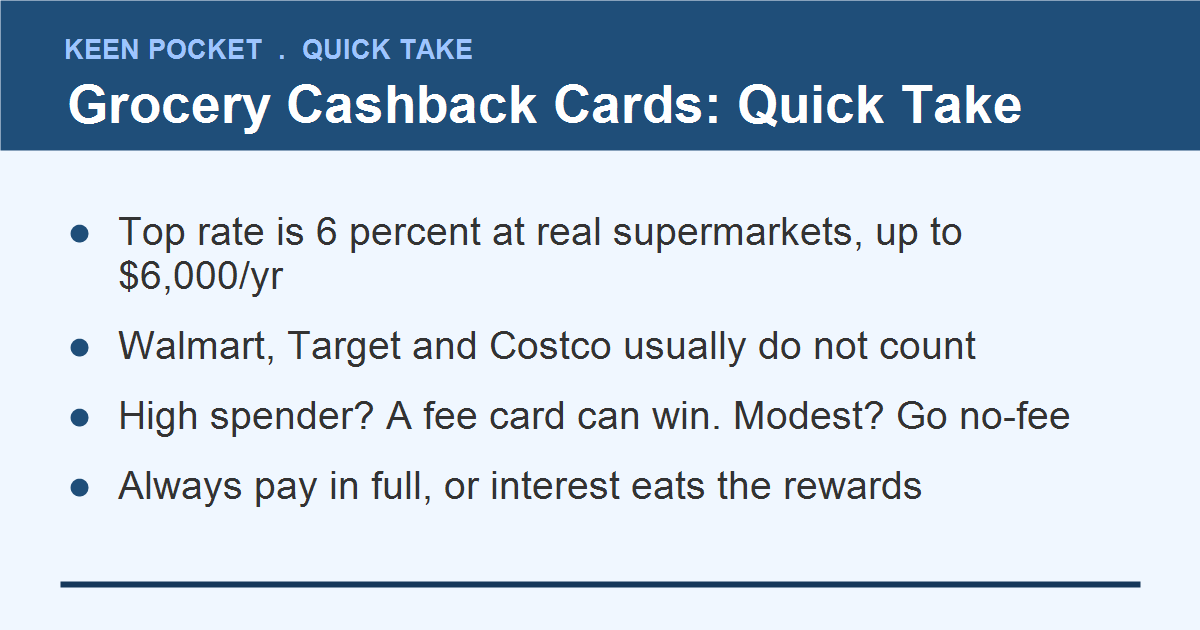
- Groceries run about $5,750 a year per household, a big, unavoidable category to earn cashback on.
- The top supermarket rate is ~6% (up to $6,000/yr), but a no-fee 3% card wins for modest spenders.
- The catch: Walmart, Target, and Costco usually do not count as supermarkets.
- Above roughly $3,200 a year of qualifying grocery spending, a 6% fee card beats a no-fee 3% card.
- Always pay in full, or interest erases the rewards entirely.
Reviewed and updated for 2026. Card rates, caps, and fees were compared against issuer terms and change often, so confirm the current offer before you apply. This is general information, not personalized advice.
How Grocery Cashback Cards Actually Work
A grocery cashback card pays you a percentage back on purchases coded as supermarket spending. Swipe at a qualifying store, and a set percent of the bill comes back to you as a statement credit or cash. The good ones pay 3% to 6% on groceries, versus the 1% to 2% a plain card gives.
The catch is that the rich rate almost always comes with a cap. A card might pay 6% on up to $6,000 of grocery spending a year, then drop to 1% after that. For most households that cap is generous, since $6,000 covers a lot of grocery runs, but heavy spenders will hit it and should plan for a backup card once they do.
The Big Catch: What Counts as a “Grocery Store”
This is where most people lose rewards without realizing it. Card networks decide what counts as a supermarket, and the definition is narrower than you would think.
Standalone supermarkets almost always qualify. But superstores like Walmart and Target, and warehouse clubs like Costco, usually do not code as grocery stores, so a grocery card often pays only its base 1% there. If you do most of your food shopping at a superstore, a grocery-category card may earn you far less than the headline rate suggests. Always check how your specific store codes before you count on the bonus.
The Best Cashback Credit Cards for Groceries
These are the card types worth knowing, with representative examples. Rates and fees are current for 2026 and can change, so verify before applying.
1. The high-rate grocery card
Cards like the Blue Cash Preferred from American Express lead the category, paying 6% back at U.S. supermarkets on up to $6,000 a year, then 1%. That is up to $360 a year at the top rate. The tradeoff is an annual fee, around $95 after the first year, so it pays off only if your grocery spending is high enough to clear that fee and then some.
2. The no-annual-fee grocery card
If you want grocery rewards without a fee, cards like the Blue Cash Everyday from American Express pay a solid 3% at U.S. supermarkets on up to $6,000 a year with no annual fee. You earn a bit less per dollar, but there is no fee to earn back, which makes it the safer pick for moderate grocery spenders.
3. The lifestyle card that includes groceries
Some cards, like the Capital One Savor, reward groceries alongside dining and entertainment, often around 3% with no annual fee. These suit people who want one card for food in general, both at the store and at restaurants, rather than a grocery specialist.
4. The rotating-category card
Cards such as the Chase Freedom Flex and several Discover cards feature grocery stores as a 5% rotating category during certain quarters. You must activate the category each quarter and there is a spending cap, but during a grocery quarter the rate is excellent. They work best as a supplement, not your only card.
5. The flat-rate backup card
A simple card that pays 2% on everything, like the Citi Double Cash, is the ideal partner to a grocery card. Use the grocery card up to its cap and at qualifying stores, then put superstore and warehouse-club groceries on the flat 2% card. Together they cover every gap.
The Grocery Cards, Compared
Here is how the types stack up. Treat these as representative 2026 terms, not guarantees.
| Card type | Grocery rate | Cap | Annual fee |
|---|---|---|---|
| High-rate (Blue Cash Preferred) | 6% | $6,000/yr | ~$95 |
| No-fee (Blue Cash Everyday) | 3% | $6,000/yr | $0 |
| Lifestyle (Savor) | ~3% | None | $0 |
| Rotating (Freedom Flex) | 5% in quarter | Quarterly cap | $0 |
| Flat-rate backup (Double Cash) | 2% everywhere | None | $0 |
Is a Grocery-Only Card Worth the Annual Fee?
The math decides this, and it is simple to run. A high-rate card only makes sense if the extra cashback beats the annual fee. Here is a realistic comparison for a household spending $6,000 a year on qualifying groceries.
| Card | Cashback | Net after fee |
|---|---|---|
| 6% card, $95 fee | $360 | $265 |
| 3% card, no fee | $180 | $180 |
| 2% flat, no fee | $120 | $120 |
At $6,000 of qualifying grocery spending, the 6% card still wins even after its fee, netting about $265 versus $180 for the no-fee 3% card. But that flips if you spend less or shop mostly at excluded superstores. Below roughly $3,200 of qualifying grocery spending a year, the no-fee 3% card comes out ahead, since there is no fee to overcome.
How to Maximize Grocery Cashback
The card is only half the game. A few habits squeeze more out of every grocery run.
- Stack with a cashback app. Use a grocery card and a receipt-scanning app on the same purchase to earn twice on food you were buying anyway.
- Mind the cap and the calendar. Track your spending toward the annual cap, and switch to a backup card once you hit it.
- Buy store gift cards at the supermarket. Many supermarkets sell gift cards for other retailers, and those purchases often earn the grocery rate.
- Pay in full every month. Cashback is worthless if interest eats it. Never carry a balance to chase rewards.
How to Choose Your First Grocery Card
With so many options, the choice comes down to a few honest questions about your own habits. Answer these and the right card usually picks itself.
First, how much do you spend on groceries a year, and where? Add up a few months of grocery receipts and note whether your main store is a true supermarket or an excluded superstore. Second, will you pay in full every month? If not, skip rewards cards entirely, because interest will dwarf any cashback. Third, do you want simplicity or maximum return? A no-fee 3% card is nearly effortless, while a 6% fee card rewards a little more attention.
When you compare offers, look past the headline rate at the cap, the fee, the excluded stores, and any sign-up bonus. The Consumer Financial Protection Bureau offers neutral guidance on comparing credit card terms, worth a read before you apply for anything. The best card is the one whose fine print fits your real shopping, not the one with the flashiest number.
Cards vs Cashback Apps: Use Both
A grocery card is not your only way to earn on food, and the smartest shoppers combine tools rather than choosing one. Cards and cashback apps reward the same purchase in different ways, so they stack.
Your credit card pays a percentage automatically at checkout, no effort required. A receipt-scanning cashback app pays extra on specific products or brands after you upload the receipt. Use both on the same trip, and a bag of groceries can earn card cashback plus app rewards on top, doubling up on money you were spending anyway.
The card does the heavy lifting for the whole bill, while the app catches bonus offers on individual items. Neither fully substitutes for the other, which is exactly why pairing them beats picking a side. It takes an extra minute at checkout for a genuinely higher return.
Flat-Rate vs Category Cards
Not everyone wants to juggle caps, quarters, and store codes, and that is a valid choice. A flat-rate card that pays 2% on everything earns a bit less on groceries but nothing to think about, which for many people is worth more than an extra percent.
Category cards win if you spend enough at qualifying supermarkets to clear the cap and any fee. Flat-rate cards win if your grocery spending is modest, your stores are excluded superstores, or you simply value simplicity. There is no wrong answer, only the one that matches how you actually shop and how much you enjoy optimizing.
Protect Your Credit While Chasing Cashback
Cashback is only a win if the card itself does not cost you more than it pays. The two things to guard are your interest and your credit score.
Rewards cards often carry high interest rates, so carrying even a small balance can wipe out a year of cashback in a couple of months. The rule is absolute: only put on the card what you can pay off in full, every single month. If a rewards card tempts you to spend more than you would with cash, the rewards are costing you, not paying you.
Your credit matters too. Applying for a new card causes a small, temporary dip, and opening several at once can hurt more. Space out applications, keep old accounts open to preserve your credit history, and always pay on time, since payment history is the biggest factor in your score. Grocery cashback is real money, but it is never worth debt or a damaged score to chase it.
What the “6%” Headline Actually Hides
Cards advertise the biggest number they can, and 6% back on groceries looks unbeatable. But that headline is a ceiling most shoppers never reach, and understanding why saves you from picking the wrong card.
Two things quietly shrink it. First, the cap: the top rate applies only to about $6,000 a year, and every dollar past that earns just 1%. Second, the store exclusions: if a chunk of your food shopping happens at Walmart, Target, or Costco, that spending earns the base rate too, not the 6%. Add them up and a household that thinks it earns 6% might really be averaging 3% to 4% once superstore trips and over-cap spending are blended in.
That is the number that matters, your effective rate, not the billboard rate. Before you chase a headline, estimate how much of your grocery spending actually qualifies, then compare the fee card’s real net against a simple no-fee 3% card. Often the quieter card wins, because a guaranteed 3% on everything beats a flashy 6% you only earn on part of the bill.
Common Grocery Card Mistakes
- Assuming your store qualifies. Walmart, Target, and Costco usually do not count as supermarkets. Check first.
- Paying a fee you never earn back. If your grocery spending is low, the no-fee card is the smarter pick.
- Forgetting to activate rotating categories. No activation, no 5%. Set a quarterly reminder.
- Carrying a balance. Interest charges dwarf any cashback. Only chase rewards you can pay off in full.
Where Your Grocery Cashback Should Go
Cashback is only a win if it becomes savings instead of quietly funding more spending. Treat the rewards as money to redirect, not a license to buy more.
Send your grocery cashback to a high-yield savings account where it grows on its own, or use it to chip at debt. To stack even more savings on the same grocery run, pair your card with the cashback apps that pay real money, and catch other recurring leaks with our tiny habits that save $500 a month, or earn on your monthly bills with our guide to cashback strategies for everyday bills. A budgeting app from our best budgeting apps roundup makes it easy to track the rewards you earn.
Frequently Asked Questions
What is the best cashback credit card for groceries only?
For high grocery spenders at true supermarkets, a 6% card like the Blue Cash Preferred usually wins even with its fee. For moderate spenders or anyone who wants no annual fee, a 3% card like the Blue Cash Everyday is the safer choice. The best pick depends on how much you spend and where.
Do grocery cashback cards work at Walmart and Costco?
Usually not at the bonus rate. Superstores and warehouse clubs typically do not code as supermarkets, so a grocery card often pays only its base 1% there. If you shop mainly at those stores, a flat 2% card may earn you more.
Is a grocery credit card worth the annual fee?
Only if your qualifying grocery spending is high enough that the extra cashback beats the fee. Above roughly $3,200 a year at real supermarkets, a 6% card with a $95 fee tends to win. Below that, a no-fee 3% card usually comes out ahead.
Can I use more than one cashback card for groceries?
Yes, and savvy shoppers do. Use a high-rate grocery card up to its cap and at qualifying stores, then a flat 2% card for superstores and anything excluded. Layering a receipt-scanning cashback app on top earns even more on the same purchase.
Does applying for a grocery credit card hurt my credit score?
A single application causes a small, temporary dip of a few points that usually recovers within months. The bigger risks are opening several cards at once or carrying a balance. Space out applications and pay in full, and a rewards card can actually help your credit over time.
How is cashback paid out on grocery cards?
Most cards pay cashback as a statement credit that lowers your bill, or as a redeemable balance, depending on the issuer. A few let you redeem for gift cards or travel. Check how your specific card pays before you count the rewards as spendable savings.
Are grocery cashback cards worth it for a single person?
It depends on your grocery spending. A single person spending $200 a month at real supermarkets earns about $86 a year on a 3% no-fee card, a nice bonus with no downside. A 6% fee card usually only pays off at higher spending, so most solo shoppers do best with a no-fee option.
Can I get grocery cashback without a credit card?
Yes. A debit-linked cashback app or a receipt-scanning app rewards grocery purchases without any credit card at all. You earn a bit less than a top grocery card, but you avoid interest and credit checks entirely, which is the right call if a credit card is not a good fit for you.
Do store loyalty programs stack with a cashback card?
Yes, and they should. A supermarket’s own loyalty or fuel-points program works alongside your credit card cashback, so you earn store rewards and card cashback on the same trip. Sign up for the free loyalty program and let both pay you at once.
Which is better, cashback or points on groceries?
For most people, cashback. It is simple, flexible, and worth a fixed amount, while points can be worth more or less depending on how you redeem them. If you value simplicity and guaranteed value, a grocery cashback card is the easier win.
The Bottom Line
The best cashback credit cards for groceries only can turn an unavoidable expense into a few hundred dollars a year, but only if you match the card to your habits. A 6% card can win big for high spenders at true supermarkets, while a no-fee 3% card is the smarter, simpler choice for everyone else. Check that your store actually counts as a grocery store, keep an eye on the cap, and above all, pay the balance in full every month so interest never erases the reward. Do that, and your weekly grocery run quietly pays you back.

Sarah Whitman is the founder and lead editor of Keen Pocket. She holds a BS in Accounting and Finance and writes plain-English guides on budgeting, saving, debt, and beginner investing.